
Earned media coverage is unpaid publicity gained when journalists, bloggers, or social accounts report on an event without direct payment. Earned media includes news articles, blog posts, broadcast segments, and organic social shares. It excludes paid advertising and company-controlled channels such as press releases posted only to a corporate site. Earned coverage amplifies reach through third-party credibility and often drives wider public attention than owned channels.
Earned media for events appears as editorial stories, feature articles, broadcast mentions, influencer posts, and organic social reposts. Measurable metrics include article counts, domain authority of placements, estimated audience size, social share counts, and referral traffic to event-related pages. Journalistic interest and organic social amplification are primary drivers of measurable earned outcomes.
Earned coverage signals external validation. It increases visibility to stakeholders, investors, clients, and the public. It can extend the lifespan of event messaging beyond the single-day schedule. For UK audiences, national and trade outlets provide distinct reach: national outlets reach millions; trade outlets reach specialist professional audiences.
Why do 60% of UK corporate events get no earned media coverage?
Most events lack distinct news value, accessible spokespeople, or timely journalist outreach, so journalists and influencers do not cover them. Event organisers often treat media relations as an afterthought. Journalists receive large pitch volumes and prioritise exclusives, data-led stories, or controversy. Without those elements, an event blends into routine corporate activity.
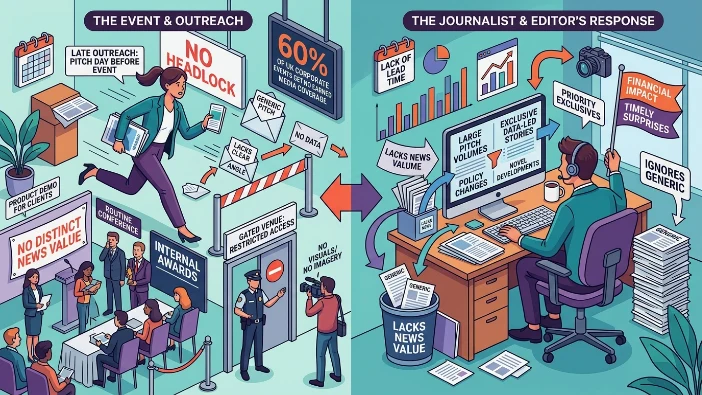
Many corporate events repeat standard agendas: product demos for clients, internal award ceremonies, or routine conferences. These formats rarely create new facts, surprises, or timely data. News editors prioritise novel developments, policy changes, or significant financial impacts.
Organisers pitch the day before or during the event. Journalists require lead time to plan coverage. Pitches lack clear angles, fail to supply embargoed materials, or omit data and spokespeople. As a result, editors decline coverage.
Events in gated venues with restricted access prevent journalists from attending. Events with no clear visuals—no demonstrable product, no high-quality imagery, no short video clips—offer little material for web and broadcast outlets. Editors choose events that translate well into images or clips.
Small event teams lack dedicated PR or media relations staff. They cannot prepare press packs, coordinate interviews, or distribute materials quickly. Journalists select events where organisers supply ready-to-publish assets.
Which event components most influence earned media pickup?
Components that increase coverage include a clear news hook, quantifiable data, accessible spokespeople, and ready-to-use multimedia assets. Journalists need a reason to write, verifiable facts to support claims, people available for quotes, and visuals that work across platforms. Events that supply all four components secure more coverage.
A news hook is a novel claim, announcement, or data release tied to current trends or deadlines. Examples: a new regulation impact analysis, a major investment announcement, or a unique research finding. Timeliness aligns the hook with editorial calendars or business cycles.
Quantitative findings, survey results, or market forecasts serve as primary anchors for articles. Provide sample sizes, methodology notes, and clear charts. Journalists fact-check numbers quickly; precise data increases trust and publication likelihood.
Assign at least one on-record spokesperson with subject expertise and availability for interviews. Provide concise biographical notes and suggested quotes. Ensure spokespeople can speak plainly in media-friendly soundbites.
Supply high-resolution images, 30–90 second video clips, and captions. Embedables and share-ready social clips increase the chance of coverage across digital and broadcast outlets. Include contact details and file names that indicate usage rights.
How should organisers structure media outreach to increase pickup?
Organisers must prepare a concise media pack, build a targeted journalist list, and issue timely, angle-driven pitches with embargo options. Media outreach starts one to three weeks before the event for major announcements and 48–72 hours for simple coverage invites. Follow clear deadlines and offer exclusive angles to top-tier outlets when appropriate.
A complete media pack contains a one-page event brief, speaker bios, key data points, high-resolution images, short b-roll clips, and contact details. Provide both downloadable files and an online press room. Use simple filenames and include suggested headlines and pull quotes.
Identify 10–30 journalists across national, trade, and local outlets who cover the event topic. Reference a recent relevant article in each pitch and explain the angle in one sentence. Personalised pitches significantly increase open and response rates.
Offer an embargoed data release to one journalist or one national outlet to secure advance coverage. Use embargoes when releasing unique research or a major announcement. Clearly state embargo times and follow up the day of the embargo with the full media pack.
What measurable outcomes should organisers track after an event?
Track article counts, estimated reach, referral traffic, social shares, sentiment, and backlinks to measure earned media impact. Assign numerical targets before the event, such as five articles in trade media or 10 social shares from influencers. Use analytics platforms, media monitoring services, and referral tracking to quantify outcomes.
Core KPIs include number of placements, cumulative domain authority of placements, estimated audience reach, referral sessions to event pages, social engagement counts, and number of backlinks. Track these for 30–90 days post-event to capture delayed coverage.
Assign monetary value using standard PR value metrics, but note journalist-driven referral traffic and conversion events provide stronger business evidence. Combine KPIs with lead or inquiry counts that occurred after coverage to assess business impact.
Which event formats produce the most earned media opportunities in the UK?
Formats that produce coverage include data-led panels, policy briefings, product launches with demonstrable impact, and live demonstrations with high-quality visuals. UK media prioritises policy relevance, financial impact, and demonstrable technological or social outcomes. Formats that clearly answer “what changed” or “what the data shows” outperform routine formats.
Events that release original research or policy analysis attract national and trade coverage. Provide executive summaries, raw data availability, and expert commentary to increase pickup.
Launches that show performance improvements, cost savings, or measurable user benefits create clear storylines. Demonstrations that include before-and-after data or third-party validation increase journalist interest.
Events with strong visuals—live demos, notable attendees, or visual case studies—supply direct assets for digital and broadcast outlets. Short, edited video clips increase shareability across social channels.
Explore More Expert Insights:
Events Are B2B’s Second-Highest Investment Priority in 2026: What’s Missing?
78% of UK B2B Marketers Now Budget for Events: The Coverage Problem
How can organisers avoid common mistakes that block coverage?
Avoid late pitching, inaccessible events, vague messaging, and lack of assets; prioritise clarity, access, and evidence. Fixing these four issues increases the probability of pickup. Clear deadlines, open accreditation for press, a strong one-sentence angle, and a ready media pack remove common barriers for journalists.
Plan media outreach 7–21 days before the event for significant announcements. Confirm spokespeople and media logistics at least 5 days before. Finalise the media pack 48 hours before outreach.
Offer press accreditation, interview slots, and a quiet space for broadcast interviews. Provide remote attendance options and pre-recorded clips for journalists unable to attend in person.
State the event’s core newsline in one sentence at the top of the press brief. List three supporting facts immediately below. Provide suggested quotes and explain why the event matters to the outlet’s audience.
Who benefits from better earned media strategies at corporate events?

Stakeholders who benefit include communications teams, senior leadership, investors, clients, and target industry audiences. Better earned coverage improves reputation, supports fundraising or sales conversations, and increases public understanding of a company’s initiatives. For trade audiences, coverage builds professional credibility.
Improved coverage expands stakeholder reach and increases the credibility of claims. It supports recruitment, investor relations, and customer acquisition when coverage ties to measurable outcomes.
Journalists gain stronger storylines and ready assets. The public and industry professionals gain clearer information about market developments, research findings, and policy implications.
Find Out More:
Video, Written, Social: Which Event Coverage Format Gets Most UK Shares?
Six in ten UK corporate events generate no earned media because organisers often fail to provide news hooks, timely outreach, accessible spokespeople, and ready multimedia assets. Events that supply clear data, concise messaging, and media-ready materials secure coverage more consistently. Implementing structured planning, targeted pitching, and measurable KPIs increases the probability journalists and influencers will publish and share event stories.
Dive Deeper Into This Topic:
Events Media Coverage Packages: What to Expect, What to Demand



