A news media partnership is a formal collaboration between a brand and a news publisher to produce and distribute content, often tied to recurring editorial or sponsorship placements, with shared goals for audience reach and credibility.
A news media partnership defines roles, content formats, distribution channels, reporting metrics, and timelines. Entities include the brand (advertiser), the publisher (news outlet), editorial teams, commercial teams, and legal/contracts teams. Common formats include sponsored articles, co-produced explainers, native content series, and integrated multimedia packages. Contracts assign rights for content reuse, data sharing clauses, performance metrics, and payment schedules. In the UK, regulatory entities such as the Competition and Markets Authority (CMA) and the Advertising Standards Authority (ASA) affect disclosures and transparency for paid editorial content. Publishers range from national broadsheets to regional digital-only outlets. Brands that have used these partnerships include those running recurring thematic series across multiple outlets.
How do news media partnerships differ from programmatic buys?
News media partnerships involve negotiated placements, editorial collaboration, and recurring content programmatic buys involve automated bidding across networks to place ads in real time.

Programmatic buying uses algorithmic auctions that place display or video ads across many websites with impressions priced per thousand (CPM) or per action. News media partnerships replace that model by negotiating fixed placements or content series on specific publisher channels. Programmatic rates vary widely; typical UK CPMs for premium inventory range from £5 to £30 depending on format and targeting.
Partnerships establish predictable costs, editorial oversight, and brand narratives aligned with publisher audiences. Partnerships deliver contextual placement content appears within trusted news environments while programmatic delivers scale across thousands of domains. Partnerships also include measurement frameworks agreed in advance, such as unique visitor reach, dwell time, and brand lift studies.
Why are brands in the UK shifting budget from programmatic to partnerships?
Brands shift budgets because partnerships deliver higher audience trust, clearer editorial context, and predictable costs tied to recurring content, improving long-term authority and measurable engagement.
Audience trust is a key driver in the UK. News publisher audiences show higher engagement with contextual content than with generic display ads. Publishers offer verified human editorial environments, which improves attention metrics such as time on page and completion rates for video. Partnerships reduce waste by targeting known audience segments within a publisher’s first-party data. Brands find recurring partnerships have a lower long-term effective cost per engaged user compared with programmatic, where viewability and ad fraud reduce value. Legal and compliance teams prefer the documented contractual relationship that allows clearer control over disclosure and content standards. Measurement and reporting are consolidated through publisher analytics and agreed third-party verification, making ROI assessment simpler for finance teams.
What are the main components of a media partnership agreement?
A media partnership agreement includes scope of work, content rights, disclosure requirements, payment terms, performance metrics, data-sharing clauses, and termination conditions.
Scope of work lists content types, frequency, and distribution windows. Content rights specify ownership, syndication rights, and reuse permissions. Disclosure requirements ensure compliance with ASA guidance on identifiable paid-for content. Payment terms specify fees, invoicing schedules, and penalties for missed deliverables. Performance metrics define KPIs such as page views, unique reach, average time on article, and video completion rates, plus reporting cadence. Data-sharing clauses set boundaries for audience data exchange and privacy compliance under UK GDPR. Termination conditions address breaches, force majeure, and notice periods. Legal reviews also confirm compliance with competition law and advertising standards. Contracts often include exclusivity windows or category restrictions to protect the publisher’s editorial integrity.
How is audience measurement handled in partnerships compared with programmatic?
Audience measurement in partnerships uses publisher analytics, agreed third-party verification, and bespoke surveys to measure reach, engagement, and brand lift, rather than purely impression counts.
Publishers provide first-party metrics such as unique users, dwell time, scroll depth, and engaged sessions. Third-party verification tools validate viewability and traffic quality. Brand lift studies and pre/post surveys measure message recall, consideration, and trust. Measurement frameworks include standardised reporting templates and regular review meetings. Programmatic reporting centers on impression counts, click-through rates, and third-party viewability metrics, which leave gaps in qualitative engagement data. Partnerships emphasise contextual metrics that capture editorial engagement and qualitative uplift. Agreements often define how data will be shared securely and how audience segments will be anonymised to meet GDPR requirements.
What legal and regulatory requirements apply to UK media partnerships?
UK partnerships must follow ASA rules on paid-for editorial transparency, CMA rules on competition, and UK GDPR for data handling; contracts must codify these obligations.
The ASA requires clear disclosure when content is paid-for or sponsored, so partnership content must include visible labels, e.g., “Sponsored” or “Paid for by.” The CMA enforces fair commercial practices and prevents misleading commercial arrangements. Data transfers and audience targeting must comply with UK GDPR; contracts must specify lawful bases for processing and data retention limits. Payment transparency helps avoid competition concerns if partnerships include exclusivity. Publishers and brands must maintain records of consent for any personal data used in measurement. Legal teams insert audit rights, indemnities, and liability caps in contracts to manage compliance risk.
What operational processes support an effective partnership?
Operational processes include joint editorial planning, content approval workflows, publication schedules, campaign reporting cycles, and cross-team governance meetings.
Joint editorial planning aligns topics with the publisher’s editorial calendar and the brand’s communications calendar. Content approval workflows outline draft reviews, legal sign-off, and final publication steps. Publication schedules set cadence and timing across platforms, including site, newsletter, social channels, and archives. Campaign reporting cycles define data delivery frequency, dashboard access, and post-campaign analysis. Cross-team governance convenes commercial, editorial, analytics, and legal stakeholders weekly or monthly depending on campaign scale. Clear SLAs for delivery and dispute resolution reduce friction. Publishers provide creative and production resources when needed. Brands commit contacts for approvals and performance reviews.
What measurable benefits do partnerships deliver?
Partnerships deliver improved engagement metrics, stronger message recall, predictable media spend, and faster authority building compared with one-off programmatic placements.
Engagement increases via longer average time on content and higher scroll depth. Message recall and brand favorability show uplift in brand lift studies. Predictable budgets arise from negotiated deals rather than auction volatility. Recurring placements compound authority: repeated expert-aligned content positions the brand in front of the same audience segments, accelerating recognition and trust. Partnerships reduce fraud exposure and improve viewability rates because content appears within controlled publisher environments. Financial forecasting becomes easier for marketing teams due to fixed schedules and reporting cadence.
Where do partnerships work best within a marketing funnel?
Partnerships work across awareness and mid-funnel stages, particularly for building credibility, educating audiences, and supporting complex decision journeys.
At top of funnel, partnerships reach broad, engaged news audiences and increase awareness through authoritative editorial context. At mid-funnel, recurring partnerships support education with deep-dive explainers and series that build trust and shape consideration. Partnerships support long-form formats and multi-touch storytelling that programmatic banners cannot sustain. For complex categories—public policy issues, health information, professional services—news partnerships provide the authority and nuance required for informed decisions. Measurement should align to funnel stage reach metrics for awareness, engagement and time-on-content for education, and brand lift for credibility.
Explore More Expert Insights:
UK Media Fragmentation: Why Single-Platform Strategies Fail in 2026
Why 75% of Enterprise B2B Firms Are Increasing Media Partnership Budgets This Year
What are typical use cases and examples in the UK context?
Common use cases include public information campaigns, sector explainers (finance, health, energy), thought leadership series, and regional audience outreach across national and local publishers.
Public information campaigns leverage publisher trust to communicate regulatory changes or public health guidance. Sector explainers help audiences understand complex topics like energy tariffs or pension reforms. Thought leadership series place expert commentary alongside editorial context to build authority. Regional outreach uses local publishers to target specific demographics with localised content. Examples include recurring explainers across regional titles and co-produced multimedia series hosted on publisher sites and newsletters.
How should brands evaluate potential publishers for partnership?
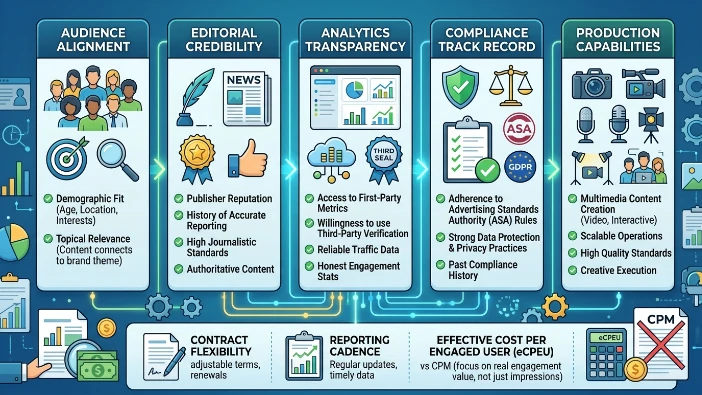
Evaluate publishers by audience alignment, editorial credibility, analytics transparency, compliance track record, and production capabilities.
Audience alignment assesses demographic fit and topical relevance. Editorial credibility reviews the publisher’s reputation and history of accurate reporting. Analytics transparency requires access to first-party metrics and willingness to use third-party verification. The compliance track record examines past adherence to ASA and data protection rules. Production capabilities test whether the publisher can create multimedia content at the required scale and quality. Contract flexibility and reporting cadence affect long-term usability. Cost comparisons should use effective cost per engaged user rather than CPM alone.
Learn More Here:
How Recurring Media Partnerships Build Authority Faster Than One-Off Placements
News media partnerships replace expensive programmatic buys by delivering predictable costs, higher engagement, editorial context, and clearer measurement. They require clear contracts, compliance with UK regulatory frameworks, and disciplined operational processes. For brands focused on authoritative messaging and sustained audience relationships, partnerships provide verified environments and repeat exposure that build faster authority than single programmatic placements.
For More Information, Explore:
UK Media Partnership Contracts: 11 Clauses Every Brand Lawyer Should Review