
B2B leaders rank events as the second-highest investment priority in 2026, allocating precise budgets and staff to live and hybrid formats. Investment focuses on audience growth, lead quality, and brand positioning rather than short-term revenue generation.
B2B organisations increase event budgets in 2026 based on measurable objectives. Many allocate 20–35% more for experiential elements, virtual platforms, and marketing integration compared with 2023 levels. Event spend concentrates on venue costs, technology stacks, content production, and audience acquisition. Decision metrics emphasise cost per qualified lead, attendee retention rate, and media reach. This investment trend signals strategic prioritisation beyond transactional sales, with events treated as long-term demand engines.
Why do B2B companies prioritise events so highly now?
Events deliver controlled environments for complex product demonstration, relationship building, and multi-stakeholder engagement. They generate high-intent interactions and data assets that support sales cycles lasting 3–12 months in typical B2B transactions.
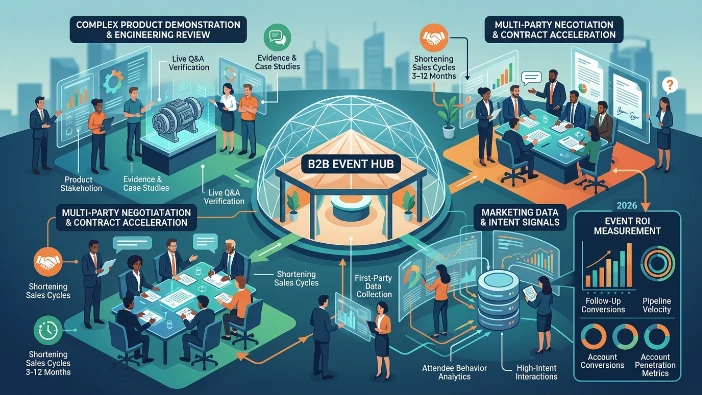
Events allow product teams to demonstrate technical solutions directly to procurement and engineering stakeholders. Sales teams use events for multi-party negotiations and contract acceleration. Marketing teams use events to gather first-party data, attendee behavior analytics, and intent signals. Procurement and legal cycles in B2B require repeated verification; events compress due diligence by presenting evidence, case studies, and live Q&A. In 2026, event ROI links to multi-channel measurement: follow-up conversions, pipeline velocity, and account penetration metrics.
What components do successful B2B event programs include?
Successful programmes include clear objectives, audience segmentation, content strategy, technology stack, measurement framework, and post-event nurture processes. Each component contains specific KPIs and assigned owners to ensure accountability and scalability.
Objectives define whether the event focuses on demand generation, customer retention, product adoption, or thought leadership. Audience segmentation classifies contacts by industry, firmographic attributes, buying stage, and prior engagement. Content strategy includes keynote scripts, breakout formats, and technical demos matched to audience segments. Technology stacks combine registration platforms, CRM integration, virtual event software, and analytics dashboards. Measurement frameworks include KPIs such as qualified meetings per 100 attendees, pipeline value after 90 days, and attendee NPS. Post-event nurture sequences use personalised outreach, content bundles, and scheduled follow-up demos.
How does event technology affect outcomes?
Event technology determines reach, personalisation, measurement fidelity, and cost efficiency. Integrating registration, engagement, and CRM systems yields precise attribution and automates lead routing to sales with defined SLAs.
Key integrations include single-sign-on registration, session-level tracking, live polling, and transcript capture. Virtual and hybrid platforms must support session analytics (attendance length per attendee, interaction events) and exportable engagement scores. CRM mapping routes leads based on engagement thresholds to sales development reps within defined time windows (for example, 24 hours). Automation reduces manual errors and shortens lead response time, improving conversion rates by measurable percentages in pilot programmes.
Which data and metrics matter for event ROI?
Core metrics for event ROI include qualified leads per 100 attendees, pipeline value at 90 days, cost per qualified lead, attendee engagement score, and retention rate of target accounts. Use both event-specific and downstream sales metrics for full attribution.
Event-specific metrics measure registration-to-attendance ratios and session view times. Engagement scoring aggregates interactions: session attendance duration, demo requests, content downloads, and chat activity. Downstream metrics track meeting conversion rate, pipeline created, average deal size from event-sourced leads, and closed-won revenue at 90 and 180 days. Compare these metrics to baseline campaign benchmarks to evaluate incremental impact. Use control cohorts to isolate event influence on sales outcomes.
What content formats deliver results at scale?
Technical demos, customer case studies, interactive workshops, and short breakout sessions drive engagement and conversion. Each format targets specific buying personas and buying stages for clearer progression through the sales funnel.
Technical demos show product capabilities to technical buyers and support precise feature evaluation. Customer case studies validate business outcomes for procurement and executive sponsors. Interactive workshops engage product users and surface adoption barriers, useful for customer success teams. Short, focused breakouts cater to specific verticals or use cases and improve relevance. Align formats to personas: demos for engineers, case studies for finance/ops, workshops for end users, and executive panels for strategic decision makers.
How should teams structure event planning and governance?
Assign clear owners for strategy, content, operations, technology, and measurement. Use a planning calendar with milestones, budgets, risk registers, and an SLA-driven lead handoff process to sales and customer success.
Strategy owners set goals and budgets. Content leads manage speaker selection and scripts. Operations teams secure logistics and vendor contracts. Technology owners configure integrations and run tests. Measurement owners define KPIs and dashboarding. Create a milestone calendar with dates for speaker confirmation, registration open, rehearsal, and tech dry run. Document risk items such as speaker cancellation, AV failure, or platform outage with contingency steps. Define lead routing SLAs: example, route hot leads within 24 hours and warm leads within 72 hours.
What common gaps limit event impact despite high investment?
Gaps include weak measurement, siloed teams, poor CRM integration, generic content, and absence of post-event nurture. These gaps reduce long-term pipeline contribution and inflate cost per qualified lead.
Measurement gaps appear when teams track vanity metrics only, such as registrations, rather than downstream revenue. Siloed teams create inconsistent messaging and duplicate spend. Poor CRM integration prevents reliable attribution and delays lead follow-up. Generic content reduces engagement and conversion; several organisations replace broad panels with targeted use-case sessions. Lack of systematic post-event nurture leaves interested attendees unconverted. Addressing these gaps yields more predictable pipeline outcomes from the same budget.
What benefits follow when the missing elements are fixed?
Fixing gaps produces higher qualified-lead conversion, reduced cost per acquisition, faster pipeline velocity, improved account penetration, and clearer evidence for ongoing investment decisions.
Improved measurement validates spend and informs budget allocation. Cross-functional alignment increases content relevance and operational efficiency. Integrated tech stacks enable real-time lead routing and faster sales responses. Targeted content improves attendee satisfaction and conversion metrics. Nurture sequences convert engagement into meetings and trials. Together these changes increase return on event spend and support repeatable scaling across programmes.
Explore More Expert Insights:
78% of UK B2B Marketers Now Budget for Events: The Coverage Problem
Why Media Coverage Is Important for Charity Events
What use cases show events delivering measurable value?
Product launches, executive summits, industry trade events, and customer advisory boards produce measurable outcomes such as trial sign-ups, enterprise contracts, retention uplift, and product-roadmap inputs tied to revenue outcomes.
Product launches accelerate awareness and trial volumes in early-adopter accounts. Executive summits generate C-suite introductions and accelerate enterprise contract negotiations. Trade events surface multiple opportunities per exhibiting account, raising average deal size. Customer advisory boards improve retention and expansion through prioritised roadmap features. Measure each use case with tailored KPIs: trials converted to paid, contracts signed within 180 days, retention rate changes, and expansion revenue within 12 months.
How should UK-based B2B teams adapt strategy for 2026?
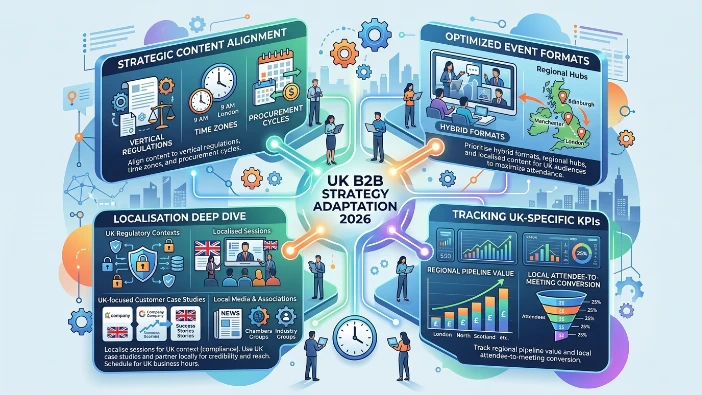
UK teams align event content to vertical regulations, time zones, and procurement cycles. They prioritise hybrid formats, regional hubs, and content localised for UK audiences to maximise attendance and downstream engagement.
Localise sessions for UK regulatory contexts such as data protection and industry-specific compliance. Schedule sessions to match UK business hours and consider regional hubs in London, Manchester, or Edinburgh for hybrid audiences. Use UK-focused customer case studies and partner with local media or associations for credibility and reach. Track UK-specific KPIs such as regional pipeline value and local attendee-to-meeting conversion.
Dive Deeper Into This Topic:
How to Pitch a UK Corporate Event to 10 News Sites Simultaneously
Events rank second in B2B investment priorities in 2026 because they produce high-intent engagement and durable data assets. Missing elements that limit impact include weak measurement, siloed operations, poor CRM integration, generic content, and absent post-event nurture. Fixing these gaps requires defined ownership, integrated technology, targeted content formats, and rigorous metrics tied to revenue outcomes. When teams implement these fixes, events scale from expensive line items to predictable pipeline drivers aligned with corporate buying cycles.
Get Detailed Information Here:
How One UK Conference Reached 2M Readers With Multi-Site Media Coverage



