

Times Intelligence Media Group partners are a network of verified publishers, regional outlets, and vertical sites that syndicate and co-publish content to deliver measured audience scale and verified engagement.
Times Intelligence Media Group (TIMG) partners include national newspapers, regional digital publishers, specialist vertical sites, and newsletter and podcast producers. Each partner signs a content license and measurement agreement. The network aggregates editorial reach while preserving publisher branding and canonical links. Partners implement standard tagging and event schemas to ensure consistent reporting. The combined distribution model produces over 4,000,000 unique monthly readers across partner sites as reported in consolidated analytics.
How does the partnership model work operationally?
The model operates on three coordinated processes: content sourcing, distribution sequencing, and unified measurement across partner sites.
Content sourcing begins with a flagship asset produced or licensed by TIMG. The flagship asset can be an investigative report, sector study, or data visualisation. Distribution sequencing defines time windows for exclusive hosting, secondary republication, and promoted summaries.
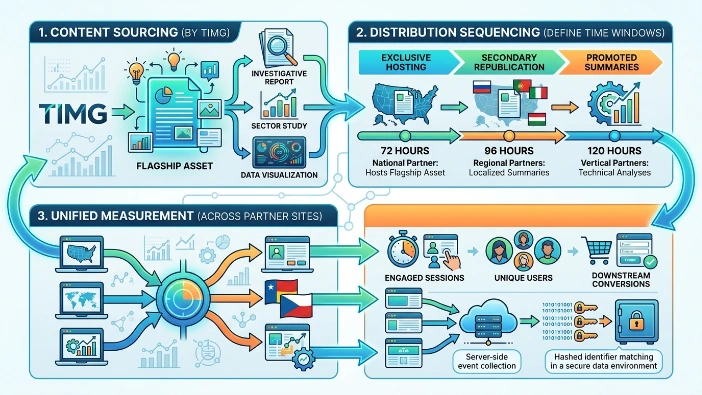
For example, a national partner may host the flagship for 72 hours, regional partners publish localised summaries at 96 hours, and vertical partners run technical analyses at 120 hours. Unified measurement captures engaged sessions, unique users, and downstream conversions via server-side event collection and hashed identifier matching in a secure data environment.
What technical systems enable cross-publisher measurement?
Technical systems include a shared event schema, server-to-server tracking endpoints, hashed identifier clean-room matching, and a central reporting dashboard.
Partners adopt a common event schema that defines page views, engaged sessions (sessions over 60 seconds or with two-plus page views), and conversion events. Server-to-server endpoints collect events to reduce loss from client-side blocking. For cross-publisher identity resolution, partners exchange hashed first-party identifiers through a controlled clean-room environment under strict data-processing agreements. The central dashboard aggregates anonymised metrics and displays incremental reach, overlap, and conversion rate by publisher. Regular audits validate data integrity and schema adherence.
What legal and contractual frameworks govern partnerships?
Partnerships rely on content licensing agreements, data processing agreements, revenue-sharing clauses, and editorial liability terms to define responsibilities and rights.
Content licensing agreements specify whether partners republish full articles, excerpts, or summaries and define canonical URL usage. Data processing agreements set lawful bases for processing, retention periods, and security controls for identifier exchanges. Revenue-sharing clauses apply when campaigns run monetised placements or subscription referral models; splits tie to measured traffic contribution. Editorial liability clauses assign responsibility for fact-checking, corrections, and retractions. A governance board with representatives from TIMG and partner publishers enforces contract terms and resolves disputes.
What audience segmentation and targeting methods do partners use?
Partners use first-party audience segments, contextual targeting, and partner-level affinity cohorts to match content to high-value readers.
Publishers map audiences by topic interest, subscription status, and geographic location. First-party segments include registered users, newsletter subscribers, and paying subscribers. Contextual targeting uses article taxonomies to surface relevant assets on partner sites. Affinity cohorts aggregate anonymised behavioural signals to identify high-engagement groups for downstream offers. For example, a health-sector cohort with newsletter subscriptions and repeated engaged sessions receives targeted long-form analysis and subscription offers on partner verticals.
How do partners monetise large-scale distribution?
Monetisation uses direct referral revenue, shared ad inventory, subscription conversions, and sponsored-content placement across partner sites.
Direct referral revenue tracks conversions such as newsletter sign-ups or subscription purchases attributed through hashed identifier matching. Shared ad inventory allocates premium placements across partner sites during campaign windows with revenue splits based on traffic contribution. Subscription conversions run timed offers with controlled landing pages to measure publisher-attributed sign-ups. Sponsored content placements appear as co-branded features with transparent attribution and shared revenue. Financial reporting is monthly with line-item attribution per publisher.
What performance metrics demonstrate the 4M+ monthly unique readers claim?
Metrics include consolidated unique users, incremental reach versus individual publishers, engaged sessions, and conversion rates measured across the partner network.
Consolidated reporting shows over 4,000,000 unique users per month across partnered domains. Incremental reach equals the total unique users minus audience overlap measured by hashed identifier matching. Engaged sessions average 1.8 million per month where sessions exceed 60 seconds or include multiple page views. Conversion rates vary by objective: newsletter opt-in rate averages 2.2% network-wide, while subscription referral conversion averages 0.9% for promotional campaigns. Independent audits validate these figures quarterly.
What benefits do publishers gain from joining the partner network?
Publishers gain access to incremental unique audiences, diversified revenue streams, and standardised measurement without ceding editorial control.
Joining publishers receive referrals from national and vertical partners that expand their audience beyond organic reach. Revenue opportunities arise from shared ad inventory, referral fees for subscriptions, and sponsored-feature revenue. Standardised measurement reduces reporting disparities and enables clearer ROI calculations. Editorial control remains with each publisher, with licensing terms and attribution rules preserving brand and journalistic standards.
What risks and compliance controls apply to network operations?
Risks include data breaches, audience cannibalisation, and editorial inconsistency; controls include encryption, overlap analysis, and editorial guidelines.
Data security uses encryption in transit and at rest, minimal identifier retention, and role-based access to the clean room. Overlap analysis quantifies audience duplication to avoid cannibalisation and to optimise partner selection. Editorial guidelines specify attribution, headline standards, and correction workflows to maintain credibility. Compliance audits review GDPR and UK data-protection alignment and document consent capture mechanisms across domains.
What use cases show measurable ROI from the network?
Use cases include national policy coverage, regional subscription growth, and vertical product launches where coordinated distribution generated measurable conversions.
National policy coverage during a legislative window delivered 2.3 million unique users in a six-week period and produced a 1.1% subscription referral rate from targeted audiences. Regional subscription drives combined local partners and national amplification to reduce acquisition cost by 28% versus single-publisher campaigns. A vertical product launch in education used specialist partners and newsletters to generate 14,000 qualified leads and a 3.6% paid-conversion rate on the referral landing page.
Explore More Expert Insights:
Media Partnership Onboarding: What Happens After You Sign With a UK Group
Agency vs Direct Publisher Partnership: A Cost-Benefit Analysis for UK Brands
How do teams operationalise campaign setup and execution?
Operationalisation uses a standard campaign brief, a shared publication schedule, technical onboarding checklist, and weekly performance reviews to manage execution.
Campaign briefs define objectives, target segments, content formats, timelines, and revenue models. The publication schedule sequences exclusive hosting, syndication, and promotional windows. Technical onboarding ensures partners implement the event schema and server endpoints, and join the clean room. Weekly performance reviews assess traffic, engaged sessions, and conversion paths, allowing tactical adjustments such as promotional timing or creative changes.
How should advertisers and content partners evaluate joining?
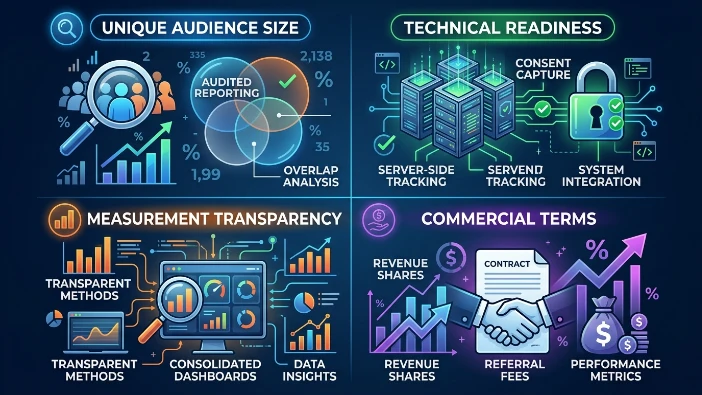
Evaluate partners on unique audience size, technical readiness, measurement transparency, and commercial terms tied to performance metrics.
Assess unique audience size via audited reporting and overlap analysis. Check technical readiness for server-side tracking and consent capture. Demand transparent measurement methods and access to consolidated dashboards. Negotiate commercial terms that align revenue shares or referral fees to measured performance metrics. Confirm legal and editorial terms that preserve brand control and compliance.
Explore More Expert Insights:
UK Media Fragmentation: Why Single-Platform Strategies Fail in 2026
Times Intelligence Media Group partners deliver over 4,000,000 monthly unique readers through coordinated content licensing, timed distribution, unified measurement, and commercial share models. The network combines technical integrations, legal frameworks, and editorial agreements to produce verified reach and measurable conversions. Advertisers and publishers evaluate participation by reviewing audited metrics, technical integration capacity, and aligned commercial terms. For campaign planning, prepare a brief that states objectives, target segments, and required KPIs for a 8–12 week pilot.
Read More for Better Understanding:
Building a Multi-Publisher Partnership Strategy Across UK News Verticals



