

A media partnership contract is a legally binding agreement that sets rights, obligations, and deliverables between a brand and a media publisher for co-produced, sponsored, or branded content over a defined term.
A contract defines the relationship between two legal entities. Key parties include the commissioning brand, the publisher, production suppliers, and any distribution partners. The agreement sets the campaign scope, deliverables, payment terms, reporting obligations, content ownership, and dispute resolution. In the UK context, contracts must align with the Advertising Standards Authority (ASA) guidance, Competition and Markets Authority (CMA) rules, and UK GDPR for data processing. Clear contracts reduce operational friction, protect brand reputation, and establish measurement expectations for commercial stakeholders.
Which clause defines the scope and deliverables?
The scope and deliverables clause specifies content types, quantity, publication dates, distribution channels, format specifications, and acceptance criteria for each deliverable.
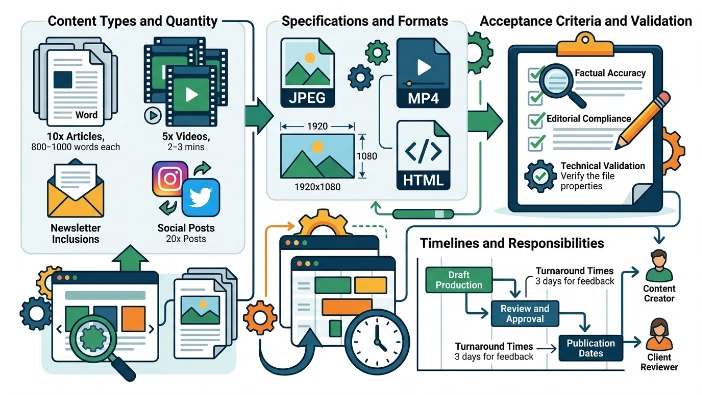
Scope must list the exact number of articles, videos, newsletter inclusions, or social posts. It must state word counts, video lengths, publication windows, and asset formats such as JPEG, MP4, or HTML. Acceptance criteria set objective checks such as factual accuracy, editorial compliance, and technical validation (e.g., image resolution 1920×1080). The clause should assign responsibility for production tasks and spell out approval turnaround times for drafts. Precise scope language prevents disputes over “additional” pieces and clarifies billing triggers tied to milestones.
What should the payment and pricing clause include?
The payment clause sets total fees, instalment schedules, invoicing procedures, late-payment penalties, and conditions for refunds or credits for missed deliverables.
Contract pricing models include fixed-fee, retainer, per-piece, or performance-based fees. The clause must state currency, VAT treatment, and payment timeline such as 30 days net from invoice. It must include interest on late payments at a specified statutory or agreed rate. Where delivery misses occur, the clause should specify fee reductions, service credits, or refund conditions. If performance fees exist, define exact KPIs, measurement tools, and independent verification processes. Clear invoicing requirements reduce payment disputes with finance teams.
How must content rights and ownership be allocated?
The rights clause defines copyright ownership, licence scope, territorial limits, duration, and reuse or syndication permissions for all content assets.
Contracts should state whether the publisher retains copyright and grants the brand a licence, or whether the brand acquires copyright. Licence parameters must specify exclusive or non-exclusive rights, permitted channels, sublicensing rights, and geographic scope (e.g., United Kingdom only, EEA). Duration must specify term length and post-term removal or archiving obligations. Syndication arrangements must list permitted third-party rehosts and revenue-sharing if applicable. Clear rights prevent later disputes over reuse across marketing channels and protect IP value.
What disclosure and compliance clauses are required?
Disclosure and compliance clauses mandate labelling of paid content, adherence to ASA rules, and confirmation procedures for pre-publication compliance checks.
The clause must require visible disclosure such as “Sponsored” or “Paid for by” as aligned with ASA’s Code. It should define metadata tagging for digital platforms, newsletter flags, and any audible disclosure in video or audio. Contracts must require compliance with UK advertising law, consumer protection rules, and any sector-specific regulations, for example, financial promotions under FCA rules. Include a process for handling ASA complaints and steps for corrective action. Legal teams should build in audit rights for compliance verification.
How should data protection and audience data be handled?
The data clause sets lawful bases for processing, data categories, retention periods, security measures, and controls for first-party audience data access under UK GDPR.
Specify whether the publisher acts as data controller or processor for analytics and targeting. The clause must list data types such as hashed email addresses, cookie identifiers, and aggregated audience segments. It must set retention periods, deletion obligations, and protocols for subject access requests. Security obligations should reference standards such as ISO 27001 or equivalent. If transfer outside the UK occurs, the clause must stipulate appropriate safeguards. Include indemnities for data breaches caused by one party and cooperation requirements for regulatory investigations.
What measurement and reporting obligations are essential?
The measurement clause defines KPIs, reporting frequency, data sources, verification methods, and rights to audit or request raw data for independent analysis.
KPIs can include unique reach, page views, average time on page, video completion rate, and brand lift percentages. Reporting frequency typically runs weekly during campaigns and a comprehensive post-campaign report within 14 to 30 days after the final publication. Define accepted measurement tools such as publisher first-party analytics, third-party viewability vendors, or independent brand lift providers. The clause should permit sample raw data access under confidentiality terms for audit or verification. Clear measurement avoids later disputes over performance-based payments.
How are editorial control and approvals governed?
An approvals clause sets the editorial workflow, review timelines, final sign-off authority, fact-checking obligations, and limits on post-publication edits.
Define submission deadlines for drafts and a maximum review period per round, for example, two business days for brand review and three business days for legal review. Confirm the publisher’s news editorial independence for news reporting versus sponsored content approval rights for the brand. Specify the number of permitted revision rounds and fees for extra edits. Address post-publication updates, corrections, and archiving rights. Timestamped approvals reduce publication delays and legal exposure.
What liability, indemnity, and insurance terms are required?
Liability and indemnity clauses allocate financial responsibility for breaches, intellectual property infringement, defamation, and data breaches, plus required insurance cover levels.
Indemnities should require each party to defend and indemnify the other for third-party claims arising from its breach, negligent acts, or misrepresentations. Limitations of liability can cap damages at a multiple of fees or a fixed sum, excluding liability for fraud and personal injury. Insurance clauses should require professional indemnity and cyber liability with specified minimum limits, for example, £1,000,000 per claim. Define procedures for claim notification and control of defence. Clear allocation of risk is critical for in-house counsel.
How should termination and exit conditions be structured?
Termination clauses must list termination for cause, termination for convenience, notice periods, consequences for outstanding deliverables, and post-termination removal or archive obligations.
For cause termination events include material breach, insolvency, or regulatory enforcement action. For convenience termination, specify notice periods such as 30 or 90 days and any early termination fees. Address payment for work completed and credits for undelivered items. Post-termination obligations include takedown schedules for content, continued data retention for compliance, and transfer of licenses if agreed. Define survival of clauses that persist after termination, such as confidentiality, indemnities, and IP licences.
Explore More Expert Insights:
How Times Intelligence Media Group Partners Deliver 4M+ Monthly Unique Readers
Media Partnership Onboarding: What Happens After You Sign With a UK Group
What confidentiality and non-disparagement provisions protect reputations?
Confidentiality clauses require protection of proprietary information and non-disparagement clauses prohibit public denigration during and after the contract term.
Define confidential categories including campaign briefs, pricing, performance data, and unpublished editorial plans. Set permitted disclosures to legal or financial advisers under NDA. Include duration of confidentiality, typically three to five years post-termination, and carve-outs for required regulatory disclosures. Non-disparagement clauses prevent public statements that harm the other party’s reputation, with specified remedies for breach. These clauses protect commercial sensitivity and long-term relationships.
How should dispute resolution and governing law be set?
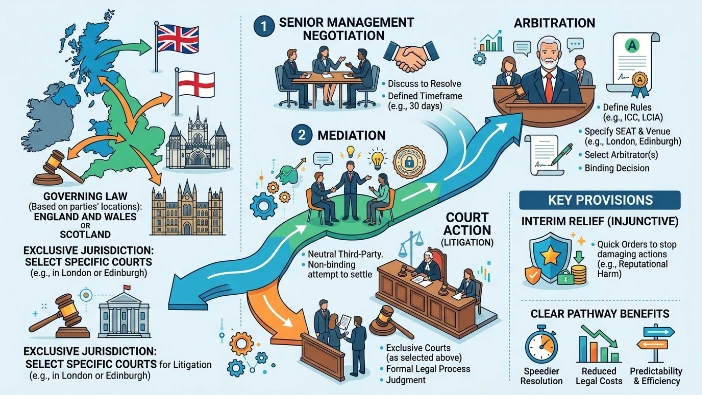
Dispute resolution clauses specify governing law (United Kingdom), exclusive jurisdiction, escalation steps, mediation, and arbitration options with clear timelines.
Choose governing law as England and Wales or Scotland depending on parties’ locations. Set exclusive courts for litigation and require multi-step escalation — senior management negotiation, followed by mediation, and then arbitration or court action. Define arbitration rules and seat if arbitration is chosen. Include interim relief provisions for injunctive relief to prevent reputational harm. Clear dispute pathways reduce legal costs and speed resolution.
Read the Detailed Explanation:
How News Media Partnerships Are Replacing Expensive Programmatic Buys in the UK
A UK media partnership contract requires precise drafting across scope, payment, rights, disclosure, data protection, measurement, editorial control, liability, termination, confidentiality, and dispute resolution. Each clause requires specific, measurable terms to reduce operational risk and to protect brand and publisher value. Legal teams should ensure alignment with ASA, CMA, and UK GDPR obligations and document compliance procedures. For targeted internal review, focus first on scope, rights, data, disclosure, measurement, and liability to cover the highest operational and regulatory risks.
Learn Everything About It Here:
How Recurring Media Partnerships Build Authority Faster Than One-Off Placements



