A media partnership proposal is a written offer that outlines collaboration terms between a publisher and an external organisation, specifying roles, content scope, timelines, and funding arrangements.
A media partnership proposal defines parties, objectives, deliverables, and governance. Parties are the publisher and the partnering organisation. Objectives state goals such as audience reach, education, or reputation. Deliverables list content types, publication dates, and distribution channels. Governance covers editorial control, legal clearance, and reporting. Funding arrangements specify payment amounts, invoicing schedules, and expense responsibilities. A clear proposal reduces ambiguity and prevents disputes during production and post-publication phases.
Why is unclear editorial control a red flag?
Unclear editorial control indicates that roles over content decisions are not defined, exposing the publisher and audience to potential bias and legal risk.
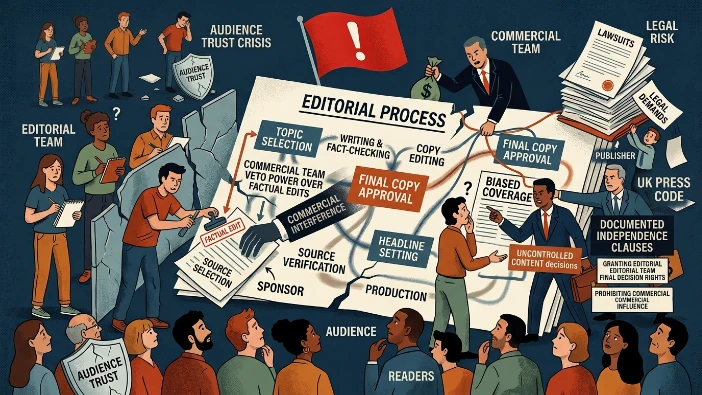
Editorial control must specify who chooses topics, who approves final copy, and who sets headlines. If the proposal lacks explicit clauses granting editorial teams final decision rights, this signals commercial influence. Commercial teams must not have veto power over factual edits or source selection. Legal risk arises if sponsors demand removal of critical material after publication. For UK publishers, documented editorial independence aligns with press code expectations and supports audience trust.
Why is the vague disclosure practice a red flag?
Vague disclosure practice hides funding relationships and misleads readers, weakening credibility and risking regulatory or reputational sanctions.
Disclosure practice must state how sponsorship will be labeled on the page, in metadata, and in social posts. The proposal must include exact wording for labels such as “partner content” and specify placement near the title and byline. Vague phrases such as “will be disclosed appropriately” lack operational detail. UK standards and advertising codes require transparent labelling. Explicit disclosure language protects both audiences and publishers and preserves content effectiveness.
Why is missing performance measurement a red flag?
Missing performance measurement prevents assessment of outcomes and blocks evidence-based decision-making for future campaigns.
Measurement must include defined KPIs, data sources, and reporting cadence. Common KPIs are unique visitors, time on page, scroll depth, and conversions attributed to editorial content. Data sources include publisher analytics, third-party tracking, and post-campaign surveys. Reporting cadence should be weekly during launch and monthly for long-term campaigns. Without these components, partners cannot evaluate ROI or optimise content strategy.
Why is ambiguous intellectual property ownership a red flag?
Ambiguous intellectual property ownership leaves rights to reuse, archive, and adapt content undefined, creating legal and commercial disputes.
Ownership clauses must specify who holds copyright for the article, images, and datasets. They must specify licence terms for reuse by either party, including geographic scope and duration in years. If the proposal does not state whether the publisher retains archive rights or whether the partner can republish material, disputes arise when repurposing content for other channels. Clear IP terms prevent downstream conflicts and enable planned content lifecycles.
Why is an insufficient fact-checking workflow a red flag?
Insufficient fact-checking workflow allows errors and legal exposure to persist, reducing trust and increasing correction costs.
A fact-checking workflow identifies steps for verification, names responsible roles, and sets timelines for checks. It must include primary-source verification, data validation, and quotation confirmation. Timelines enable fact-checkers to complete work before publication without delaying schedules. If a proposal omits fact-checking roles or timelines, the publisher assumes higher risk for factual errors, retractions, and defamation claims.
Why is weak audience alignment a red flag?
Weak audience alignment indicates the proposed content does not match the publisher’s audience profile, reducing engagement and running higher opportunity costs.
Audience alignment requires the proposal to specify target demographics, interest segments, and performance benchmarks relative to typical publisher content. It must reference audience data such as monthly unique users, age brackets, or topical affinity. If the proposal offers generic audience claims without data or gives examples with no context, the content will underperform relative to publisher norms. Clear alignment ensures editorial effort reaches appropriate readers and meets partner goals.
Why is inadequate contractual liability allocation a red flag?
Inadequate contractual liability allocation leaves parties exposed to disproportionate legal or financial responsibility for content-related harm.
Liability clauses must allocate responsibility for defamation, data breaches, and regulatory breaches. They must include indemnity caps stated in monetary terms and specify jurisdiction for dispute resolution. A proposal that omits liability limits or uses broad mutual indemnities transfers excessive risk to publishers. Precise liability terms protect both parties and clarify insurance requirements, including coverage amounts in GBP and minimum policy duration.
Why is limited distribution or republishing rights a red flag?
Limited distribution or unclear republishing rights restricts content reach and prevents partners from using produced assets across owned channels.
Distribution clauses must list permitted channels: publisher website, newsletters, social platforms, and partner channels. Republishing rights require specification of licence type (exclusive, non-exclusive), duration in months or years, and geographic scope. If a proposal restricts republishing without compensation or leaves channel lists open-ended, content reach becomes artificially constrained and value erodes. Clear rights maximise content utility and long-term value.
What processes reduce these red flags when negotiating partnerships?
Implement standard operating procedures that define editorial control, disclosure, measurement, IP, fact-checking, audience fit, liability, and distribution before contract signing.
A standard operating procedure (SOP) template includes mandatory contract clauses and checklists for each red-flag area. The SOP must require sign-off by editorial, legal, commercial, and data teams. It must include model disclosure language and standard KPI sets with measurement tools. The SOP should specify retention periods for datasets and license terms in years. Using an SOP accelerates negotiation and reduces ad-hoc concessions that create risk.
Explore More Expert Insights:
How Recurring Media Partnerships Build Authority Faster Than One-Off Placements
Building a Multi-Publisher Partnership Strategy Across UK News Verticals
How should publishers test proposals before approval?
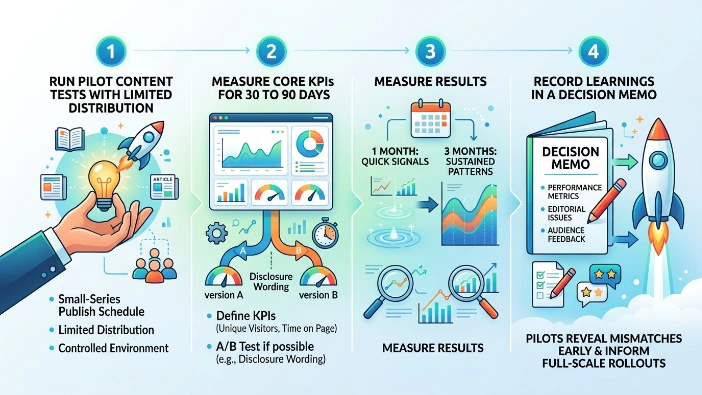
Run pilot content tests with limited distribution, measure core KPIs for 30 to 90 days, and record learnings in a decision memo.
A pilot requires a small-series publish schedule, defined KPIs such as unique visitors and time on page, and an A/B test if possible for different disclosure wording. Measure results for one month for quick signals and three months for sustained patterns. Produce a decision memo that records performance metrics, editorial issues, and audience feedback. Pilots reveal mismatches early and inform full-scale rollouts.
Where do publishers find standard clauses and guidelines relevant to UK media partnerships?
Publishers should consult press regulator codes, advertising standards guidelines, and legal templates for content partnerships available from media associations.
Press regulator codes include editorial standards and transparency expectations. Advertising standards provide labelling rules for paid content. Media industry associations publish template contracts and guidance for editorial-commercial separation. Legal counsel must vet templates for jurisdictional alignment and indemnity levels. Using established sources reduces legal ambiguity and aligns practices with industry norms.
Complete Details Available Here:
The Credibility Gap: Why UK Audiences Trust Editorial Partners Over Paid Ads
Identify and address eight contract and production weaknesses early: editorial control, disclosure, measurement, IP ownership, fact-checking workflows, audience alignment, liability allocation, and distribution rights. Use SOPs, pilots, and recognised legal templates to reduce risk. Clear, specific contract language and measurable KPIs increase the likelihood of successful media partnerships and protect both publisher and partner interests.
Explore the Advanced Guide:
B2B Lead Generation Through Media Partnerships: A 12-Month UK Attribution Study