

A recurring media partnership is a sustained contractual collaboration between a brand and a news publisher to produce and distribute a sequence of co-created or sponsored content over time.
A recurring media partnership defines roles, content cadence, distribution channels, and measurement expectations. Entities include the brand (commissioning partner), the publisher (news outlet), editorial producers, commercial managers, and legal counsel. Content formats include multi-article series, video episodes, newsletter inserts, and bespoke microsites. Contracts specify publication frequency, content ownership, data sharing, disclosure language, and payment schedules. Publishers supply first-party audience segments and analytics. Brands supply expert sources, topic briefs, and review capacity. The agreement aligns the publisher’s editorial calendar with the brand’s communications timetable to ensure sustained exposure to the same audience cohorts.
How does a recurring partnership build authority faster than a one-off placement?
Recurring partnerships build authority by delivering repeated, consistent messaging within trusted editorial environments, increasing cumulative exposure and audience trust more rapidly than single placements.
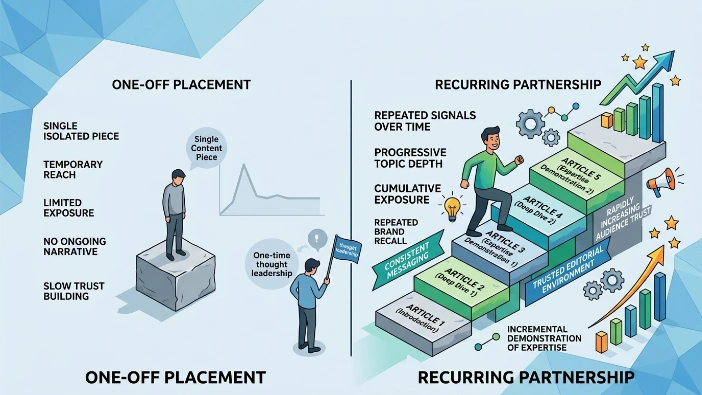
Authority requires repeated signals over time. Recurring content places the same experts or themes before the same audience repeatedly. This repetition improves recognition and message recall measured in brand lift studies. Publisher environments offer contextual credibility: content appears alongside editorial reporting that the audience already trusts. One-off placements provide temporary reach but no ongoing narrative. Recurring partnerships allow progressive topic depth, enabling incremental demonstration of expertise across multiple pieces. Measurement uses reach, dwell time, repeat visitors, and survey-based trust metrics to quantify authority growth over defined campaign windows.
What are the key components of a recurring media partnership?
Key components include scope and cadence, content governance, measurement framework, data-sharing terms, disclosure rules, and commercial terms.
Scope and cadence define the number of pieces, formats, and publication schedule. Content governance sets approvals, editorial independence, and review timelines. The measurement framework identifies KPIs such as unique reach, average time on page, repeat engagement rate, and brand lift percentages. Data-sharing terms cover first-party audience segments, anonymised reporting, and compliance with UK GDPR. Disclosure rules comply with the Advertising Standards Authority’s requirements for paid content labelling. Commercial terms list fees, invoicing, exclusivity clauses, and termination conditions. Contracts also include SLAs for delivery and audit rights for verification of metrics.
How is editorial control managed in these partnerships?
Editorial control is managed through defined approval workflows, editorial guidelines, and clear distinctions between native editorial content and paid material.
Approval workflows specify draft submission deadlines, legal reviews, and final sign-off authority. Editorial guidelines state tone, fact-checking standards, and source requirements. Agreements clarify that editorial independence remains with the publisher on news content, while sponsored or co-produced pieces follow jointly agreed briefs. Disclosure labels and metadata tags mark paid content for transparency. Publishers typically reserve final editorial decision rights for news reporting, and brands retain review rights for sponsored narratives. The process includes version control and timestamped approvals to prevent publication delays.
What measurement approaches show faster authority building?
Measurement uses repeated exposure metrics, engagement quality, longitudinal brand lift studies, and cohort-based behavioural tracking to demonstrate faster authority building.
Repeated exposure metrics track how many unique users encounter multi-piece series across a campaign period. Engagement quality measures include average time on page, scroll depth, and completion rates for multimedia content. Longitudinal brand lift studies use baseline and post-exposure surveys to quantify changes in trust and perceived expertise, reporting percentage point changes. Cohort tracking follows the same audience segment across multiple exposures to record changes in return visits and actions such as newsletter sign-ups. Publishers combine first-party analytics with third-party verification to ensure data integrity.
What operational processes ensure effectiveness over time?
Operational processes include joint editorial planning, a shared production timetable, routine performance reviews, and a governance forum for issue resolution.
Joint editorial planning maps topics across the campaign lifecycle and assigns publishing windows. A shared production timetable sets deadlines for drafts, approvals, asset delivery, and publication. Routine performance reviews occur weekly or monthly to assess KPIs and adjust content focus. A governance forum brings together commercial, editorial, analytics, and legal stakeholders for escalation and decisions. Clear SLAs for deliverables and dispute resolution clauses reduce friction. Documented workflows and a single campaign manager on each side improve coordination and reduce approval bottlenecks.
Which audience segments benefit most from recurring partnerships?
Audience segments that value trusted information and repeated exposure—professionals, policy-interested readers, and local communities—benefit most from recurring partnerships.
Professionals in finance, health, and energy value depth and repeat expertise. Policy-interested readers follow ongoing explainers and regulatory updates. Local communities respond to regional series that deliver relevant public information. Recurring content retains and re-engages these segments with progressive topic depth. Publishers’ first-party data helps brands target these cohorts precisely. Measurement focuses on repeat visit rates and content series completion within these segments to demonstrate authority growth.
What are the common content formats used in recurring partnerships?
Common formats include series of explainers, episodic video, recurring newsletters, expert Q&A columns, and interactive microsites that host multiple pieces.
Explainer series break complex topics into sequenced articles. Episodic video presents recurring interviews or panels. Recurring newsletters place content directly into subscribers’ inboxes on a regular schedule. Expert Q&A columns establish a named expert presence over time. Interactive microsites aggregate series content, multimedia assets, and supplementary data visualisations. Each format allows progressive depth and drives return visits. Publishers combine formats across site, social, and email distribution to maximise sustained exposure.
How do costs and ROI compare with one-off placements?
Costs are predictable through fixed fees and retainers, while ROI improves via higher engagement, reduced audience waste, and cumulative lift in trust metrics.
Recurring partnerships use fixed fees, retainer models, or per-piece pricing, enabling predictable budgeting. One-off placements pay CPM or single sponsorship fees with variable outcome quality. ROI for recurring partnerships measures effective cost per engaged user using engagement metrics rather than raw impressions. Higher average time on content and repeat visits lower effective acquisition costs for attention. Brand lift studies quantify increases in trust and preference expressed as percentage point gains, which convert into long-term value for pricing power and conversion efficiency.
Explore More Expert Insights:
Building a Multi-Publisher Partnership Strategy Across UK News Verticals
KPIs That Actually Matter When Measuring a UK Media Partnership Performance
What use cases in the UK show clear results with recurring partnerships?
Use cases include public information campaigns, sector education series, ongoing thought leadership, and regional outreach through local publishers.
Public information campaigns deploy series that explain regulatory changes or public services. Sector education series provide sustained explainers for finance or energy topics. Ongoing thought leadership places named experts in recurring columns or video shows. Regional outreach uses local publisher series to reach town-level audiences. Examples include multi-month explainer series on policy changes and recurring expert columns in regional titles that show measurable increases in repeat readership and trust indicators.
How should brands structure pilot programmes for recurring partnerships?

Pilots should run for a defined period, include a minimum of three content pieces, set clear KPIs, and use baseline/post-exposure measurement to validate authority gains.
Define a pilot term of 3 to 6 months. Commit to a minimum of 3 pieces to allow cumulative effects. Set KPIs such as unique reach, average time on content, repeat visitor rate, and percentage-point brand lift. Use baseline surveys before launch and follow-up surveys after the final piece to measure changes. Include agreed analytics dashboards and third-party verification. Review results in a formal analysis to decide on scaling or contract renewal.
Explore the Complete Guide:
How News Media Partnerships Are Replacing Expensive Programmatic Buys in the UK
Recurring media partnerships combine contractual clarity, editorial collaboration, and measurable exposure to build authority faster than single placements. They require defined scope, governance, measurement, and GDPR-compliant data sharing. For mid-funnel objectives that demand credibility and education, recurring partnerships provide repeatable authority gains measurable through engagement and brand lift metrics.
Discover More Insights:
UK Media Partnership Contracts: 11 Clauses Every Brand Lawyer Should Review



