
The 7-day window is a specific period after distribution when journalists return the highest volume of replies and booking confirmations, typically days 2–8, with peak responses on day 3.
The 7-day window describes the concentrated time frame after a press release goes live when journalist engagement metrics—email opens, reply rates, request-for-info (RFI), and interview bookings show the largest volume. Measurement comes from newsroom analytics and distribution platforms that track open rates, reply timestamps, and journalist actions. In the United Kingdom market, aggregated data from media distribution reports in 2025 and 2026 show reply clusters beginning on day 2, peaking on day 3, then tapering through day 8. This pattern reflects journalists’ inbox triage, newsroom editorial planning cycles, and morning editorial meetings that settle coverage choices within a week.
Why does this 7-day pattern occur?
The pattern emerges from journalist workflows, editorial calendars, and publication schedules that align decision-making within a week after receiving pitches or releases.
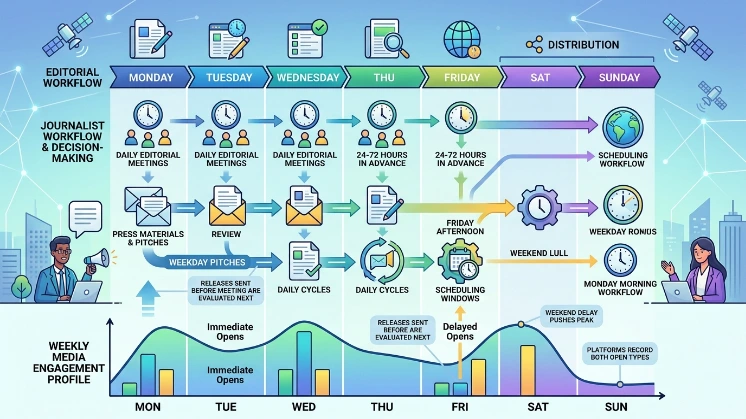
Journalists process incoming press materials during defined work cycles. UK newsrooms typically hold daily editorial meetings that finalise stories 24–72 hours ahead of publication. Press releases received before an editor’s scheduling window get evaluated in the next meeting, producing a concentrated set of responses shortly after. Weekend timing matters: releases sent on Friday afternoon often see delayed review until Monday, shifting peak engagement later. Distribution platforms record both immediate opens and delayed opens aligned with these cycles. The interaction of daily editorial deadlines and release timing creates a clear seven-day engagement profile.
How is the 7-day window measured?
Measurement uses timestamped tracking of opens, replies, link clicks, and briefing requests across email, media portals, and distribution analytics aggregated over multiple releases.
Tracking requires consistent metadata: send time, recipient role (beat, desk), and subsequent actions (open, reply, RFI, booking). Analysts produce time-series charts of engagement by hour and day after send. Key metrics include reply rate per 1,000 recipients, median time-to-first-reply, and cumulative response share by day. In UK data sets, cumulative response share typically reaches 60–75% by day 7 and exceeds 90% by day 14 for releases that receive any attention. These numeric thresholds define the practical length of the window and help communications teams schedule follow-ups and embargo lifts.
What components influence the 7-day response curve?
Components include send timing, subject relevance, recipient list quality, embargo settings, and newsroom schedules.
Send timing affects which editorial meeting evaluates the release. Subject relevance requires precise beats and desk targeting; broader topics dilute immediate relevance. Recipient list quality depends on up-to-date contact roles and verified inboxes; lists with 90% verified contacts return faster replies than lists with 60% verification. Embargo settings that require pre-publication review compress responses into the embargo lift moment. Newsroom schedules—daily newspapers, trade magazines, and online outlets—each contribute different reply rhythms: trade journalists often reply within 24–48 hours; national desk editors reply within 48–96 hours; regional reporters respond within 72–120 hours.
How should PR teams schedule sending to maximise this window?
Schedule distribution to align with target journalists’ editorial meeting cycles: send Tuesday morning for national desks and Tuesday–Thursday for trade and regional reporters.
Tuesday morning aligns with post-weekend editorial planning and avoids Monday backlog. For national outlets, send between 08:00–10:00 GMT to hit decision-making before midday meetings. For trade outlets, early Tuesday or Wednesday yields faster reviews because their planning cycles start midweek. Avoid Friday after 15:00 GMT and Saturday sends that wait until Monday reviews. If using embargoes, set embargo lifts between 09:00–10:00 GMT on the chosen day to synchronize with morning news cycles and secure placement within the 7-day engagement peak.
What follow-up cadence works within the 7-day window?
Follow up once on day 2 and, if no reply, once more on day 5; prioritise phone or direct messaging for top-target journalists.
A single polite follow-up on day 2 prompts journalists who saw the release but did not prioritize it. A second follow-up on day 5 reaches journalists whose schedules delayed review. For high-priority targets, use a short phone call or verified direct message within 24–48 hours after send. Avoid daily follow-ups that reduce goodwill. Track each outreach in a shared log with timestamp and outcome to prevent duplicate contacts and to measure follow-up effectiveness within the 7-day period.
What KPIs should teams track to evaluate success in this window?
Track reply rate, RFI rate, booking rate, placements secured within 7 days, and median time-to-first-reply.
Reply rate is replies per 1,000 sends. RFI rate is requests for additional material or interviews per 1,000 sends. Booking rate is confirmed interviews or on-record briefings per 1,000 sends. Placements within 7 days measure earned coverage achieved during the window. Median time-to-first-reply indicates when outreach gains traction. For UK campaign benchmarks in 2025–2026, strong campaigns report reply rates of 12–18% within seven days for targeted lists and placement rates of 3–6% within the same window.
What differences exist between embargoed and non-embargoed releases?
Embargoed releases concentrate responses around the embargo lift day, while non-embargoed releases generate staggered responses throughout the 7-day window.
Embargoed materials create a synchronized decision point. Journalists who accept the embargo conduct pre-release research and schedule coverage for publication at lift time, producing a spike in confirmations immediately before or at the embargo lift. Non-embargoed releases enter inboxes for organic review; responses then follow individual routines, yielding a more distributed curve across the 7-day period. Embargo strategy requires precise timing and clear embargo instructions to ensure compliance and optimal simultaneous coverage.
How do different UK media types behave within the 7-day window?
National newspapers reply within 48–96 hours; broadcast producers reply within 24–72 hours; trade press replies within 24–48 hours; and the local press replies within 72–120 hours.
National newspapers maintain fast editorial meetings but high volume, producing early decisions then ongoing reviews. Broadcast producers prioritise immediate relevance and production schedules; they respond quickly for timely segments. Trade press focuses on sector expertise and often replies within two days. Local press operates on longer cycles tied to regional desk resourcing, producing slower response patterns. Each media type’s timeline informs target prioritisation and follow-up scheduling to maximise responses inside the seven-day window.
Explore More Expert Insights:
How to Build a UK Media Distribution List That Gets 4× More Opens
Step-by-Step: Writing a Press Release That Wins AI Citations and News Pickups
What tactical changes improve response rates in the 7-day window?
Use precise subject lines, customised lead paragraphs, verified contact lists, and time-appropriate distribution to improve response rates.
Precise subject lines state the news and its relevance to the recipient’s beat. Customised lead paragraphs explain why the story matters to the outlet’s audience. Verified contact lists reduce bounce rates and speed replies. Timing aligns send times with recipient work cycles. These tactical adjustments increase the probability that a journalist will open, evaluate, and respond within the seven-day period. Use tracking pixels and link analytics to identify which journalists opened the release and prioritise follow-ups accordingly.
What are practical use cases for applying the 7-day window?
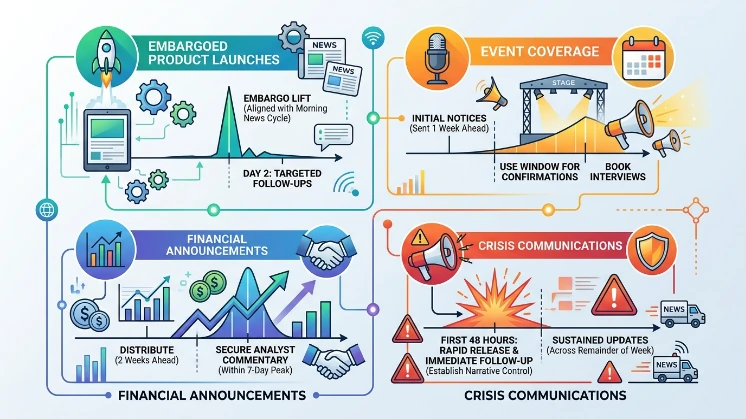
Use the window to plan embargoed launches, product announcements, event coverage, and crisis communications for concentrated journalist engagement.
For embargoed product launches, schedule the embargo lift to align with morning news cycles and prepare targeted follow-ups on day 2. For events, send initial notices one week ahead and use the window for confirmations and booking interviews. For financial announcements tied to market dates, distribute two weeks ahead and use the seven-day peak to secure analyst commentary. For crisis communications, use rapid release plus immediate follow-up in the first 48 hours to establish narrative control and then sustain updates across the remainder of the week.
Read More to Understand Better:
What the £5.87M UK PR Market Growth Means for Brand Visibility in 2026
The 7-day window gives a predictable, measurable period for journalist engagement after a UK press release. Align send timing with editorial cycles, use verified lists, apply one or two strategic follow-ups, and track reply and placement KPIs. These practices convert timing insights into higher reply rates and faster placements within seven days. For teams evaluating distribution tactics and internal processes, use this window as the primary planning horizon for response-focused PR workflows.
Get the Full Insights Here:
How Multi-Site PR Distribution Across 10 News Properties Scales Earned Media