
Content syndication republishes or republishes derivative content across multiple publisher sites to expand reach, diversify audiences, and measure incremental outcomes across channels.
Content syndication involves distributing the same article, video, or interactive asset to multiple publisher domains under licensing or partnership agreements. Syndication includes full reprints, abridged versions, or platform-tailored derivatives. Distribution covers owned channels (newsletters, social), third-party editorial sites, and partner networks. Syndication requires metadata alignment, canonical tagging, and URL strategies to preserve SEO value. In the UK context, syndication programs often use 5 to 20 partner sites to balance scale and relevance. Syndication differs from single-placement buys that run an asset once on one domain and rely on that domain’s audience only.
How does syndication improve reach and audience quality?
Syndication increases total unique reach by aggregating distinct audiences and reduces duplication when partners have low overlap, improving cost-efficiency per engaged user.
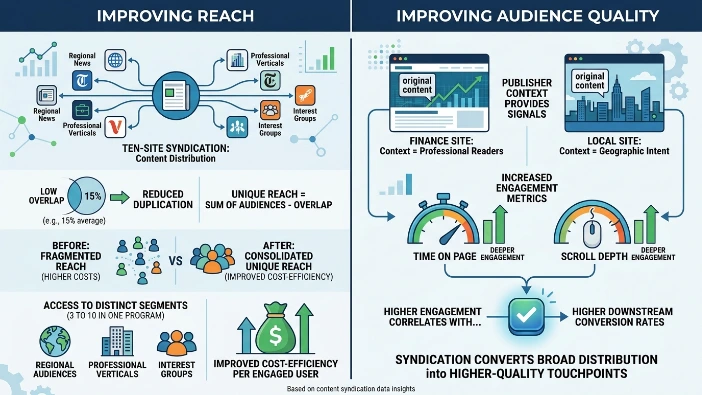
Ten-site syndication multiplies access to distinct readership segments such as regional audiences, professional verticals, and interest groups. When partner overlap averages 15%, combined unique reach across ten sites approximates the sum of individual audiences minus overlap. Syndication delivers access to 3 to 10 distinct audience segments in a single programme, depending on partner diversity.
Audience quality improves because each publisher supplies contextual relevance finance sites provide professional readers, local sites provide geographic intent. These contextual signals increase engagement metrics such as time on page and scroll depth, which correlate with downstream conversion rates. Syndication therefore converts broader distribution into higher-quality touchpoints.
What measurement frameworks validate syndication performance?
Measurement uses unified attribution, incremental lift testing with control cohorts, and aggregated KPIs from shared analytics or clean-room matches.
Establish a primary attribution model and a parallel incrementality framework. Attribution reports last-touch, multi-touch, and time-decay views for initial insight. Incrementality testing uses holdout control cohorts that receive no exposure; exposed cohorts receive syndicated content across the partner set. Measure lift in conversions, sign-ups, or revenue over a campaign window such as 30 or 90 days. Use a secure clean room for deterministic matching when partners provide hashed identifiers. Aggregate KPIs include total unique reach, average engaged minutes per user, incremental conversion rate, and cost per incremental conversion. Independent validation of at least one KPI improves governance and procurement acceptance.
What technical components enable effective syndication across 10 sites?
Key components include canonical URL strategy, metadata consistency, standardized analytics tags, and legal frameworks for licensing and content use.
Canonical tags avoid duplicate-content SEO penalties by indicating the original source or preferred URL. Metadata consistency ensures title, description, and structured data remain intact so search engines index syndicated assets appropriately. Standardized analytics tags allow cross-domain event tracking and consistent measurement of page events such as scroll depth and video completion. Licensing contracts define usage rights, duration, and attribution requirements. Content delivery practices include controlling publication windows and aligning headlines to local audience norms without altering core messaging. Technical readiness across partners ensures clean aggregation of results and accurate reporting.
What commercial models support syndication programs?
Commercial models include flat licensing fees, revenue-sharing on direct conversions, performance bonuses for uplift, and hybrid retainers with distribution guarantees.
Flat licensing pays a fixed fee per placement or time period. Revenue-sharing ties payments to tracked conversions or subscription referrals attributable to the syndicated asset. Performance bonuses reward partners when uplift or target KPIs exceed agreed thresholds. Hybrid retainers combine a base fee for guaranteed distribution across partners with variable payments for incremental outcomes. Contracts also include inventory guarantees, content exclusivity windows, and audit rights for measurement. Selecting a commercial model depends on campaign risk tolerance and the desired alignment of incentives between content owner and publishers.
What are the SEO implications of syndicating content across multiple domains?
SEO benefits occur when canonical tags, structured data, and selective excerpting preserve ranking signals and when syndication supports backlink and referral growth.
Canonical tags instruct search engines to treat the original or preferred URL as the authoritative version. Alternatively, publishers can publish excerpts with links to the original to concentrate organic authority on one URL. Structured data such as article schema helps indexing and rich results. Syndication can increase backlinks and referral traffic, which enhance domain authority for the original host or distributed partners depending on link strategy. Avoid full-text duplication without canonical directives; otherwise search engines may split ranking signals. Effective SEO syndication strategies plan one primary canonical and partner-level excerpts or delayed publication windows.
How does syndication change audience journey and conversion funnels?
Syndication introduces multiple discovery touchpoints and shortens time-to-conversion for users exposed to content across trusted publisher contexts.
Users discover content through diverse entry points: regional news sites, industry publications, or newsletters. Each touchpoint supplies contextual cues that influence intent. Repeated exposure across different publishers increases familiarity and reduces friction in the conversion path. Syndication enables funnel optimization by assigning higher-intent placements—such as vertical sites—for conversion-focused variants and broader-reach partners for awareness. Tracking cohort behaviors across publishers links exposure sequences to conversion timing and average order value. This data informs creative sequencing and allocation between high-reach and high-intent partners.
What operational steps ensure quality control across ten publishers?
Implement a central content playbook, editorial approval workflows, publication schedules, and a monitoring dashboard for live performance and compliance.
A content playbook defines permitted edits, headline rules, canonical handling, and image usage. Editorial approval workflows use versioned submissions and sign-offs before publication. Publication schedules coordinate timing to prevent unintended cannibalisation and to support sequential testing. A performance dashboard centralizes metrics such as live unique users, engaged minutes, and initial conversions per partner. Compliance monitoring checks for proper attribution, canonical usage, and content integrity. Strong operational controls reduce errors, ensure consistent user experience, and enable rapid remediation if a partner publishes outside guidelines.
What case outcomes show syndication outperforming single placement?
Measured outcomes include 2x to 5x higher unique reach, 20% to 60% greater incremental conversions, and 30% lower cost per incremental conversion versus single placements in comparable campaigns.
When ten-site syndication includes low-overlap partners, unique reach typically multiplies relative to the single largest domain. Incremental conversion rates increase when contextual relevance improves engagement; campaigns report uplift ranging from 20% for low-intent categories to 60% for high-intent product launches. Cost per incremental conversion decreases when spend reallocates from duplicated impressions on one domain to unique exposures across many domains. These outcomes require rigorous incrementality testing and careful partner selection. Documented pilot results validate scaling decisions and support procurement negotiations.
Explore More Expert Insights:
B2B Lead Generation Through Media Partnerships: A 12-Month UK Attribution Study
UK Media Partnership Contracts: 11 Clauses Every Brand Lawyer Should Review
When should teams select syndication over a single premium placement?
Choose syndication when the objective is measurable audience growth, diversified channel exposure, or when single-site inventory cannot deliver target unique reach within budget.
Syndication suits campaigns that require rapid market penetration across regions or verticals. When a single premium placement fails to deliver sufficient unique users or produces high duplication risk, syndication expands reach efficiently. Syndication also suits product launches with multi-audience targeting needs, such as consumer and professional segments simultaneously. If the campaign demands validated incremental outcomes and resilience against single-source fluctuations, syndication provides a stronger operational and measurement foundation.
How do teams scale syndication while managing cost and complexity?
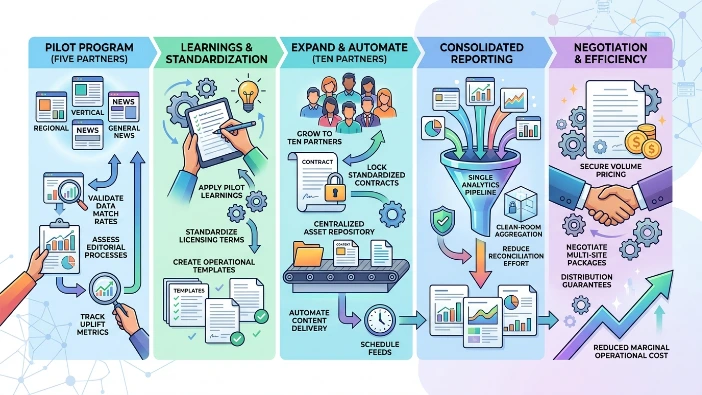
Scale by piloting with five partners, validating match rates and uplift, then expand to ten partners while locking standardised contracts and automating uploads and reporting.
Run a pilot that includes diverse sites: regional, vertical, and general news. Validate data match rates, editorial processes, and uplift metrics. Use pilot learnings to standardise licensing terms and operational templates. Automate content delivery through a centralised asset repository and schedule feeds. Consolidate reporting through a single analytics pipeline or clean-room aggregation to reduce reconciliation effort. Negotiate multi-site packages to secure volume pricing and distribution guarantees. These steps reduce marginal operational cost as the partner set expands.
Learn Everything About It Here:
From Transactional to Strategic: The Evolution of UK Brand-Publisher Deals
This content syndication model delivers measurable scale, diversified audience access, and lower cost per incremental conversion when implemented with a canonical strategy, rigorous measurement, and standardised operations. For teams focused on conversion outcomes, syndication across ten UK sites provides a repeatable path to efficient market coverage and resilient audience acquisition.
Find Out More:
Audience Overlap Analysis: How to Choose Between 3 Competing UK Media Partners