

A press release for AI citations and news pickups is a structured factual document that presents newsworthy information using clear metadata and authoritative sources so AI search engines and journalists can extract, verify, and cite it.
A press release is an official statement distributed to media, aggregators, and digital platforms. For AI citation, the release must include explicit entities: people, organisations, dates, locations, and verifiable data points. AI systems prioritise text with structured metadata (schema.org, Dublin Core), persistent links, and direct quotes attributed to named individuals. Journalists use press releases to verify facts quickly; AI systems index releases to answer user queries and to surface sources for news stories. Define the news hook clearly and state the primary fact in the opening paragraph.
Which metadata and tags increase AI trust and pickup?
AI systems prefer schema.org JSON-LD, clear author and publisher fields, persistent URLs, and machine-readable dates and identifiers.
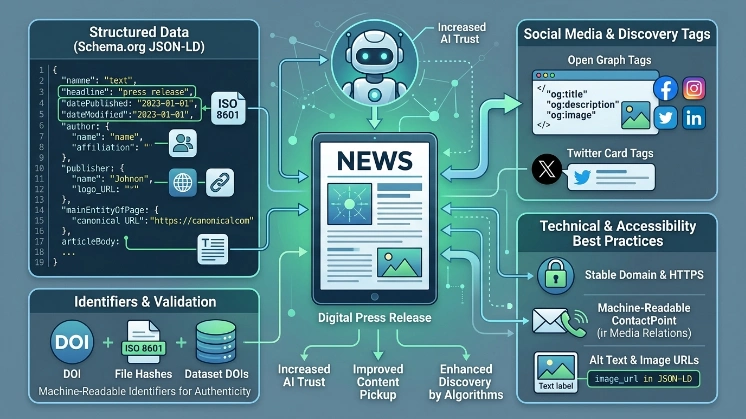
Include schema.org/PressRelease or schema.org/NewsArticle fields: headline, datePublished, dateModified, author (name and affiliation), publisher (name, logo URL), mainEntityOfPage (canonical URL), and articleBody. Add identifiers such as DOI, file hashes, or dataset DOIs when possible. Use Open Graph tags and Twitter Card tags for social media indexing. Provide machine-readable contact Point entries for media relations. Use ISO 8601 date format for metadata while keeping human-readable dates in the text. Host the press release on a stable domain and use HTTPS. Use alt text for images and include image URLs in JSON-LD.
What language and wording do AIs and journalists prefer?
AIs and journalists prefer declarative sentences, named entities, precise numbers, direct quotes with attribution, and passive voice avoidance.
Write sentences that state facts without modal verbs. Use full names and titles for people on first mention. Present numeric data with units and date stamps, for example “sales increased 27% year-on-year to 3.2 million units in Q1 2026.” Place direct quotes after the factual statement they support, and attribute the quote to a named person and role, e.g., “said Dr Jane Smith, Chief Scientist.” Avoid marketing adjectives and superlatives. Use consistent terminology for entities throughout the release. Spell out acronyms on first use and include standard identifiers (company registration numbers, charity numbers) where relevant.
How do you provide verifiable evidence and primary sources?
Attach primary documents, link to datasets or regulatory filings, and reference third-party verification with direct URLs and file timestamps.
Cite full URLs to public reports, PDFs, and data repositories. Where possible, upload supporting documents as archived snapshots with timestamps (for example via permanent archive services). Include dataset DOIs, government report citations, and regulatory filing references. When using internal data, describe the methodology briefly and link to a detailed methodology file. For clinical or scientific claims, reference peer-reviewed articles with full citations including journal name, volume, pages, and DOI. For financial claims, link to audited statements or the filing in the appropriate regulator’s database.
What visual and attachment formats work best for AI and newsrooms?
Use high-resolution JPEG/PNG for images, searchable PDF for documents, CSV/JSON for datasets, and provide captions plus machine-readable metadata for each file.
Provide images with descriptive filenames and alt text that describe the subject and date. For charts, include underlying CSV or JSON data files and a short methodology note. Supply logos in SVG and PNG formats. Ensure PDFs are text-searchable and include document metadata (author, creation date). For multimedia, provide MP4 files with subtitles and a transcript in plain text. Host all files on stable URLs and include file size and MIME type in the metadata.
How long should each section of the release be?
Keep the lead focused on the main news fact. Use three to six short paragraphs in the body to expand on evidence, supporting facts, quotes, and next steps. Limit the boilerplate to a concise entity definition: legal name, primary activity, founding year, and headquarters. Provide a single media contact block with name, role, phone number, email, and office hours. Use numbered dates and full place names in the dateline.
Where do you place schema and machine-readable content?
Embed schema.org JSON-LD in the HTML head and include a machine-readable metadata file at a standard location on the site.
Place JSON-LD for PressRelease in the HTML head to ensure indexing. Include a plain-text version of the release and a metadata endpoint such as /press/press-release-slug/metadata.json. Provide an alternative RSS or Atom feed entry for the release. Use consistent canonical URLs and implement robots metadata to allow indexing. Ensure sitemaps list the press release with lastmod timestamps.
How do you optimise for AI query extraction and snippet generation?
Place the primary fact in the first 50–100 words, use named entities and numbers early, and repeat key facts in the boilerplate and metadata.
Search engines and AI parsers extract concise answers from the first paragraphs. Use a lead that contains the key answer. Repeat core facts in metadata and in the final boilerplate sentence. Provide standalone fact lists in the body as short paragraphs labelled with named entities (for example “Fact: X — 12,345 units sold on 10 May 2026”) to aid extraction. Avoid rhetorical questions and ambiguous references.
What distribution channels increase pickup by AI and newsrooms?
Publish on a stable website, syndicate via newswire services, deposit in relevant registries, and notify journalists and aggregators directly with machine-readable links.
Post the release on the organisation’s site under a clear URL and include JSON-LD. Use industry newswires that support structured metadata and provide XML/JSON feeds. Deposit regulatory filings in government registries when relevant. Send targeted email alerts to journalists with a plaintext version and links to full resources. Use social platforms’ native cards with metadata enabled. Provide a newsroom API or RSS feed for aggregators.
Explore More Expert Insights:
PA Media vs Wire Services: What 500 UK Campaigns Revealed
Press Release Distribution Checklist: 11 Steps UK PRs Miss
What are common technical errors that block AI citations?
Missing schema, inaccessible attachments, broken links, unsearchable PDFs, and inconsistent entity naming block AI citation.
Check that JSON-LD validates with schema.org rules. Verify all links return 200 status codes and that PDFs contain selectable text. Ensure images are reachable and have alt text. Confirm canonical tags point to the published URL. Avoid using redirects that strip query parameters from metadata URLs. Maintain consistent spelling for names and entity identifiers across the release and metadata.
Find Out More:
How AI Search Engines Are Replacing Traditional Newswires for 800M Weekly Users
How do you measure success for AI citations and news pickups?
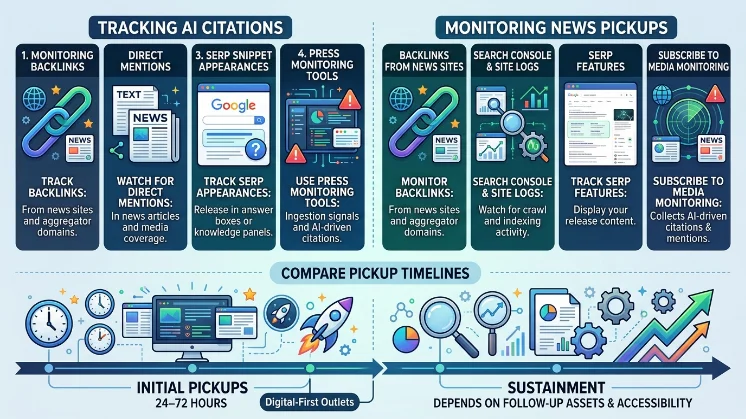
Track citations by monitoring backlinks, direct mentions in news articles, SERP snippet appearances, and ingestion signals in press monitoring tools.
Monitor backlinks from news sites and aggregator domains. Use Search Console and site logs to watch for crawl and indexing activity. Track SERP features that display your release in answer boxes or knowledge panels. Subscribe to media monitoring that collects AI-driven citations and mentions. Compare pickup timelines: initial pickups typically occur within 24–72 hours for digital-first outlets, and sustainment depends on follow-up assets and accessibility.
Read the Full Blog Here:
Comparing UK PR Distribution Services: Reach, Turnaround and Cost in 2026



