

Multi-site PR distribution is the coordinated release of a single press statement across ten distinct news properties to amplify reach, centralise messaging, and increase earned media pickup. This process uses simultaneous submission, tailored headlines, and placement scheduling.
Multi-site PR distribution sends the same core announcement to multiple newsroom platforms at once while customising presentation for each property. The distribution bundle contains the headline, subhead, dateline, body copy, boilerplate, and multimedia assets. Editors receive a tailored version that matches their editorial format and audience. Delivery methods include newsroom portals, wire services, direct email to editors, and API pushes to publishing platforms. Timing coordination ensures releases hit all properties within the same hour window to create momentum and shared coverage.
Key operational steps include audience mapping, asset standardization, property-specific formatting, embargo management, and tracking. Audience mapping identifies the ten news properties by circulation, vertical focus, and audience demographics. Asset standardization produces one canonical press release and variations for format differences. Embargo management sets a uniform release time or staggered windows. Tracking uses press monitoring and UTM-tagged links to measure pickup by each property.
What components are required to deploy distribution across ten properties?
Required components include a canonical press release, ten property-specific variants, a delivery mechanism, multimedia assets, an embargo schedule, and analytics tracking. Each component aligns with editorial standards and measurement needs.
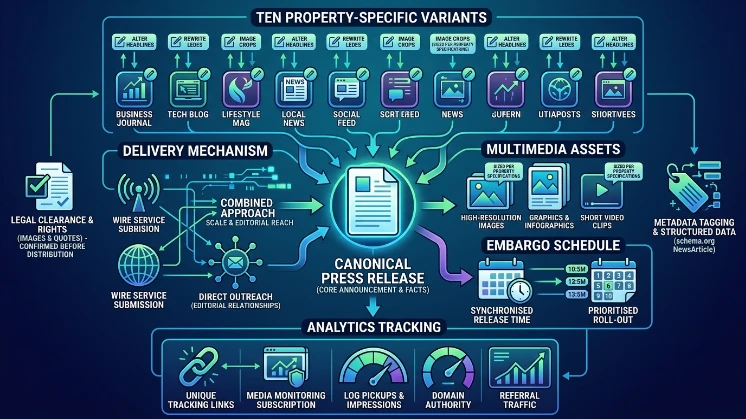
A canonical press release captures the core announcement and facts. Property-specific variants alter headlines, ledes, and image crops to match each property’s style and audience. The delivery mechanism can be a combined approach of wire service submission and direct outreach to maintain both scale and editorial relationships. Multimedia assets comprise high-resolution images, graphics, and short video clips sized per property specifications.
The embargo schedule defines a synchronised release time or a prioritised roll-out with exact timestamps. Analytics tracking requires unique tracking links and media monitoring subscriptions to log pickups, impressions, domain authority, and referral traffic. Legal clearance and rights for images and quotes must be confirmed before distribution. Metadata tagging and structured data (schema.org NewsArticle) improve discoverability and syndication potential.
How does multi-site distribution increase earned media volume and quality?
Multi-site distribution increases earned media by creating simultaneous coverage opportunities, raising the signal-to-noise ratio for journalists, and improving syndication probability across regional and national outlets.
Simultaneity creates a moment when multiple outlets publish the same factual story, which increases the chance that aggregators, industry blogs, and social channels amplify the content. Targeted headline variants increase relevance for each property’s audience, improving editor acceptance rates. Syndication becomes more likely when several reputable properties run the story within a short span; other publishers and trade outlets rely on those initial placements as verification.
Quality improves when property-specific assets reduce editing friction for journalists. When images, captions, and verified spokespeople are provided, outlets publish richer stories with correct attribution. Multi-site distribution also enables quality measurement: pick-up rate, domain authority of pick-up sites, average time-to-publish, and referral traffic. These metrics help evaluate both volume and editorial quality.
What metrics quantify ROI from a ten-property PR campaign?
Core metrics include pickup rate, total impressions, domain authority-weighted reach, referral traffic, backlinks, and conversion events tied to the campaign. Combine these with earned media value calculations for ROI assessment.
Pickup rate equals the number of properties that published the release divided by ten. Total impressions aggregate reported audience figures from each property. Domain authority-weighted reach adjusts impressions by each property’s SEO authority to reflect discoverability. Referral traffic measures direct visits from published articles using UTM parameters. Backlinks count authoritative links generated by the coverage and track anchor text relevance.
Conversion events link media exposure to measurable outcomes such as resource downloads, newsletter signups, or demo requests. Earned media value (EMV) estimates equivalent paid media cost for similar reach; calculate EMV using property-specific CPM rates and compare to distribution costs. Time-to-publish and share velocity provide operational insight into which properties accelerate coverage.
How do editorial relationships affect multi-site distribution success?
Strong editorial relationships increase acceptance, shorten review cycles, and improve placement prominence; weak relationships raise rejection rates and increase reliance on wire services.
Direct relationships let communicators pitch contextual angles and provide follow-up clarification quickly. Editors with established trust accept releases with minimal changes and often grant higher-visibility placements such as front-page or topic-section slots. When relationships are limited, distribution depends on wire services and standard submission portals, which produce broader but shallower placement.
Maintaining editorial relationships requires consistent accuracy in press materials, timely responses to queries, and respect for each property’s style guide. Tracking which editors historically publish similar topics and noting required formats and lead times increases placement probability across the selected ten properties.
What legal and compliance steps protect a distributed PR release?
Legal steps include rights clearance for multimedia, source verification, factual review, embargo compliance, and data protection alignment with UK regulations. Each step reduces legal risk and maintains editorial integrity.
Rights clearance ensures images and video include signed releases or licensed usage. Source verification confirms factual claims with documents or named spokespeople and preserves journalistic standards. Embargo compliance documents permission windows and shared timelines with editors; breaches erode trust. Data protection requirements require removing or anonymising personal data and following UK data privacy laws. Disclosures for financial claims or commercial relationships must appear in the release to meet regulatory expectations and reduce liability.
What technical setup ensures smooth multi-property delivery?
Technical setup includes an asset repository, formatted templates for each property, distribution software or API integrations, UTM tagging, and real-time monitoring dashboards to confirm publication.
An asset repository centralises canonical text, image files, video, and consent forms. Property templates enforce formatting requirements and metadata fields, including schema.org markup. Distribution software handles scheduled delivery, direct editor routing, and API pushes to partner CMSs. UTM tagging and shortened links enable measurement of referral traffic from each property. Real-time monitoring dashboards consolidate press pickups, social shares, and performance metrics so teams can act immediately if corrections or amplifications are necessary.
What are the tactical benefits for UK brands using ten-property distribution?
Tactical benefits include rapid national reach, localised audience penetration, improved SEO through authoritative backlinks, and measurable multi-channel referral traffic that supports campaign goals.
For UK brands, simultaneous placement across national, regional, and sector-specific properties creates a comprehensive footprint. Localised audience penetration helps with regional sales activations and community reputation. Backlinks from established UK news domains increase search ranking for targeted keywords. Measurable referral traffic from multiple sources provides clean attribution for PR-driven conversions and supports budget justifications for future earned-media investments.
What use cases benefit most from distribution across ten properties?
Use cases include product launches, regulatory announcements, funding rounds, executive appointments, and crisis statements where fast, broad, and verifiable reach matters.
Product launches secure customer awareness across demographics. Regulatory announcements require authoritative publication to inform stakeholders and satisfy compliance. Funding rounds and M&A announcements achieve market validation when multiple reputable outlets report the same facts. Executive appointments obtain professional visibility for recruitment and partner confidence. Crisis statements manage factual narratives quickly across influential outlets to reduce misinformation.
Explore More Expert Insights:
What a Managed PR Distribution Service Does That Your In-House Team Cannot
Comparing UK PR Distribution Services: Reach, Turnaround and Cost in 2026
What are common pitfalls and how does a ten-property approach mitigate them?
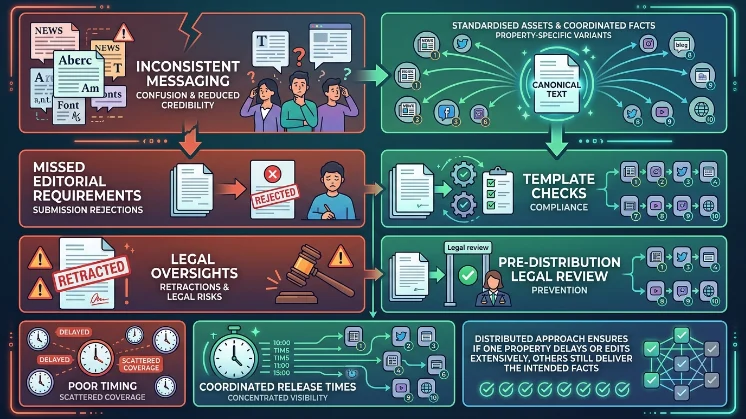
Common pitfalls are inconsistent messaging, missed editorial requirements, legal oversights, and poor timing; using ten properties mitigates single-point failures through redundancy, standardised assets, and coordinated timing.
Inconsistent messaging causes confusion and damages credibility. Standardised canonical texts and property-specific variants ensure consistent facts and tailored leads. Missing editorial requirements cause rejections; template checks reduce that risk. Legal oversights produce retractions; pre-distribution legal review prevents this. Poor timing scatters coverage; coordinated release times concentrate visibility. The distributed approach ensures that if one property delays or edits extensively, others still deliver the intended facts.
How should marketing teams evaluate vendors or platforms for ten-property distribution?
Evaluate vendors on editorial reach across the ten desired properties, API integration capabilities, reporting granularity, pricing transparency, and compliance safeguards. Request trial runs and case studies with measurable outcomes.
Explore the Advanced Guide:
What the £5.87M UK PR Market Growth Means for Brand Visibility in 2026
Assess the vendor’s direct relationships with the targeted ten properties. Verify API or FTP integration ease for automated pushes. Require reporting that includes pickup timestamps, domain authority, referral URL performance, and conversion tracking. Confirm transparent pricing per distribution and for add-on services like multimedia hosting. Demand documented compliance workflows and sample NDAs or rights agreements. Request case studies demonstrating actual pickup rates and ROI for comparable UK campaigns.
Check the Complete Explanation:
Timing Your UK Press Release: The 7-Day Window Journalists Respond Most



