
Why does the UK lead global e-commerce retail share?
The UK leads because high internet penetration, strong online payment adoption, dense logistics networks, and established digital retail ecosystems increase the proportion of retail spent online. Internet access in the UK exceeds 95% of households according to national surveys. Card and digital-wallet payment adoption covers over 90% of consumer transactions. Urban density shortens delivery distances and lowers shipping cost per order. Established marketplaces and hundreds of thousands of online retail sites create extensive product choice and competition.
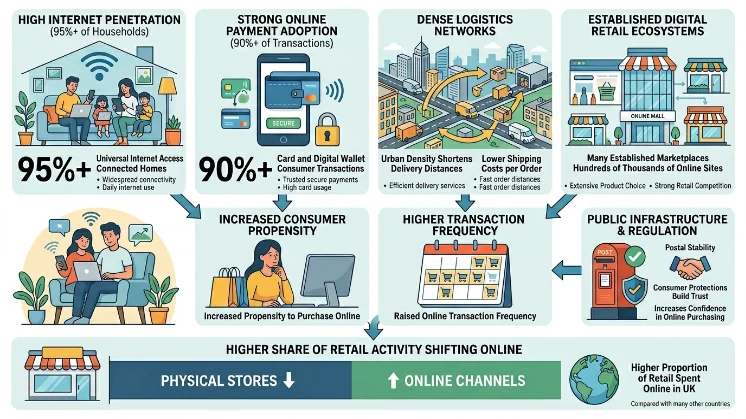
These factors increase consumer propensity to purchase online and raise online transaction frequency. Public infrastructure and regulation also support cross-border digital commerce through postal stability and consumer protections that increase trust in online purchasing. Combined, these elements produce a higher share of retail activity shifting from physical stores to online channels compared with many other countries.
What is display advertising and how is it defined?
Display advertising uses visual creatives images, video, or rich media placed on web pages or in-app environments to drive awareness, traffic, or direct response. Display ads include static images (JPEG, PNG), animated GIFs, HTML5 banners, and video units. Ad placements occur via programmatic buying, direct publisher deals, or ad networks. Targeting uses first-party data, contextual signals, or third-party segments. Metrics for display advertising include impressions, viewability rate, click-through rate (CTR), cost per click (CPC), and conversion rate.
Publishers on news sites, blogs, and portals allocate inventory in CPM (cost per mille) or CPC pricing models. Advertisers set campaign goals—brand lift, site visits, or conversions and optimise creative and placements against those goals. Display advertising is distinct from search ads because it reaches audiences during content consumption rather than in response to active queries.
How does display advertising perform on UK news sites specifically?
Display advertising on UK news sites achieves high reach and strong contextual engagement because news sites have large daily unique audiences and content that signals user intent. National and regional news websites attract millions of unique visitors daily. This scale provides advertisers with high-frequency exposure across topical content.
News content offers clear contextual categories politics, finance, sport, lifestyle that align with audience segments. Contextual alignment increases ad relevance and engagement. News site inventories often include premium placements with high viewability, such as leaderboard, MPU, and native formats. Publishers use header bidding and private marketplaces to increase yield, which raises CPM but also improves placement quality. For many campaigns, news site placements deliver lower acquisition costs when combined with targeted creative and frequency capping.
Why does display advertising “win” for e-commerce share in the UK?
Display advertising supports the UK’s high e-commerce share by driving scalable awareness, accelerating product discovery, and converting content-driven demand into online purchases. High online retail share requires consistent online discovery and purchase paths. Display ads create repeated exposure that builds brand and product awareness across large audiences. Visual creatives show product detail and price quickly, prompting direct site visits or search-based follow-ups.
Display supports cross-device journeys: a consumer sees an ad on a news site, later searches on mobile or desktop, and completes a purchase. Retargeting through display recaptures users who visited product pages but left without buying. On the supply side, news publishers provide premium, high-viewability inventory that increases message delivery reliability. Combined, these mechanisms shorten the time between discovery and purchase and increase the share of retail conducted digitally.
What components of display campaigns drive measurable e-commerce outcomes?
Key components are targeted audience segments, contextual placement, compelling creative, frequency management, and measurement tied to conversion events. Targeting includes demographic segments, interest cohorts, and first-party website visitors. Contextual placement aligns creatives with topical content to raise relevance. Creative types product images, short video, and native formats deliver different engagement rates; video tends to increase engagement time, images increase quick recognition.
Frequency caps prevent overexposure and limit wasted impressions. Measurement must link display impressions and clicks to downstream conversions via tracking pixels, server-to-server postbacks, or statistical attribution models. A robust attribution setup includes last-click, multi-touch, and incrementality tests to quantify how display impressions contribute to total online sales. Campaign optimization uses these signals to allocate budget toward placements and creatives that produce the lowest cost per sale.
How do advertisers measure return on ad spend for display in UK e-commerce?
Advertisers measure return using revenue attributed to display-driven conversions divided by display ad spend, supplemented by customer lifetime value and incremental lift tests. Direct ROI calculation uses tracked conversions with associated revenue. When a purchase occurs, the attribution system assigns the conversion value to the display campaign based on the chosen attribution window and model.
Incrementality testing runs holdout groups where some users do not receive display ads. Comparing conversion rates and revenue between exposed and holdout groups produces an estimate of sales uplift directly caused by display. Customer lifetime value (LTV) extends ROI by including repeat purchases over a defined horizon, such as 12 months. Combining immediate conversion metrics with LTV and incrementality tests yields a comprehensive view of economic impact.
What process do advertisers use to optimise display campaigns for UK e-commerce?
Advertisers iterate by testing creative variants, adjusting targeting, reallocating spend to high-performing placements, and validating results with incrementality tests. The optimisation cycle begins with hypothesis creation: which creative, placement, or audience will lower CPC or raise conversions? Advertisers run A/B or multivariate tests across creatives and headlines.
They monitor early KPI signals CTR, viewability, and engagement time—then evaluate conversion and revenue outcomes. Budget shifts favor placements and segments with the best cost-per-acquisition (CPA). Advertisers test frequency caps to balance reach and ad fatigue. They use server-side analytics and attribution platforms to confirm that observed lifts align with business goals. Regular cadence is weekly for early-stage adjustments and monthly for strategic reallocations.
Explore More Expert Insights:
Generative AI Is Pushing Search Budgets to Display: What UK Advertisers Need to Know
Why B2B Banner Ads on UK News Sites Outperform LinkedIn Sponsored Posts for Intent
What benefits does display advertising offer to UK e-commerce merchants?

Display advertising offers scalable audience reach, faster product discovery, improved conversion rates through retargeting, and measurable effects on online sales. Reach enables merchants to expose products to large daily audiences on premium publisher sites.
Visual creatives communicate product details and promotions quickly. Retargeting recaptures high-intent visitors who previously viewed product pages. Measurement frameworks allow merchants to attribute revenue to display campaigns and to run incrementality tests to confirm causal impact. Together, these benefits increase the portion of retail activity conducted online by converting content engagement into transactions.
Click Here to Explore More:
Creative Testing for UK News Site Banners: A 4-Variable Framework That Reduces CPC
What use cases show display advertising supporting e-commerce growth in the UK?
Use cases include new product launches, seasonal promotion amplification, cart abandonment recovery, and cross-sell campaigns to existing customers. In a new product launch, display ads build awareness across topical news sections and drive product detail page visits. For seasonal promotions, display scales messages quickly during peak shopping windows such as Black Friday and Christmas. Cart abandonment recovery uses retargeting to remind users of incomplete purchases with dynamic creatives showing the exact items. Cross-sell campaigns target past purchasers with complementary products and measured offers, increasing average order value. Each use case links impressions to site behavior and purchases through tracking and attribution to demonstrate incremental sales.
The UK’s highest e-commerce retail share arises from widespread internet access, mature payments infrastructure, dense logistics, and a competitive digital retail ecosystem. Display advertising complements these structural strengths by delivering large-scale awareness, contextual relevance on high-traffic news sites, and measurable paths to conversion. Advertisers optimise campaign components targeting, creative, frequency, and measurement to convert audience exposure into online purchases and to quantify the impact on e-commerce share.
Must-Read Detailed Guide:
How One UK Tech Brand Achieved 0.8% CTR on News Site Banners in a 6-Week Run