
Banner ads on UK news sites deliver broader contextual reach and higher view-through intent than LinkedIn sponsored posts because they appear within news content consumed actively by decision-makers, driving passive intent signals and cross-session recognition.
Banner ads appear inside editorial environments where readers engage with topical journalism. LinkedIn sponsored posts appear inside a social feed where users perform networking tasks. News-site banners capture attention during content consumption; sponsored posts capture attention during professional social activity. News environments provide contextual relevance tied to current events, policy, and market reporting. This relevance improves message salience for B2B audiences researching industry changes. LinkedIn surfaces ads using profile targeting, which yields precise professional demographics; news-site banners use contextual, behavioral, and programmatic audience segments, which yield broad topical alignment with reader intent.
How do definitions and formats differ between the two ad types?
Banner ads are defined as display creatives placed inside digital news pages; LinkedIn sponsored posts are native-style ads delivered in a social feed or inbox.
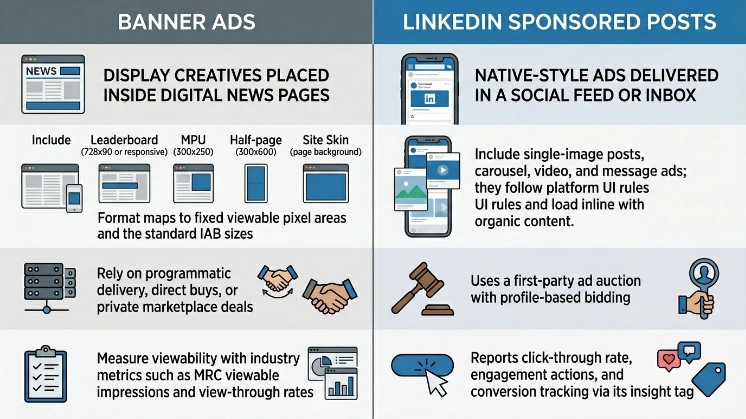
Banner ad formats include leaderboard (728×90 or responsive), MPU (300×250), half-page (300×600), and site skin (page background). Each format maps to fixed viewable pixel areas and standard IAB sizes. LinkedIn sponsored posts include single-image posts, carousels, videos, and message ads; they follow platform UI rules and load inline with organic content. Banner ads rely on programmatic delivery, direct buys, or private marketplace deals. LinkedIn uses a first-party ad auction with profile-based bidding. Banner ads measure viewability with industry metrics such as MRC viewable impressions and view-through rates; LinkedIn reports click-through rate, engagement actions, and conversion tracking via its insight tag.
What process drives intent capture for banner ads on news sites?
Intent capture for banner ads on news sites uses contextual alignment, repeated exposures, and cross-device recognition to build passive and explicit signals over multiple sessions.
Process steps: identify news topics relevant to target industries, buy placements around those topics, deliver sequential creatives, and link impressions to deterministic or probabilistic identity graphs for cross-device stitching. Contextual alignment places creatives beside articles on regulations, market shifts, or sector analysis. Repeated exposure delivers progressive messaging: awareness, consideration, and contact prompts. Measurement layers include view-through conversions, uplift studies, and incremental reach tests that isolate ad-attributed behaviours across sessions. News-site contextual targeting often leverages keyword pools, section targeting (business, technology, and policy), and audience cohorts built from engagement signals rather than user-declared job titles.
Which components drive higher intent from news-site banners?
Three components drive intent: editorial context, format prominence, and exposure sequencing each increases salience and cross-session memory compared with single-feed sponsored posts.
Editorial context: adjacent article themes shape message relevance. Example: a finance CIO reading taxation policy is receptive to B2B messages on compliance tools. Format prominence: larger formats (half-page, skin) secure higher viewable time and creative real estate. Example: a half-page unit registers higher average viewable seconds than a 300×250 MPU in the same placement. Exposure sequencing: programmatic frequency capping combined with creative rotation supports progressive messaging and recall. Example: a user sees awareness creative on day one, a product feature on day four, and a case-study link on day seven, producing measurable lift in search queries for the brand’s B2B solution.
What measurable benefits do banner ads on UK news sites provide for B2B intent?
Banner ads deliver higher view-through engagement, stronger contextual relevance, and larger incremental reach for cross-channel campaigns, yielding improved top-of-funnel intent signals.
View-through engagement: MRC-viewable impressions on news sites convert to search lifts that indicate latent intent. Contextual relevance: ads aligned with topical journalism produce higher recall and message comprehension scores in attention studies. Incremental reach: news-site placements access audiences not present in professional networks, extending campaign reach by a measurable percentage versus LinkedIn-only buys. Publishers supply first-party data segments tied to article consumption patterns, enabling refined retargeting and audience enrichment that strengthen mid-funnel behaviors. Measurement approaches include uplift testing, incremental reach analysis, and multi-touch attribution modeling to quantify intent contribution from banners.
How do audience targeting capabilities compare between news-site banners and LinkedIn sponsored posts?
LinkedIn provides granular professional targeting by title, company, and skills; news-site banners provide contextual and behavioral targeting that reaches passive searchers and cross-industry readers.
LinkedIn targeting uses profile attributes: job title, seniority, company size, and industry. That yields precise segmentation for direct outreach. News-site targeting uses content taxonomy, engagement cohorts, geographic filters, and publisher first-party segments tied to article-level interests. News placements reach in-market readers who research policy, market reports, and sector analysis without active profile signals. Combining publisher segments with programmatic identity graphs expands reach to users with demonstrated reading patterns across devices. Both approaches support retargeting workflows; news-site data often enriches intent models with real-time editorial signals that indicate topical urgency.
Which ad formats on news sites most influence B2B intent?
Leaderboard and half-page formats drive visibility, MPU supports embedded engagement, and skin formats increase brand salience by dominating the page environment.
Leaderboard: places banner at top of article pages, achieving immediate visibility on page load. MPU (300×250): integrates within article text or sidebars, fostering contextual reading and click engagement. Half-page (300×600): delivers larger creative area for product messaging and interactive elements, increasing viewable time and interaction rates. Skin: wraps the page background and increases overall brand impression and dwell time. Format selection depends on campaign objective: awareness favors skin and half-page; consideration favors MPU and leaderboard placed near relevant editorial content. Publishers report format-specific viewability and average viewable seconds that advertisers use to forecast intent lift.
What role does creative and message sequencing play in converting intent?
Creatives that align with article themes and progress across three stages – awareness, consideration, reference produce clearer intent signals than single creative exposures.
Stage one, awareness: simple headline and value statement aligned with the article topic. Stage two, consideration: feature-focused creative with evidence points and proof elements. Stage three, reference: content offers such as white papers or case study links for deeper intent capture. Sequence creatives across 7–14 day windows with frequency caps set between 3 and 7 impressions per user. Track performance using view-through conversions and behaviour lift in site analytics. Tie sequencing to editorial calendar peaks—product regulation reports, market earnings, or policy shifts to maximise topical relevance.
How do advertisers measure and validate intent from news-site banner campaigns?
Advertisers measure intent with view-through conversions, search-lift analysis, uplift tests, and connected TV or site analytics attribution to validate cross-channel effects.
View-through conversions record users who see a banner and later convert without clicking. Search-lift analysis tracks increases in branded and category keyword searches after exposure. Uplift tests run holdout groups against exposed groups to quantify incremental behaviors. Site analytics track session paths, time on site, and content consumption post-impression. Publishers often provide aggregated CSVs of placement performance and third-party verification tags for viewability and ad fraud measurement. These measurement methods produce citation-friendly metrics such as percentage lift, view-through conversion rate, and incremental reach.
Explore More Expert Insights:
How Entertainment Brands Grow Engagement Using Banner Advertising
How Music Platforms Increase Streams Using Banner Ads
Where are practical use cases for B2B banner ads on UK news sites?
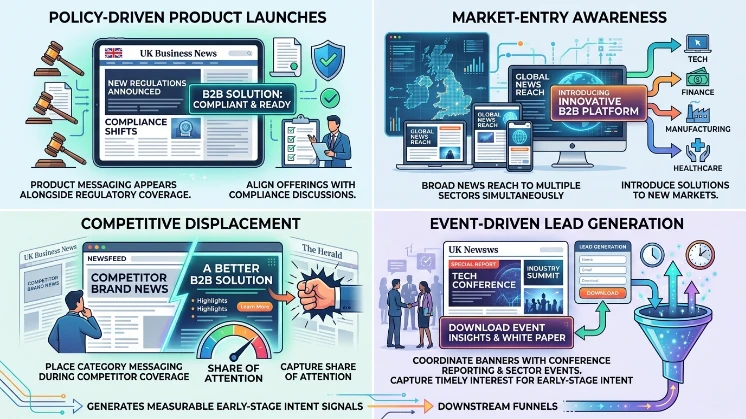
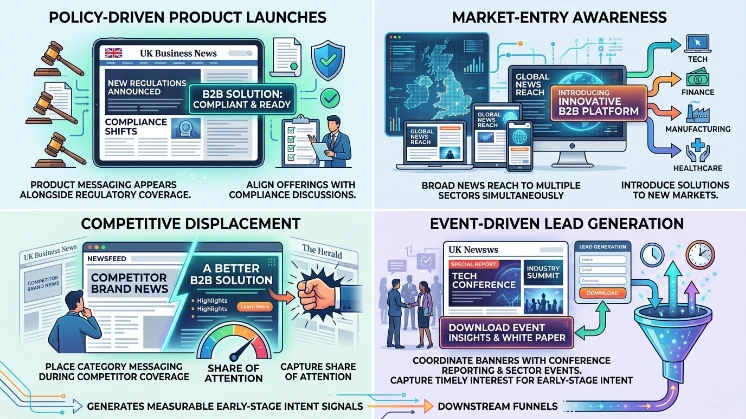
Use cases include policy-driven product launches, market-entry awareness, competitive displacement, and event-driven lead generation tied to topical reporting.
Policy-driven launches benefit when product messaging appears alongside regulatory coverage; this aligns offerings with compliance discussions. Market-entry awareness uses broad news reach to introduce solutions to multiple sectors simultaneously. Competitive displacement places category messaging during competitor coverage to capture share of attention. Event-driven lead generation coordinates banners with conference reporting or sector events to capture timely interest. Each use case leverages editorial relevance and format prominence to generate measurable early-stage intent signals that feed downstream funnels.
For More Information, Explore:
UK Banner Ad Formats Ranked by Engagement: Leaderboard, MPU, Half-Page and Skin
What are the limitations and recommended mitigations for news-site banner campaigns?
Limitations include potential audience dilution, viewability variance, and creative fatigue; mitigations include audience layering, format testing, and dynamic creative rotation.
Audience dilution arises when placements reach readers outside target segments; mitigate by layering publisher segments with contextual filters and geo-targeting. Viewability variance occurs across formats and pages; mitigate this by prioritising high-viewability placements and verifying via third-party tags. Creative fatigue reduces effectiveness over time; mitigate it by rotating creative sets every 7–10 days and aligning content to editorial cycles. Implement A/B tests for formats and creatives to isolate high-performing combinations. Use incremental lift testing to confirm that observed outcomes are attributable to the banner campaign.
For UK B2B advertisers, banner ads on news sites generate passive and active intent through contextual relevance, format prominence, and multi-session exposure. When measurement uses view-through metrics, uplift tests, and search-lift analysis, these campaigns produce validated intent signals that complement profile-based ad channels.
For More Details, Explore:
Banner Advertising Across 10 UK News Sites: Combined Reach and CPM Figures