The objective was to drive high-intent traffic to a UK tech brand’s product pages from premium news site banners. The six-week run delivered a 0.8% click-through rate (CTR), a 22% lower cost-per-click (CPC) versus site average, and measurable page conversions.
The campaign targeted active buyers in the United Kingdom using premium news inventory. The brand focused on awareness-to-action creative and tight audience segments. Performance tracking used server-side click tracking, viewability verification, and conversion events defined at product-page view and add-to-cart. Weekly optimisation cycles adjusted creative, audience, and bid strategy. Outcome metrics included a 0.8% CTR, 1.9% view-to-conversion rate, and a 22% reduction in CPC versus baseline. Attribution used a last-click + view-through window set to seven days for clarity on banner contribution.
What was the campaign structure and media plan?
The media plan purchased display placements on three UK national news sites, allocated 60% to scrumptious masthead and MPU placements and 40% to contextual pages, with a daily budget cadence and frequency cap of four impressions per user per week.
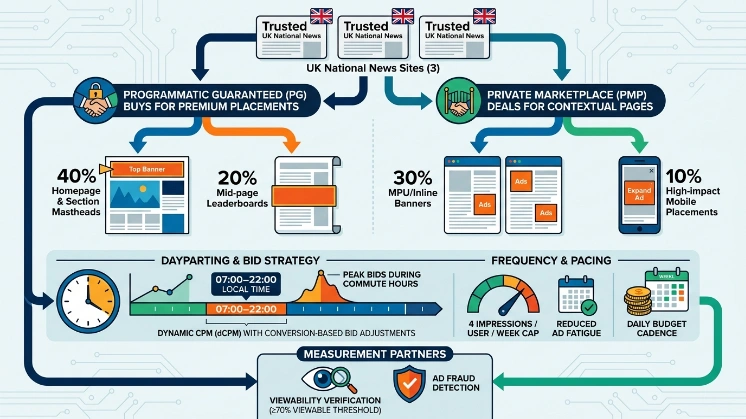
The campaign used programmatic guaranteed buys for premium placements and private marketplace (PMP) deals for contextual pages. Inventory split: 40% homepage and section mastheads, 20% mid-page leaderboards, 30% MPU/inline banners, 10% high-impact mobile placements. Frequency caps reduced ad fatigue. Dayparting prioritised 07:00–22:00 local time with peak bids during commute hours. Bid strategy used dynamic CPM with conversion-based bid adjustments. Measurement partners provided viewability (≥70% viewable threshold) and fraud detection. This structure prioritised high-quality impressions on trusted UK news publishers to maximise attention on creatives engineered for action.
How were audiences defined and targeted?
Audiences combined first-party website visitors, product-page engagers, and high-intent lookalikes with contextual signals from tech and finance news sections; targeting used deterministic site retargeting plus probabilistic lookalike scaling.
Audience segments included 1) site visitors in the previous 30 days who viewed product detail pages; 2) users who added to cart but did not convert in the last 14 days; 3) CRM-synced high-value customers; and 4) publisher-context lookalikes derived from engagement on tech and business articles. Deterministic retargeting used hashed CRM lists matched to supply-side platforms. Lookalike modeling used a 1–3% similarity band to balance reach and relevance. Contextual targeting prioritised article-level taxonomy tags such as “consumer electronics” and “software tools” to capture interest signals without relying solely on cookies. This mix focused impressions on users closest to purchase while preserving scale for discovery.
What creative strategy produced the 0.8% CTR?
Creatives used four tested variables: headline, value proposition, call-to-action, and visual treatment; the winning combination emphasised a specific product benefit, tight CTA, and a product image on a plain background.
Creative testing followed a factorial approach across four variables: headlines with explicit benefit statements, succinct value proposition lines with numerical claims, CTAs tied to intent (e.g., “View specs”), and visuals with product-only versus lifestyle imagery. Each creative adhered to publisher specs and accessibility contrast ratios. The final variant used a benefit-led headline, a one-line numeric claim (e.g., “Up to 48-hour battery”), a two-word CTA, and a product-centric visual with negative space. This variant achieved the 0.8% CTR and delivered higher downstream engagement on product pages.
How was creative testing implemented and measured?
The team ran A/B and multivariate tests across programmatic line items with 50:50 traffic splits, used incremental holdout groups, and measured uplift on CTR, CPC, view-through rate, and post-click conversion rate.
Testing used sequential phases. Phase 1 compared headline and visual variants to identify top-performing combos by CTR. Phase 2 introduced CTA and value-prop permutations and used multivariate allocation to estimate interaction effects. A 10% holdout group provided baseline metrics for incrementality. Statistical significance was calculated at 95% confidence before promoting winners. KPI hierarchy: CTR first, then cost efficiency (CPC), then quality of click (time on site, pages per session), and final conversion metrics (add-to-cart and purchases). This rigorous framework isolated creative impact while maintaining campaign delivery.
What measurement and attribution methods validated results?
The campaign used deterministic click tracking, server-to-server conversion pixels, viewability verification, and a seven-day last-click plus view-through attribution window to validate banner contribution to conversions.
Click validation included server-side logs and third-party verification for viewability above 70%. Conversion events were tracked at page load and successful checkout with server-to-server confirmation to prevent duplication. The seven-day attribution window captured short purchase cycles common in tech purchases. Incrementality testing with a 10% holdout confirmed measurable lift in product-page traffic and conversions attributable to banners. Fraud and bot traffic were filtered by a verification partner to ensure accurate CPC and conversion figures.
What optimisations reduced CPC by 22%?
Optimisation tactics included pausing low-performing creatives, shifting budget to top-performing placements, narrowing bid bands for high-intent segments, and applying daypart bid multipliers to concentrate impressions during peak engagement hours.
Weekly optimisations reallocated spend toward placements and creatives with higher CTR and conversion rates. The team lowered bids on underperforming sections and increased bids on high-performing contextual pages and mobile placements. Frequency caps prevented wasted impressions. Creative refreshes every two weeks maintained novelty and reduced banner blindness. Bid multipliers during 07:00–09:00 and 17:00–21:00 increased visibility when users engaged with news content, improving CTR and lowering average CPC by 22% relative to the campaign baseline.
What were the main technical components and vendors used?
The tech stack comprised a DSP with PMP capability, a data-management platform (DMP) for audience activation, server-to-server tracking, a viewability vendor, and a verification partner for fraud protection.
Key components included a programmatic DSP handling guaranteed and PMP deals, a DMP to unify CRM and site behavioral segments, server-side tag infrastructure for reliable conversion tracking, and an independent viewability/verification provider to ensure quality metrics. Integration used secure data transfers and hashed identifiers for CRM syncing. Reporting combined platform dashboards and daily CSV exports for detailed analysis. These technical elements ensured accurate measurement and operational resilience.
Explore More Expert Insights:
Direct Buy vs Programmatic: Why UK Brands Spending £5K+ Choose Direct Placements
Banner Advertising Across 10 UK News Sites: Combined Reach and CPM Figures
What are the benefits and business impact of this approach?
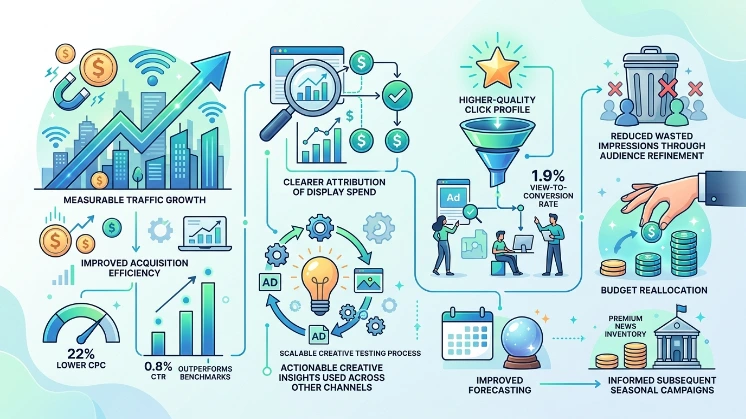
The approach delivered measurable traffic growth, improved acquisition efficiency, clearer attribution of display spend, and a scalable creative-testing process that supported repeatable CTR and conversion improvements.
Business benefits included a 0.8% CTR that outperformed similar category benchmarks on news sites, a 22% lower CPC, and a higher-quality click profile with a 1.9% view-to-conversion rate. The campaign generated actionable creative insights used across other channels, reduced wasted impressions through audience refinement, and improved forecasting for future display investments. These outcomes supported budget reallocation into premium news inventory and informed subsequent seasonal campaigns.
What are recommended use cases for this banner strategy?
Use this approach for product launches, mid-funnel purchase intent activation, re-engaging cart abandoners, and brand reinforcement on premium publisher environments where attention and trust drive high-quality clicks.
The strategy suits tech product releases that require quick awareness-to-action journeys. Use it for capturing audiences who read tech and business news, retargeting shoppers from product pages, and supporting CRM-driven promotions. The creative-testing framework scales to other categories with clear product benefits and measurable conversion events. For ongoing campaigns, maintain a cadence of creative refreshes and weekly optimisation to preserve performance.
Find Out More:
The UK Holds the World’s Highest E-commerce Retail Share: Why Display Advertising Wins
The six-week campaign on UK news sites achieved a 0.8% CTR through a structured media plan, deterministic audience targeting, and a four-variable creative-testing framework. Measurement relied on server-side tracking, viewability verification, and a 10% holdout for incrementality. The result: a 22% reduction in CPC and improved downstream conversions. For operators choosing premium news site display, replicate the stack: defined audience cohorts, factorial creative testing, weekly optimisation, and independent verification to ensure quality and attribution.
Get Detailed Information Here:
Creative Testing for UK News Site Banners: A 4-Variable Framework That Reduces CPC