
Generative AI drives changes in consumer search behavior and content creation, reducing the efficiency of traditional search ads and redirecting spend toward display inventory. Generative AI systems deliver direct answers, summaries, and content snippets inside search interfaces and apps. These outputs lower click-through rates for classic search listings. Advertisers find fewer measurable search-driven visits for the same spend. As a result, media planners reallocate budget to display formats that capture attention on publisher sites, apps, and programmatic exchanges. This reallocation targets audiences earlier in their decision journeys and preserves brand exposure when search intent signals weaken.
Generative AI changes how users obtain information. When users receive concise answers in a search result pane, they skip clicking through to multiple pages. That behavior reduces impressions and conversions tied to search ads. In addition, publishers and platforms integrate generative features that surface content within their ecosystems, keeping users in-platform and limiting referral traffic. The combined effect is fewer high-intent search clicks per advertising pound invested. Advertisers respond by testing display placements that deliver guaranteed visibility and context-aligned creative.
Generative AI alters discovery by synthesizing data from many sources into single-view outputs. Users accept synthesized insights without visiting source pages. This reduces traceable referral paths and complicates last-click attribution. Advertisers lose direct signals that attribute performance to search keywords. Measurement frameworks shift toward view-based and engagement-based metrics. That change favors display channels where viewability and attention metrics exist and can be linked to downstream conversions through multi-touch models.
How should UK advertisers evaluate display as a destination for redirected search budgets?
Evaluate display by comparing cost-per-thousand (CPM), viewability, attention metrics, and measurable downstream conversions against search CPC outcomes. Start with inventory quality and measurement parity. Inspect viewability rates, fraud mitigation, contextual relevance, and inventory transparency. Use standardised attention metrics like visible time and interaction rates. Compare CPMs for premium publisher placements versus programmatic open exchanges. Run holdout tests that shift modest portions of search budgets into display while maintaining a control group of search-only spend. Track downstream conversions, assisted conversions, and revenue per thousand impressions as evaluation signals.
Inventory attributes include viewability percentage, fraud rate, contextual targeting accuracy, and publisher reputation. High viewability ensures the creative is seen long enough to register. Low fraud rates reduce wasted spend. Contextual targeting matches creative to page themes, improving relevance. Publisher reputation affects brand safety and user trust. Prioritise inventory with verified supply path transparency and third-party measurement tags to maintain accountability.
Adopt multi-touch attribution and incrementality testing. Use randomised holdouts to measure causal lift from display placements. Collect conversion windows that align with typical purchase cycles—7, 14, and 30 days—and report assisted conversions from view-through and click-through events. Include cost-per-acquisition (CPA), return on ad spend (ROAS), and revenue per thousand impressions (RPM) in assessments. Maintain consistent measurement setups across channels to enable direct comparison.
What display formats and contexts best absorb redirected search budgets?
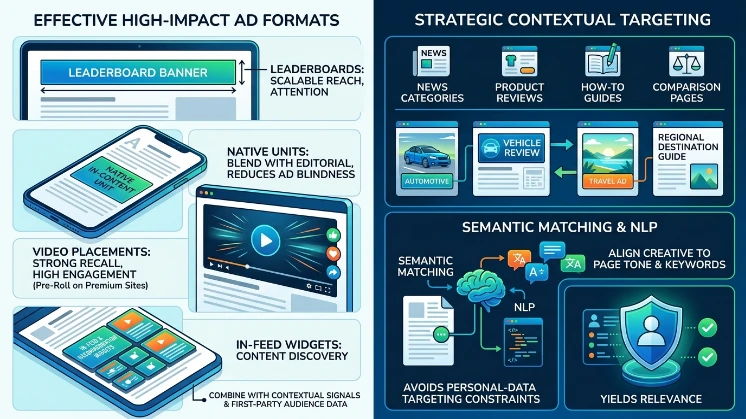
High-impact display formats leaderboards, native in-content units, and video placements on premium sites deliver scalable reach and measurable attention when paired with contextual targeting. Formats with large creative real estate and motion generally produce stronger recall and engagement. Native in-content units blend with editorial context and reduce ad blindness. In-feed and recommendation widgets perform well for content discovery. Video pre-roll on premium publisher sites captures attention in longer sessions. Combine these formats with contextual signals and first-party audience data to replicate the relevance historically provided by search intent.
Contextual strategies map content themes to likely interest signals. Use taxonomy-driven topics: news categories, product reviews, how-to guides, and comparison pages. For example, automotive campaigns place creative on vehicle review pages; travel offers appear on regional destination guides. Leverage semantic matching and natural language processing to align creative to page tone and keywords without relying on user search queries. This yields relevance while avoiding personal-data targeting constraints.
A creative must state value quickly and include a clear visual hierarchy: headline, supporting text, and a single visual cue. For video, use the first 3 seconds to present the offer or brand. For native units, match publisher font and tone to reduce friction. Test multiple creative messages at scale and rotate assets every 7–14 days to avoid audience fatigue. Track engagement metrics such as time-in-view and interaction rate to identify top-performing creative.
What audience targeting changes when search budgets move to display?
Audience targeting shifts from query-based intent to behavior, contextual cohorts, and first-party signals that indicate interest over time. Query intent gives precise demand signals; display relies on inferred interest and exposure patterns. Use first-party CRM data, email engagement, site visitors, and conversion segments to build audiences. Supplement with publisher-provided cohorts and contextual segments. Combine retargeting lists with lookalike modeling constrained to UK audience signals. Ensure all targeting complies with UK data protection and platform policies.
High-value first-party signals include recent site visitors, repeat purchasers (within 90 days), email openers, and product page viewers. Segment by recency and value: visitors in the last 7 days, purchasers in the last 30 days, and users who viewed high-intent pages. Use these segments to seed display prospecting and retargeting campaigns. Enrich segments with on-site behavior such as cart abandonment or content consumption depth.
Use a tiered approach, narrow retargeting pools for conversion-focused placements, broader contextual segments for awareness, and matched lookalikes for scale. Allocate spend: 20–30% to retargeting, 40–50% to contextual prospecting, and 20–40% to scaled publisher buys depending on campaign goals. Reassess allocations every 14 days based on lift tests and CPA movement.
Read the Full Blog Here:
How to Set Frequency Caps for UK Display Campaigns That Avoid Audience Fatigue
What measurement and privacy considerations apply in the UK?
Measurement must rely on cookieless strategies, server-side tagging, and privacy-compliant measurement frameworks while adhering to UK GDPR and ICO guidance. Browsers and platforms reduce third-party cookie availability. Implement server-to-server event tracking and first-party measurement endpoints. Use privacy-preserving aggregated measurement, cohort-based reporting, and probabilistic attribution where deterministic signals lack coverage. Maintain documentation of lawful bases for data processing and explicit consent records when required. Align measurement windows and attribution rules with campaign objectives and regulatory constraints.
Implement a first-party cookie framework for your domains, set up server-side tagging (cloud or on-prem), and use enhanced conversions with hashed first-party identifiers. Deploy consent management platforms that log user consents and provide consent signals to ad tech partners. Validate measurement pipelines using test events and compare with CRM backend conversions to quantify underreporting. Use incrementality testing to account for measurement gaps introduced by privacy changes.
Report on causal lift from randomised control tests, CPA and ROAS per channel, assisted conversion values, CPM and viewability trends, and incremental revenue attributed to display. Present results for 7-, 14-, and 30-day windows to capture short- and mid-term effects. Include an explanation of measurement limitations due to cookieless environments and the steps taken to mitigate them.
Explore More Expert Insights:
Why B2B Banner Ads on UK News Sites Outperform LinkedIn Sponsored Posts for Intent
How Entertainment Brands Grow Engagement Using Banner Advertising
What are the operational steps for UK advertisers moving search spend to display?
Plan a phased reallocation: audit current search performance, set KPIs for display, run controlled tests, and scale based on lift and CPA improvements. Begin with an audit of search keyword performance by CPA and conversion rate. Define display KPIs: viewable CPM, engagement rate, view-through CPA, and incremental revenue. Design randomised holdout tests that shift 10–25% of search budget into display for defined cohorts. Compare control and test groups over a 30-day period. If display provides equal or better incremental conversions at acceptable CPA, increase allocation in 10% steps and continue testing.
Define supply path transparency policies, standardise vendor measurement tags, and require fraud and viewability verification. Contractual SLAs should include reporting cadence and attribution windows. Maintain a central analytics view where channel-level data converges with CRM outcomes. Coordinate legal and privacy teams to validate consent and data processing.
What outcomes can UK advertisers expect when reallocating budgets?
Outcomes include broader reach, increased brand exposure, measurable assisted conversions, and new challenges in attribution that demand robust lift testing and first-party measurement. Display campaigns generate impressions at scale and capture early-stage interest. Expect higher CPMs on premium inventory but stronger attention metrics. Attribution will shift from last-click to multi-touch and incrementality metrics. Advertisers will find opportunities to convert users earlier in the funnel and to remarket with tighter creative. They will also need improved measurement systems and governance to verify spend efficacy.
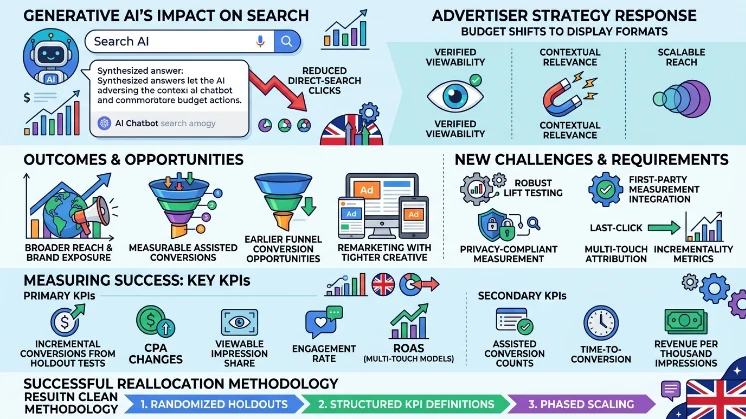
Primary KPIs are incremental conversions from holdout tests, CPA changes, viewable impression share, engagement rate, and ROAS calculated with multi-touch models. Secondary KPIs include assisted conversion counts, time-to-conversion, and revenue per thousand impressions.
Get Detailed Information Here:
Direct Buy vs Programmatic: Why UK Brands Spending £5K+ Choose Direct Placements