
Banner retargeting ads are display advertisements shown to users who previously interacted with a tech startup’s website, app, or product pages. They re-engage warm audiences by reminding them of earlier interest and guiding them back into the conversion pathway.
Banner retargeting ads operate on prior behavioral signals rather than cold audience targeting. A user visits a website, views a product page, or interacts with a feature. That interaction is recorded through tracking mechanisms such as cookies or event-based identifiers.
After the initial visit, banner ads appear across external websites and platforms where display networks operate. These ads maintain visual consistency with the startup’s product identity and focus on reinforcing prior interest rather than introducing new concepts.
Tech startups use banner retargeting to recover lost attention cycles. Users often leave before completing actions such as signup, demo requests, or trial activation. Retargeting banners reintroduce the same value proposition in a simplified visual format.
How SaaS Platforms Improve Lead Qualification Using Mid-Funnel Ads Readers understand how retargeting supports consideration and comparison of solutions.
How SaaS Platforms Turn Sales-Ready Leads Into Customers Using Final Stage Display Ads Readers evaluate how retargeting converts high-intent users into paying customers.
How do banner retargeting ads work across user journeys?
Banner retargeting ads work by tracking user interactions, categorizing engagement levels, and serving tailored display creatives across different digital environments to re-engage users at multiple decision stages of the conversion journey.
The process begins when a user interacts with a startup’s digital asset. This interaction generates behavioral data points such as page visits, click depth, and session duration. These signals define intent strength.
Once a user leaves the site, ad distribution systems match the user identifier with available display inventory. Banner ads are then served across websites, mobile apps, and content platforms.
Different stages of the user journey determine ad frequency and messaging intensity. Early-stage visitors receive general product reinforcement banners. Mid-stage users receive feature-focused messages. Late-stage users receive urgency-based reminders.
The system operates continuously. Each impression reinforces familiarity, which increases the probability of return visits. This repetition effect is critical in reducing decision hesitation in tech adoption environments.
Startups structure retargeting journeys in sequential exposure loops. The goal is not immediate conversion but progressive re-engagement across multiple touchpoints until the user returns to complete an action.
What data powers banner retargeting ad targeting?
Banner retargeting ad targeting relies on behavioral, contextual, and engagement data, including page visits, click patterns, session duration, device type, and user intent signals collected during interactions with digital product environments.
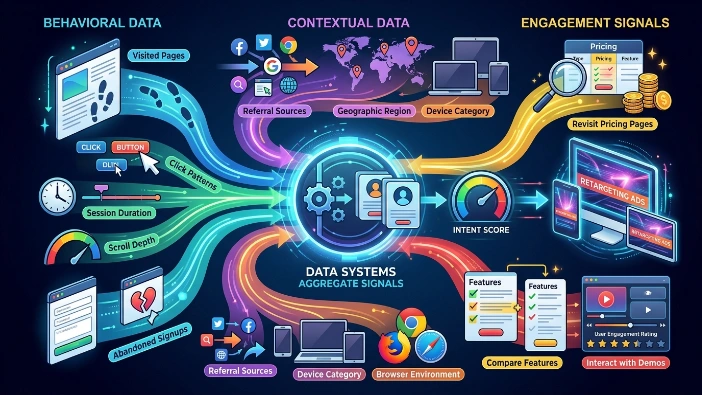
Behavioral data captures what users do on a platform. This includes visited pages, scroll depth, time spent on specific features, and abandoned actions such as incomplete signups or unfinished onboarding flows.
Contextual data defines where and how the user interacted. It includes referral sources, geographic region, device category, and browser environment. These attributes help classify audience segments more precisely.
Engagement signals measure intensity of interaction. High-intent users often revisit pricing pages, compare features, or interact with product demos. These actions indicate stronger conversion probability.
Data systems aggregate these signals into user profiles. Each profile is assigned an intent score that determines retargeting priority and ad frequency.
This structured data flow ensures that banner retargeting is not random exposure but behavior-driven delivery. It increases relevance and reduces wasted impressions across low-intent audiences.
Why do banner retargeting ads increase conversion rates?
Banner retargeting ads increase conversion rates by reinforcing memory recall, reducing decision friction, and re-engaging users who already demonstrated interest, which shortens the time between initial exposure and final action completion.
Conversion rates improve because retargeting focuses only on users with prior engagement history. These users already understand the product category and require fewer informational steps to convert.
Repeated exposure strengthens recall. Users often need multiple touchpoints before making decisions in complex digital products. Banner ads maintain consistent visibility across browsing sessions.
Retargeting reduces abandonment impact. Many users leave due to distraction, timing, or comparison behavior rather than lack of interest. Banner ads reintroduce the product when users resume browsing activity.
Conversion efficiency increases because ad spend is concentrated on warmer audiences. This reduces acquisition cost per conversion compared to broad targeting methods.
The structured repetition effect increases return visits. Each visit increases familiarity, which directly correlates with higher signup and purchase completion rates in digital product environments.
What role does segmentation play in retargeting banners?
Segmentation defines how audiences are grouped based on behavior, intent level, and interaction depth, enabling banner retargeting ads to deliver context-specific messaging aligned with user readiness to convert.
Segmentation divides users into structured categories. These categories include first-time visitors, feature explorers, pricing page viewers, and abandoned signups.
Each segment receives different ad messaging logic. First-time visitors see introductory reinforcement banners. Feature explorers see functional benefit-focused banners. Pricing viewers see value comparison reminders.
Segmentation increases relevance. Without segmentation, all users receive identical messaging regardless of intent level, which reduces engagement efficiency and increases ad fatigue.
Tech startups use segmentation to prioritize budget allocation. High-intent segments receive higher frequency exposure because they are closer to conversion decisions.
Segmentation also enables sequential messaging. Users progress from awareness reinforcement to decision reinforcement through controlled exposure stages, improving conversion probability across the funnel.
Explore More Expert Insights:
How SaaS Brands Scale Growth Using Programmatic Banner Ads
How Software Companies Boost Lead Generation Using Banner Ads
How do startups measure performance of banner retargeting ads?
Startups measure banner retargeting performance using metrics such as click-through rate, return visit rate, conversion rate, cost per acquisition, and assisted conversions to evaluate effectiveness across engagement and revenue outcomes.
Click-through rate measures how many users interact with retargeting banners after exposure. Higher rates indicate strong message relevance and visual alignment.
Return visit rate tracks how often users come back after seeing retargeting ads. This metric reflects recall effectiveness and re-engagement strength.
Conversion rate measures completed actions such as signups, downloads, or purchases after retargeting exposure. It represents final outcome efficiency.
Cost per acquisition evaluates financial efficiency. It compares total ad spend against the number of converted users acquired through retargeting campaigns.
Assisted conversions measure indirect impact. Users may convert after multiple exposures, where retargeting contributes to decision reinforcement rather than direct final click attribution.
These metrics together provide a structured evaluation framework for optimising banner retargeting performance in tech startup environments.
What use cases show banner retargeting effectiveness in tech startups?
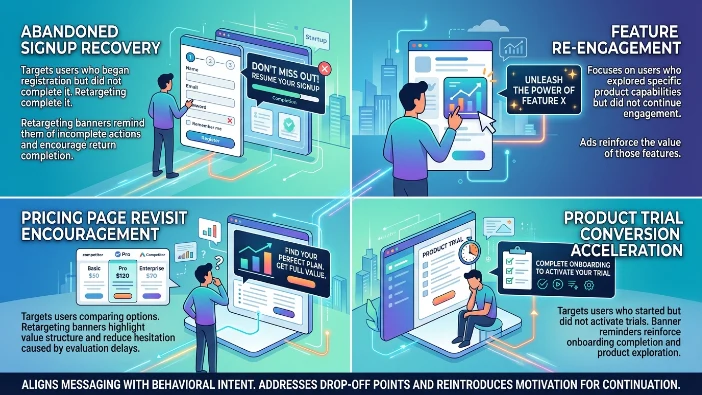
Banner retargeting effectiveness appears in use cases such as abandoned signup recovery, feature re-engagement, pricing page revisit encouragement, and product trial conversion acceleration within tech startup ecosystems.
Abandoned signup recovery targets users who began registration but did not complete it. Retargeting banners remind them of incomplete actions and encourage return completion.
Feature re-engagement focuses on users who explored specific product capabilities but did not continue engagement. Ads reinforce the value of those features.
Pricing page revisit encouragement targets users comparing options. Retargeting banners highlight value structure and reduce hesitation caused by evaluation delays.
Product trial conversion acceleration targets users who started but did not activate trials. Banner reminders reinforce onboarding completion and product exploration.
These use cases demonstrate how retargeting aligns messaging with behavioral intent. Each scenario addresses a specific drop-off point in the user journey and reintroduces motivation for continuation.
Banner retargeting effectiveness increases when use cases are matched precisely with user behavior stages. This alignment ensures higher conversion efficiency and reduced acquisition loss across digital funnels.