
Mid-funnel ads in SaaS lead qualification are targeted digital advertisements shown to users who already know a product category and have interacted with initial marketing touchpoints. These ads focus on refining interest, filtering intent strength, and guiding prospects toward evaluation-ready decisions.
Mid-funnel ads operate between awareness and conversion stages. They do not introduce the product from scratch. They also do not push final purchase decisions. Instead, they focus on users who have already visited websites, engaged with content, or interacted with top-funnel campaigns.
In SaaS environments, lead qualification requires separating casual interest from serious evaluation behavior. Mid-funnel ads perform this function by delivering structured messaging that reflects product capability, use case relevance, and problem-solution alignment.
These ads appear across display networks, social placements, and retargeting environments. They reinforce prior engagement and guide users toward deeper consideration activities such as demo exploration or feature comparison.
Mid-funnel advertising improves clarity in the buying journey. It reduces noise by focusing only on users who demonstrate measurable intent signals, such as repeat visits or content downloads.
How do mid-funnel ads improve lead qualification in SaaS platforms?
Mid-funnel ads improve SaaS lead qualification by identifying engaged users, reinforcing product relevance, and filtering high-intent prospects through structured engagement signals that distinguish evaluators from early-stage browsers.
The qualification process begins with behavioral tracking. SaaS platforms capture actions such as pricing page visits, product feature exploration, and repeated session activity. These signals indicate evolving intent strength.
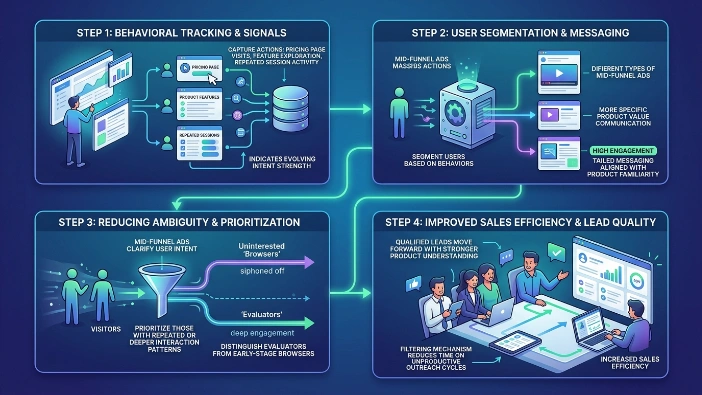
Mid-funnel ads then segment users based on these behaviors. Each segment receives tailored messaging aligned with their level of product familiarity. Users with higher engagement receive more specific product value communication.
Lead qualification improves because mid-funnel ads reduce ambiguity in user intent. Instead of treating all visitors equally, the system prioritizes those who demonstrate repeated or deeper interaction patterns.
This filtering mechanism improves sales efficiency. Qualified leads move forward with stronger product understanding, reducing time spent on unproductive outreach cycles.
In SaaS ecosystems, this structured qualification approach increases pipeline accuracy. Marketing teams deliver more refined leads to sales teams, improving conversion probability downstream.
What data is used in mid-funnel ad targeting for SaaS leads?
Mid-funnel ad targeting in SaaS uses behavioral data, engagement metrics, and contextual interaction signals such as page visits, feature clicks, session duration, and content downloads to identify and classify qualified leads accurately.
Behavioral data captures direct user actions. These include repeated visits to product pages, interaction with feature descriptions, and navigation across solution-specific sections. Each action contributes to intent scoring.
Engagement metrics measure depth of interaction. Longer session durations and multi-page exploration indicate stronger interest. SaaS platforms use these signals to prioritize retargeting exposure.
Contextual signals define the environment of interaction. Device type, referral source, and geographic location help refine segmentation models. These factors improve targeting precision across mid-funnel campaigns.
Lead qualification models combine these datasets into structured scoring systems. Each user is assigned an intent level that determines ad messaging depth and frequency.
This data-driven structure ensures mid-funnel ads focus on users with verified interest patterns rather than broad or unqualified audiences.
Why do SaaS platforms rely on mid-funnel ads for lead qualification?
SaaS platforms rely on mid-funnel ads for lead qualification because they bridge the gap between initial awareness and purchase readiness, ensuring only engaged, informed, and high-intent users progress further in the conversion journey.
Awareness-stage traffic often includes mixed intent levels. Some users are researching general concepts while others actively compare solutions. Mid-funnel ads separate these groups based on interaction history.
These ads reinforce product relevance. Users who previously explored SaaS features receive structured reminders that align with their specific interests and use cases.
Lead qualification improves because mid-funnel ads reduce dependency on manual filtering. Marketing systems automatically refine audiences based on engagement thresholds.
This automation improves efficiency in sales pipelines. Sales teams receive leads with higher contextual understanding of the product category and its value proposition.
Explore:
How Tech Startups Increase Conversions Using Banner Retargeting Ads
Mid-funnel advertising also reduces wasted conversion effort. Users who are not ready for evaluation naturally drop off, while qualified users continue progressing through the funnel.
What are the key components of mid-funnel SaaS ad strategies?
Mid-funnel SaaS ad strategies consist of audience segmentation, intent scoring, message personalization, and behavioral retargeting systems that collectively refine lead quality and guide users toward evaluation readiness.
Audience segmentation divides users based on interaction depth. Segments include first-time visitors, repeat explorers, and high-engagement users interacting with pricing or feature pages.
Intent scoring assigns numerical values to user behavior. Higher scores represent stronger conversion readiness. This scoring system determines ad frequency and message complexity.
Message personalization aligns ad content with user behavior. Users exploring automation features receive messaging focused on workflow efficiency, while integration-focused users receive compatibility-related content.
Behavioral retargeting ensures ads appear after relevant interactions. This timing increases relevance and improves engagement probability.
These components work together to create structured qualification pipelines. Each element contributes to refining user intent clarity before reaching final decision stages.
How do mid-funnel ads support SaaS buyer journey progression?
Mid-funnel ads support SaaS buyer journey progression by reinforcing product understanding, addressing consideration-stage questions, and guiding users from general interest toward structured evaluation behavior.
The buyer journey in SaaS environments involves multiple decision layers. Users first identify problems, then explore potential solutions, and finally evaluate specific products.
Mid-funnel ads operate in the evaluation phase. They provide structured reinforcement of product capabilities and use-case relevance without introducing new concepts.
These ads reduce uncertainty by presenting consistent messaging across multiple touchpoints. Users repeatedly encounter the same value signals, which improves familiarity.
Progression occurs through repeated exposure. Each interaction strengthens understanding of product relevance to specific business needs.
Read:
How SaaS Platforms Turn Sales-Ready Leads Into Customers Using Final Stage Display Ads
Mid-funnel ads ensure users move from passive interest to active evaluation. This transition improves lead quality and increases conversion readiness.
What use cases demonstrate mid-funnel ad effectiveness in SaaS platforms?
Mid-funnel ad effectiveness in SaaS platforms appears in use cases such as feature comparison engagement, abandoned pricing page recovery, content download follow-ups, and demo interest reinforcement campaigns targeting evaluation-ready users.
Feature comparison engagement targets users who explore multiple product capabilities. Ads reinforce selected features and highlight relevance to specific workflows.
Abandoned pricing page recovery focuses on users who viewed pricing structures but did not proceed. Mid-funnel ads reintroduce value context and reduce hesitation signals.
Content download follow-ups target users who accessed whitepapers or guides. Ads reinforce the same topic area and guide users toward product evaluation.
Demo interest reinforcement campaigns target users who visited demo pages but did not complete booking actions. Ads maintain engagement momentum.
These use cases demonstrate structured qualification refinement. Each scenario targets a specific behavioral trigger that indicates partial but incomplete intent progression.
Explore More Expert Insights:
How Software Brands Build Trust Using Case Study Banner Campaigns
How SaaS Companies Increase Feature Adoption Using Banner Advertising Funnels
How is mid-funnel ad performance measured in SaaS lead qualification?
Mid-funnel ad performance in SaaS lead qualification is measured using metrics such as engagement rate, qualified lead rate, conversion progression rate, cost per qualified lead, and assisted conversion contribution across multi-touch attribution models.
Engagement rate measures interaction with ads after exposure. Higher engagement indicates stronger message alignment with user intent.
Qualified lead rate tracks how many users move from mid-funnel engagement to evaluation-ready status. This metric defines lead quality improvement.
Conversion progression rate measures movement across funnel stages. It tracks how many users advance from mid-funnel to final decision phases.
Cost per qualified lead evaluates financial efficiency. It compares ad spend against the number of leads that meet qualification thresholds.
Assisted conversion contribution measures indirect influence. Mid-funnel ads often support conversions that occur after multiple touchpoints.
These metrics create a structured evaluation system. SaaS platforms use them to optimize targeting precision and improve pipeline quality.
What is the overall role of mid-funnel ads in SaaS growth strategy?
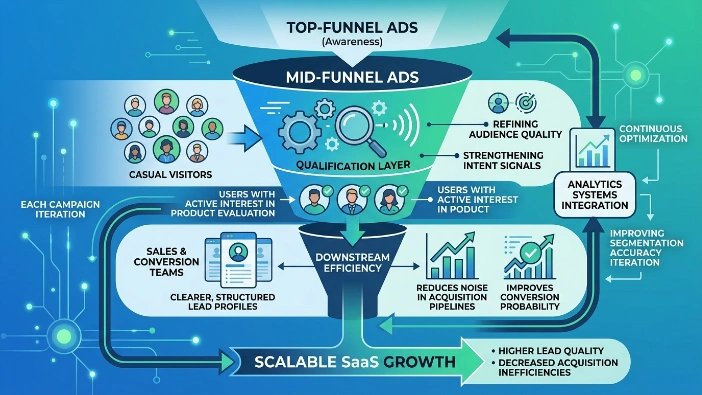
Mid-funnel ads play a central role in SaaS growth strategy by refining audience quality, strengthening intent signals, and ensuring only evaluation-ready users progress toward final conversion stages within structured marketing funnels.
Mid-funnel ads function as a qualification layer. They separate casual visitors from users with active interest in product evaluation.
This refinement improves downstream efficiency. Sales and conversion teams operate with clearer, more structured lead profiles.
The system reduces noise in acquisition pipelines. Only users with validated engagement patterns move forward, improving conversion probability.
SaaS platforms integrate mid-funnel ads with analytics systems to maintain continuous optimization. Each campaign iteration improves segmentation accuracy.
This structured approach ensures scalable growth. Lead quality increases while acquisition inefficiencies decrease across digital marketing operations.