
Trust-based banner ads are BOFU digital display formats that convert case study readers into paying customers by reinforcing verified outcomes, re-targeted proof signals, and decision-stage messaging that removes purchase uncertainty using measurable performance evidence from prior user success data.
These banner ads operate at the bottom of the funnel where users already consumed case studies and now evaluate final purchase decisions. The format focuses on reinforcement rather than discovery. It repeats validated outcomes in short, structured messages such as percentage improvements, cost reductions, or efficiency gains.
Trust-based banner ads differ from awareness ads because they do not introduce new information. They consolidate existing proof. The message structure relies on prior engagement with case studies and transforms passive interest into active buying intent.
A structured funnel interpretation applies across stages:
How SaaS Brands Scale Growth Using Programmatic Banner Ads
TOFU guides learning and awareness, MOFU builds evaluation through verified case evidence, BOFU converts validated interest into purchase readiness through trust reinforcement and decision clarity.
How do trust-based banner ads convert case study readers into customers?
Trust-based banner ads convert case study readers into customers by reinforcing previously consumed proof, triggering decision-stage recall, and presenting consistent outcome validation across multiple ad impressions that reduce hesitation and accelerate purchase completion.
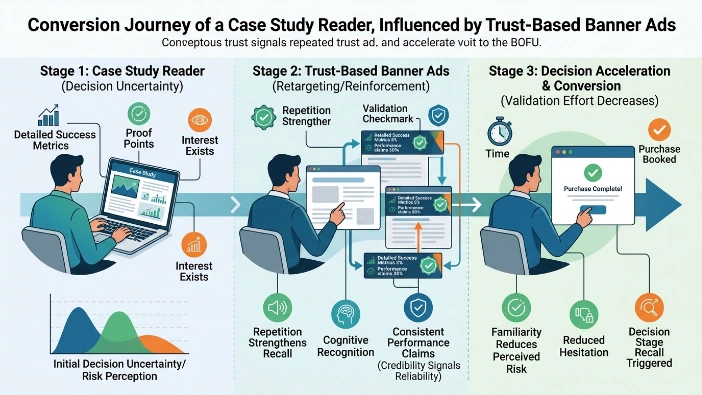
The conversion process begins after a user reads a detailed case study. At this point, interest exists but decision uncertainty remains. Banner ads reappear with condensed versions of the same success metrics.
This repetition strengthens cognitive recall. Users recognize the outcome they previously evaluated. Familiarity reduces perceived risk.
The second mechanism is consistency reinforcement. When users repeatedly see identical performance claims across different placements, credibility increases. Consistency signals reliability.
The third mechanism is decision acceleration. Users exposed to repeated trust signals move from consideration to action faster because validation effort decreases.
This process aligns with BOFU behavior patterns where users finalize choices based on proof repetition and outcome certainty rather than new discovery.
What components make trust-based banner ads effective in BOFU conversion?
Effective trust-based banner ads contain four components: quantified performance metrics, case study reference alignment, decision-focused messaging, and visual hierarchy designed for rapid comprehension within three seconds of user attention exposure.
Quantified performance metrics form the foundation. These include numerical improvements such as “38% reduction in onboarding time” or “52% faster reporting cycles.” Numbers replace descriptive claims.
Case study reference alignment connects the banner to previously viewed content. This ensures continuity between long-form case studies and condensed banner messaging.
Decision-focused messaging removes ambiguity. It avoids general descriptions and focuses on outcomes relevant to final purchase decisions such as cost savings or operational efficiency.
Visual hierarchy prioritizes the key metric first. Supporting context appears in secondary text. This structure ensures immediate understanding in high-scroll environments.
These components work together to maintain clarity, relevance, and trust consistency across multiple digital touchpoints.
How does retargeting support trust-based banner ad conversions?
Retargeting supports trust-based banner ad conversions by identifying users who previously engaged with case studies and repeatedly exposing them to outcome-based messaging that reinforces credibility and reduces decision friction across multiple digital sessions.
Retargeting begins with behavioral tracking. Users who read case studies are tagged based on engagement signals such as time spent, scroll depth, and page completion.
These users enter segmented audiences. Each segment receives banner ads aligned with the specific case study content they consumed.
The repeated exposure creates reinforcement loops. Users see identical or closely related success metrics across different platforms and publishers.
Frequency control ensures exposure remains consistent. Typical BOFU campaigns use 5 to 12 impressions per user across a 7 to 14 day period.
This structured repetition increases conversion probability by maintaining top-of-mind awareness during the final decision phase.
What metrics measure performance of trust-based banner conversion campaigns?
Performance of trust-based banner conversion campaigns is measured using click-through rate, conversion rate, assisted conversions, return on ad spend, and view-through attribution that tracks influence on final purchase decisions across multi-session buyer journeys.
Click-through rate measures immediate engagement. Higher CTR indicates strong message relevance and clarity of outcome communication.
Conversion rate tracks completed actions such as demo bookings, subscription purchases, or trial activations after exposure to banner ads.
Assisted conversions capture users who interact with banners but convert later through other channels. This reflects indirect influence.
Return on ad spend evaluates financial efficiency. It compares campaign cost with revenue generated from converted users.
View-through attribution measures conversions from users who did not click but were exposed to banner messaging. This metric captures passive influence on decision-making.
These metrics collectively measure both direct and indirect conversion impact within BOFU campaigns.
How do software brands structure BOFU banner messaging for maximum conversion impact?
Software brands structure BOFU banner messaging by condensing full case study outcomes into single-sentence performance statements that highlight measurable impact, industry relevance, and decision-ready value propositions within extremely limited visual space.
The messaging structure begins with a quantified result. This includes precise performance improvements such as percentage gains or time reductions.
The second element includes contextual relevance. This identifies the business function or industry impacted, such as finance operations, customer onboarding, or data analytics workflows.
The third element reinforces decision readiness. It highlights the operational benefit that directly influences purchasing decisions.
Example structure includes statements such as “Reduced enterprise reporting time by 47% across financial teams.” This compresses full case study value into a single actionable insight.
This format ensures rapid comprehension and supports decision acceleration in BOFU environments.
What role does audience segmentation play in trust-based banner conversions?
Audience segmentation ensures trust-based banner ads reach users based on behavior, intent level, and case study engagement history, enabling precise delivery of outcome-based messaging aligned with their evaluation stage and purchase readiness level.
Behavioral segmentation identifies users who previously interacted with case studies, pricing pages, or product comparison content.
Intent segmentation classifies users based on search and browsing signals. High-intent users receive BOFU-focused banners with strong outcome reinforcement.
Industry segmentation aligns case study content with user sectors. A logistics-related case study is delivered to supply chain professionals, while finance automation content targets financial decision-makers.
Engagement depth segmentation distinguishes between partial readers and full case study readers. Full readers receive stronger conversion-focused messaging.
This structured segmentation ensures relevance and increases conversion efficiency across display networks.
Explore More Expert Insights:
How SaaS Companies Increase Paid Conversions Using High-Intent Feature Retargeting Ads
How Tech Startups Turn Solution Seekers Into Qualified Leads Using Conversion Banner Ads
How can software brands optimise trust-based banner campaigns for higher conversion rates?
Software brands optimize trust-based banner campaigns by refining message clarity, increasing outcome specificity, improving audience targeting precision, and maintaining consistent case study-to-banner alignment across all BOFU retargeting placements and conversion tracking systems.
Message clarity improves when only one performance metric is displayed per banner. This reduces cognitive load and increases comprehension speed.
Outcome specificity increases trust. Generic claims are replaced with precise numerical results tied to documented case studies.
Targeting precision improves when audience segments are refined based on actual case study engagement behavior rather than broad demographic filters.
Consistency alignment ensures that banner messages match the exact outcomes described in case studies. Misalignment reduces credibility and lowers conversion rates.
Optimization also includes frequency balancing. Exposure levels between 5 and 12 impressions per user maintain engagement without saturation.
Explore:
How Software Brands Build Trust Using Case Study Banner Campaigns
BOFU campaigns function as the final conversion layer where validated interest becomes purchase action through structured trust reinforcement and repeated outcome exposure.
How do trust-based banner ads complete the conversion journey from case study reader to customer?
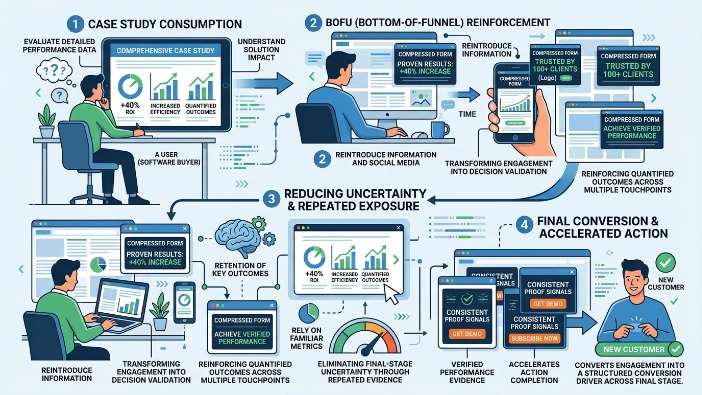
Trust-based banner ads complete the conversion journey by transforming case study engagement into decision validation, reinforcing quantified outcomes across multiple touchpoints, and eliminating final-stage uncertainty through repeated exposure to verified performance evidence.
The journey begins with case study consumption. Users evaluate detailed performance data and understand solution impact.
BOFU banner ads reintroduce this information in compressed form. This ensures retention of key outcomes during decision-making.
Repeated exposure reduces uncertainty. Users rely on familiar metrics instead of re-evaluating alternatives.
Final conversion occurs when users encounter consistent proof signals across multiple BOFU banners. This consistency removes hesitation and accelerates action completion.
This system ensures that case study content does not remain informational but becomes a structured conversion driver across the final stage of the software buyer journey.