Banner ads in software lead generation are graphical digital advertisements placed on websites, apps, and networks to attract potential users. Software companies use them to increase visibility, capture attention, and direct early-stage audiences toward product interest and lead capture systems.
Banner ads are visual marketing units displayed across digital inventory such as news websites, blogs, and industry platforms. These ads contain structured messaging, imagery, and call-to-action elements designed to introduce software products to new audiences. In lead generation systems, banner ads function at the awareness stage where users first encounter a software solution.
Software companies use banner ads to establish top-of-funnel visibility in competitive markets like the United Kingdom. These ads appear to users based on contextual relevance, browsing behavior, and demographic signals. The objective is to create initial engagement rather than immediate purchase intent. Banner ads form the first structured interaction between a potential user and a software solution.
How do banner ads generate leads for software companies?
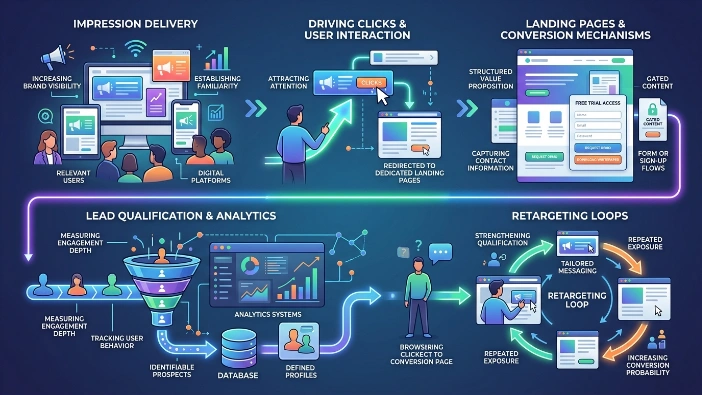
Banner ads generate leads by attracting user attention, driving clicks to landing pages, and capturing contact information through forms or sign-up flows. Software companies convert initial impressions into identifiable prospects using structured funnel pathways and optimized conversion points.
The lead generation process starts with impression delivery, where banner ads are shown to relevant users across digital platforms. Each impression increases brand visibility and establishes familiarity. When users interact with the banner, they are redirected to dedicated landing pages that explain software value in a structured format.
These landing pages contain conversion mechanisms such as registration forms, trial access options, or gated content. Software companies track user behavior from click to conversion using analytics systems that measure engagement depth. This process transforms anonymous traffic into qualified leads.
Banner ads also support retargeting loops. Users who interact but do not convert are re-exposed to tailored messaging. This repeated exposure increases conversion probability and strengthens lead qualification within the funnel system.
What targeting methods increase banner ad lead quality?
Targeting methods increase banner ad lead quality by identifying relevant audiences based on behavior, industry signals, location, and intent data. Software companies use segmentation techniques to ensure ads reach users with higher probability of engagement and conversion readiness.
Behavioral targeting identifies users based on previous browsing activity related to software categories. Contextual targeting places ads on pages that match software-related content themes. Demographic targeting focuses on professional roles, industries, and company sizes relevant to software use cases.
Geographic targeting plays a significant role in regions like the United Kingdom where regulatory environments and business structures influence software adoption patterns. Audience segmentation refines ad delivery to users who match ideal customer profiles.
Intent-based targeting increases lead quality by analyzing search behavior and content consumption patterns. Users who show repeated interest in software-related topics receive higher exposure frequency. This structured targeting system reduces wasted impressions and increases qualified lead acquisition efficiency.
What role does audience intent play in banner ad performance?
Audience intent determines banner ad performance by defining how ready a user is to engage with software solutions. Higher intent users respond more frequently to banner ads, resulting in stronger click-through rates and improved lead conversion efficiency.
Intent is categorized into awareness, consideration, and decision stages. At the awareness stage, users consume general information about software categories. Banner ads introduce solutions without requiring immediate action. At the consideration stage, users evaluate different tools and compare features.
At the decision stage, users demonstrate clear interest in selecting a solution. Banner ads targeting this group focus on specific value propositions and direct conversion pathways. Intent signals are derived from browsing history, keyword behavior, and content interaction depth.
Software companies align banner ad messaging with intent levels to maximize relevance. Misaligned messaging reduces engagement, while intent-matched ads increase click probability. This alignment strengthens the overall lead generation pipeline by ensuring consistent progression through funnel stages.
Which banner ad formats improve engagement for software leads?
Banner ad formats improve engagement when they combine visual clarity, responsive design, and structured messaging. Software companies use static banners, animated banners, and responsive display units to maximize visibility and interaction across devices.
Static banners deliver consistent messaging with minimal load time, making them effective for broad awareness campaigns. Animated banners increase attention by presenting sequential information such as features or benefits in motion format. Responsive banners adjust layout based on device type, ensuring accessibility across desktop and mobile users.
Interactive banner formats allow users to engage with elements directly within the ad unit. These formats increase dwell time and improve recall rates. Software companies prioritize clarity in messaging structure, ensuring that each banner communicates a single value proposition.
Engagement increases when banner ads align with user context and platform placement. High-performing formats reduce cognitive load and deliver direct value propositions that support early-stage lead generation objectives.
How is a banner ad funnel structured for lead generation?
A banner ad funnel is structured in sequential stages that guide users from awareness to lead capture through repeated exposure, engagement triggers, and conversion pathways designed for software lead generation systems.
The funnel begins with top-level exposure where banner ads generate awareness across broad audiences. At this stage, messaging focuses on introducing software categories and general value. Users who interact move into the engagement stage where more detailed information is presented.
The middle stage of the funnel focuses on user evaluation. Banner ads at this level highlight specific features, use cases, and benefits. Landing pages provide structured explanations that support decision-making.
The final stage captures leads through conversion mechanisms such as sign-ups, registrations, or content access forms. Retargeting ensures that users who do not convert initially are re-engaged with refined messaging. This structured funnel ensures continuous movement from awareness to qualified lead generation.
Read:
How SaaS Companies Increase Paid Conversions Using High-Intent Feature Retargeting Ads
Explore More Expert Insights:
How SaaS Companies Drive User Acquisition with Display Advertising
How SaaS Businesses Retarget Website Visitors Using Banner Ads
What metrics measure banner ad lead generation success?
Banner ad lead generation success is measured using impression volume, click-through rate, conversion rate, cost per lead, and engagement depth. These metrics evaluate performance across awareness, interaction, and conversion stages in software marketing systems.
Impression volume measures how often banner ads are displayed to target audiences. Click-through rate indicates how effectively ads generate user interest. Conversion rate tracks how many users complete lead capture actions after clicking.
Cost per lead evaluates the financial efficiency of acquiring a qualified prospect. Engagement depth measures how long users interact with landing pages after clicking banner ads. Software companies use these metrics collectively to assess funnel performance.
High-performing campaigns show balanced improvement across all metrics rather than isolated gains. Consistent tracking ensures optimization of targeting, messaging, and placement strategies. These measurements form the foundation of data-driven lead generation systems in software marketing.
Explore:
How Software Companies Boost Lead Generation Using Banner Ads
Why do software companies use banner ads for awareness?
Software companies use banner ads for awareness because they provide scalable visibility, precise targeting, and structured introduction of solutions to new audiences across digital platforms without requiring immediate user commitment.
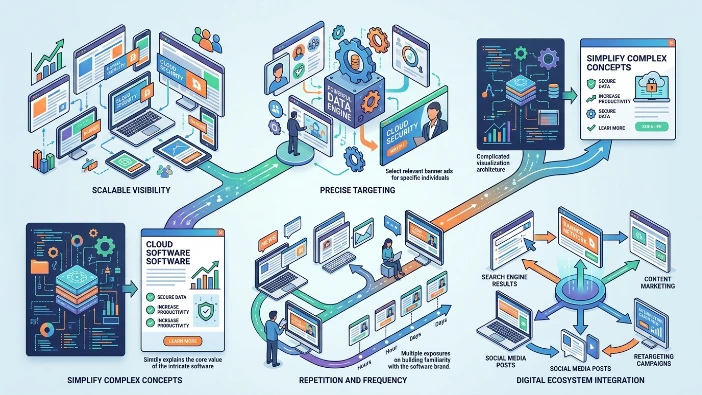
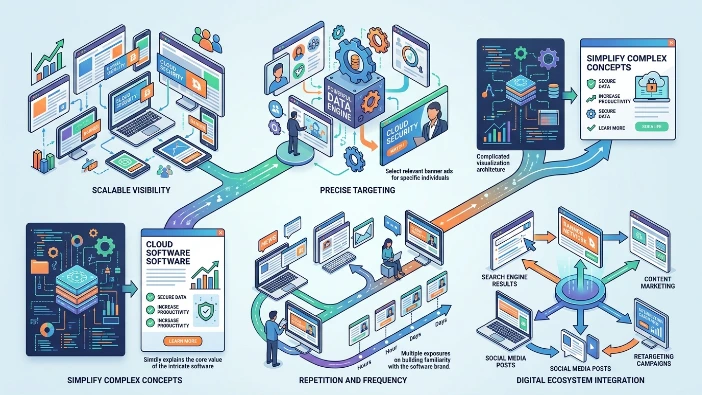
Banner ads enable software companies to reach large audiences across multiple digital environments. This scale supports early-stage awareness building in competitive software markets. The visual format allows complex software concepts to be simplified into structured messaging.
Awareness campaigns rely on repetition and exposure frequency. Banner ads deliver consistent visibility across user journeys, reinforcing recognition of software categories and solutions. This repetition increases familiarity and prepares users for deeper engagement.
Software companies also use banner ads because they integrate with broader digital ecosystems such as search, content marketing, and retargeting systems. This integration strengthens multi-channel lead generation strategies and ensures consistent user progression through awareness stages.
Banner ads remain essential for initiating structured lead generation pipelines in software marketing environments.