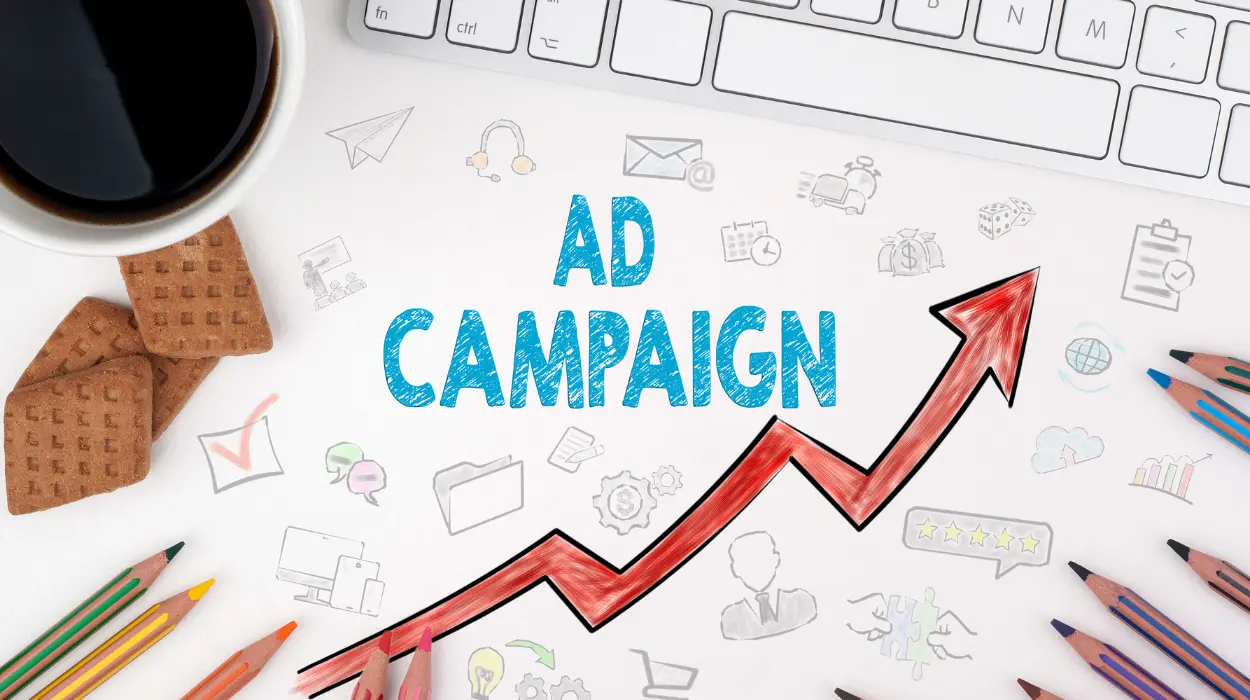
Banner ad campaigns are digital advertisements displayed on websites and apps that promote restaurant offerings, menus, or promotions to drive awareness and clicks. Banner ads include image, animated, and HTML5 formats. They target users by geography, demographics, interests, and browsing behaviour. Common placements include food blogs, local news sites, delivery apps, and programmatic display networks.
Banner ads are static images, animated GIFs, or interactive HTML5 creatives. Sizes follow standards such as 300×250, 728×90, 160×600, and 320×50. Rich media banners add video or expandable elements. Each format requires defined file size limits, commonly 150 KB for standard display.
Targeting uses cookies, mobile identifiers, and contextual signals. Geographic targeting restricts delivery to defined postcodes or cities. Demographic targeting filters by age and gender where data exists. Contextual targeting places ads on pages discussing food, restaurants, or local events. Frequency caps limit impressions per user, typically 3–10 daily.
How do banner ad campaigns increase restaurant orders?
Banner ads increase orders by raising awareness, directing users to menu pages, and retargeting visitors who previously viewed menus or items. Campaigns create touchpoints that convert passive visitors into clicking users. They move users from discovery to action through sequential exposures and tailored creative.
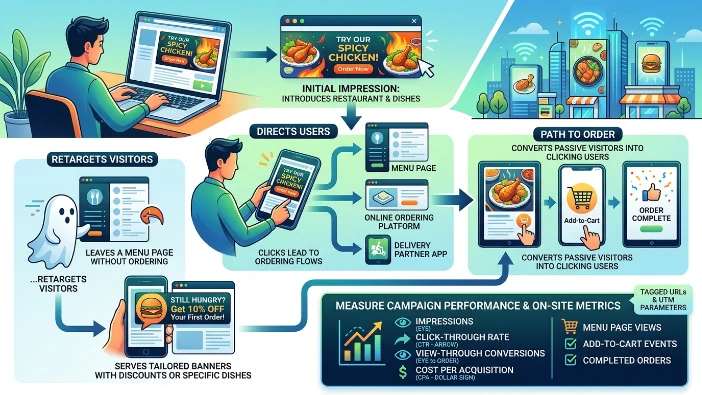
Initial impressions introduce a restaurant or menu item. Clicks send users to menu pages, online ordering platforms, or delivery partners. Retargeting captures users who viewed menus but did not order and serves them tailored banners highlighting specific dishes, discounts, or delivery times.
Impressions, click-through rate (CTR), view-through conversions, and cost per acquisition (CPA). Track on-site metrics: menu page views, add-to-cart events, and completed orders. Use tagged URLs and UTM parameters for accurate attribution. Typical benchmarks, CTR 0.05%–0.5% for display, higher for targeted contextual placements.
What components make an effective restaurant banner ad?
Effective banners use clear images, concise headlines, a visible value proposition, and matching landing pages that show the same menu items. Images must display food at high resolution and match brand colours. Headlines state offers, dish names, or delivery times. Landing pages present the same dishes with prices and an ordering button.
Use mouth-watering food photos sized and cropped for common banner formats. Include a short headline of 3–6 words and a subline with essential details, such as delivery time or discount percentage. Add an order or view-menu indicator on the landing page. File sizes must stay within ad network limits to avoid slow load times.
Landing pages must mirror banner visuals and messaging. If a banner advertises a 20% discount on pizzas, the landing page must show the same discount and active ordering options. Reduce friction: pre-fill location, show delivery time estimates, and display clear pricing. Track conversions with pixel and event tracking.
When should restaurants use retargeting in banner campaigns?
Restaurants should use retargeting after users visit menus or product pages but leave without ordering, to remind and convert them with tailored offers. Retargeting segments include menu viewers, item viewers, and cart abandoners. Use sequential messaging: reminders, incentive offers, and urgency-driven creatives.
Set retargeting windows based on purchase intent. Use short windows (24–72 hours) for lunch and dinner campaigns. Allow longer windows (7–14 days) for new-menu awareness. Apply frequency caps to avoid ad fatigue: 3–8 impressions per user per day for peak hours.
Sequence messages from light reminders to stronger incentives. Example: first banner shows a popular dish image; second banner highlights a 10% discount; third banner shows “order now for 30-minute delivery.” Use exclusion lists to stop serving retargeting ads to users who completed orders.
How do restaurants measure the ROI of banner ad campaigns?
ROI measurement uses tracked conversions from ad clicks and view-through events, comparing ad spend to incremental orders attributed to campaigns. Calculate return on ad spend (ROAS) by dividing revenue from orders linked to the campaign by total ad spend. Use first-click, last-click, and view-through attribution for comparisons.
Implement multi-touch attribution for a fuller view. Use last-click for short funnels and view-through for display-driven awareness. Compare baseline order volumes before and during campaigns to estimate incremental impact. Subtract organic uplift, promotional impacts, and seasonality to isolate campaign effect.
Collect data from ad platforms, website analytics, and point-of-sale or order management systems. Use server-to-server tracking or conversion APIs for delivery apps and third-party ordering platforms. Verify consistency across systems weekly and reconcile discrepancies.
Which targeting strategies work best for UK restaurants?
In the UK, successful targeting combines geographic radius targeting, contextual placements near local news and food content, and interest segments for cuisine types. Focus on city-level or postcode-level delivery areas. Align banners with local events, match cuisine interest (e.g., pizza, Indian, vegan), and target high-consumption time slots such as 11:30–14:30 and 17:30–21:30.
Set geo-targets by delivery radius or serviceable postcodes. Use higher bid modifiers within 1–3 miles of the restaurant. Exclude out-of-delivery-area zones to avoid wasted clicks. For chain restaurants, target high-performing branches by adjusting bids.
Place banners on food blogs, local news sites, and listings pages that UK users visit for restaurant searches. Contextual placements increase relevance and lift CTR. Use programmatic private deals for premium local inventory when available.
What budget and bidding approaches optimise order growth?
Budget allocation should prioritise high-intent slots and peak hours, with bidding set to target CPA or maximum conversions to control cost per order. Allocate 60% of weekly budget to peak meal times and 40% to off-peak testing. Set CPA targets based on average order value (AOV) and desired margin.
Use target CPA bidding when historical conversion data exceeds 50 conversions per campaign per month. Use manual CPC for new campaigns with limited data. Increase bids 10%–25% for placements within 1 mile of the restaurant and for users who have previously viewed the menu.
Get the Full Insights Here:
How Restaurants Build Order Intent Using Menu Banner Advertising
What creative testing practices improve conversion rates?
Test one variable at a time across images, headlines, and offers to identify the highest-performing creative combinations. Run A/B tests with statistically significant sample sizes before scaling winners. Track CTR, landing page conversion rate, and CPA.
Rotate creatives every 7–14 days for stable traffic. Test image variants, headline length, and offer types (percentage off versus free delivery). Stop tests after reaching 1,000–5,000 impressions and at least 50 clicks to determine significance.
High-quality food image with “20% off” headline. Test B: same image with “30-minute delivery” headline. Compare CTR and order conversion rates.
Explore More Expert Insights:
How Travel Brands Drive Seasonal Bookings Using Banner Campaigns
How Tourism Services Increase Engagement Using Banner Ads
What legal and accessibility considerations apply in the UK?
Restaurants must follow UK advertising rules, display accurate pricing, and ensure banners are accessible with readable text and alternative text for images. Follow CAP Code restrictions on misleading claims. Include VAT in advertised prices where applicable. Provide alt text for images to meet accessibility standards.
Comply with UK GDPR for tracking and cookie use. Obtain explicit consent for non-essential cookies before using behavioural targeting. Record consent preferences and respect do-not-track signals.
Where do banner ad campaigns fit within a broader marketing mix?
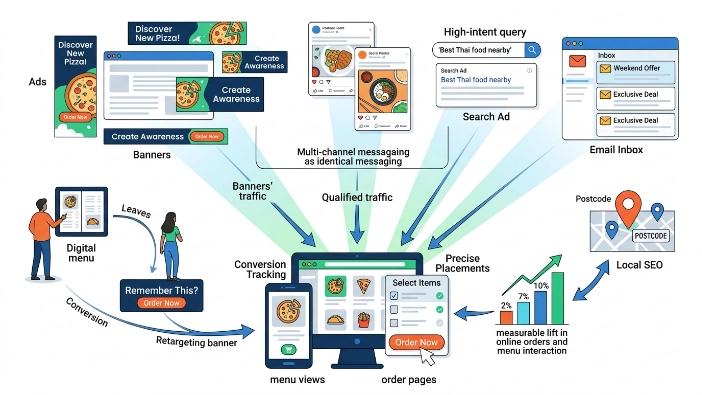
Banner ads function as upper-funnel awareness drivers and mid-funnel retargeting tools that feed traffic to menu and order pages. Combine banners with search ads, social, email, and local SEO to create a multi-channel presence. Use banners to increase visibility and retargeting to recover lost conversions.
Coordinate banner timings with emails and social posts to amplify messages during promotions. Use search ads for high-intent queries and banners for discovery. Ensure consistent messaging and identical offers across channels.
Read More to Understand Better:
Restaurant Banner Ads That Convert Menu Views Into Online Orders
Banner ad campaigns increase restaurant orders by creating measurable awareness, driving qualified traffic to menus, and converting visitors through retargeting and aligned landing pages. Effective campaigns use standard ad sizes, targeted geographic and contextual placements, precise tracking, and ongoing creative tests. In the UK, focus on postcode-level targeting, peak meal times, clear pricing, and GDPR-compliant consent. When executed with matched landing pages and conversion tracking, banners deliver measurable lifts in menu views and online orders.