Holiday travel ads that turn seasonal interest into final bookings are targeted advertising campaigns designed to convert users from browsing holiday options into completed reservations within a defined seasonal window. These ads use date-based urgency, price transparency, inventory linkage, and conversion-focused creative to drive measurable bookings.
Holiday travel ads in this context are digital promotions placed across display, paid social, programmatic, native, and search channels. They align creative, audience signals, and offer mechanics with calendar-driven demand. Conversion tracking ties ad exposure to booking events such as seat purchase, room reservation, or package checkout. Clear definitions: “seasonal window” equals a campaign timeframe tied to public holidays, school breaks, or weather seasons; “final booking” equals a completed transactional event recorded in a booking system.
How do holiday travel ads move users from interest to purchase?
They progress users through targeted messaging, progressive offers, real-time availability, and streamlined conversion paths that reduce friction and create a direct route to payment. Campaigns map creative sets to funnel stages and audience segments. Early-stage banners highlight destinations and inspiring imagery for users with high intent signals, such as recent searches for flights or hotels. Middle-stage banners present concrete offers, like package prices, dates, and inclusions. Bottom-stage banners display live availability, dynamic pricing, and one-click booking options.
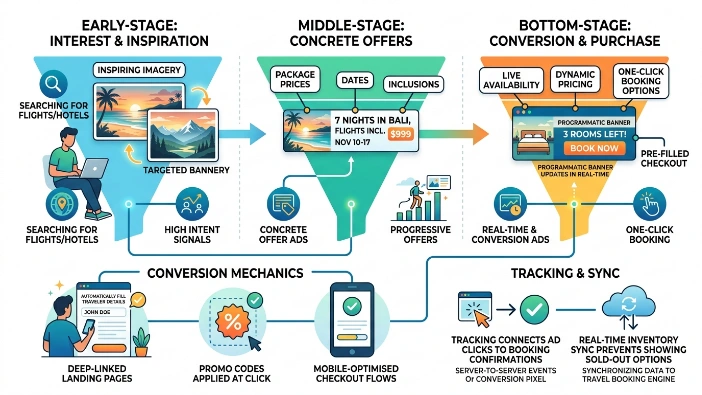
Conversion mechanics include deep-linked landing pages that pre-fill traveller details, promo codes applied at click, and mobile-optimised checkout flows. Tracking connects ad clicks to booking confirmations via server-to-server events or conversion pixels. Real-time inventory sync prevents showing sold-out options. Example: a programmatic banner updates available room types and shows a booking button linked to a pre-filled checkout for specific travel dates.
What components must a campaign include to convert seasonal interest into bookings?
Key components include audience signals, dynamic creative, real-time inventory integration, clear pricing, conversion-optimised landing pages, and precise attribution. Audience signals require intent data such as search queries, site behaviour, past bookings, and CRM segments. Dynamic creative uses templates to insert destination names, travel dates, prices, and urgency lines.
Real-time inventory integration connects the ad or landing page to the booking engine to show exact availability and prevent over-promising. Clear pricing shows total cost or transparent starting price inclusive of taxes where possible. Conversion-optimised landing pages minimise fields, support guest checkout, and display trust signals like payment security.
Attribution captures events: view, click, add-to-cart, checkout start, and booking confirmation. Use server-side event forwarding plus ad platform pixels to reconcile cross-device paths. Example components in a winter ski campaign: audience includes past winter-bookers, creative shows slope images plus exact date ranges, landing page pre-fills preferred ski pass options, inventory shows room and lift-pass bundles, and attribution ties the ad ID to the booking reference.
Which targeting signals drive the most efficient seasonal bookings?
High-efficiency signals combine recent intent (searches, form fills), historical purchases, and contextual indicators such as geo and date-related interest. Signals rank by recency and purchase propensity. High-value signals include: searches for specific destinations or flights within 0–14 days, users who abandoned booking in the last 30 days, guests with loyalty status, and CRM segments of past seasonal bookers. Contextual indicators include device location near departure hubs, school holiday calendars, and weather-triggered interest spikes.
Segment examples: recent searchers for “December flights to Edinburgh,” users who added a hotel but did not complete checkout within 72 hours, and email subscribers who opened seasonal promotion messages twice in seven days. Combine these signals via rule-based segments or probabilistic scoring for real-time bidding and creative selection.
How does dynamic creative and pricing increase booking conversions?
Dynamic creative personalises visuals, copy, and price points based on user signals and live inventory, which boosts relevance and reduces decision time. Creative templates swap destination images, call-to-action text, and price inserts. Pricing components include ticket or room price, optional add-ons, and final price after fees. Real-time price insertion guarantees the offer matches the booking engine. Urgency elements insert remaining seats or time-limited discount counters.
Example flow: a user who searched “family holiday Cornwall August” sees a banner showing an available four-night family suite, price per night updated live, and a CTA linking to a checkout with family add-ons pre-selected. This direct match shortens the path between interest and payment.
What landing page features produce the highest booking completion rates?
Landing pages that prioritise speed, clear offer details, simple forms, trust signals, and one-click booking produce higher completion rates. Speed means page load under three seconds on mobile. Offer details list exact travel dates, total price, cancellation policy, and inclusions. Forms ask for minimal required fields and support guest checkout. Trust signals include secure payment badges, verified reviews, and booking confirmation examples. Progress indicators show steps remaining in the booking flow.
Essential features: deep-linked itineraries, calendar widgets set to suggested travel dates, pre-applied promo codes, and exit intent messaging with a concise last-chance incentive. Example: a holiday package landing page shows the package itinerary, total price inclusive of taxes, a “book now” button that opens a lightweight modal for payment, and a visible secure checkout badge.
How do measurement and attribution validate ROI for seasonal booking ads?
Measurement combines event-level conversion tracking, revenue attribution, and incremental lift testing to quantify bookings driven by ads. Event-level tracking logs add-to-cart, checkout start, and booking confirmation with order value. Attribution models include last-click for direct bookings and multi-touch for assisted conversions. Incrementality tests use holdout audiences or geo-based experiments to isolate ad-driven bookings. Revenue attribution ties ad IDs or campaign UTM parameters to booking references via server-side matching.
Report metrics include cost per booking (CPB), return on ad spend (ROAS), booking conversion rate, and incremental bookings versus control. Example validation: a 14-day campaign with server-side event matching shows 1,200 bookings, CPB £35, and 22% incremental lift compared with a holdout group.
What creative and copy elements increase urgency and clarity without causing mistrust?
Use specific availability numbers, explicit date ranges, exact prices, and factual cancellation terms to create urgency while maintaining transparency. Urgency elements list seats remaining, hard cutoff dates, and time-bound discounts. Clarity elements present total price, included items, and refund rules. Avoid ambiguous phrasing such as “limited seats” without context. Provide exact inventory counts where feasible and document booking deadlines. Example messaging: “3 rooms left at £129 total for 2 adults, travel 20–24 August. Free cancellation within 48 hours.”
Which channels deliver the best final-booking performance for holiday ads?
Channels with strong intent signals and direct response capabilities perform best, paid search, remarketing display, paid social with deep links, and metasearch integrations. Paid search reaches users actively searching for travel inventory. Remarketing display retargets users who interacted with booking flows. Paid social captures high-intent CRM segments and lookalikes with deep links to booking pages. Metasearch surfaces live fares and drives direct bookings through price comparison interfaces. Programmatic display with dynamic creative supports scale where inventory is consistently updated.
Search ads for “flights to Malaga 1 Sept” convert quickly; remarketing banners to checkout abandoners recover bookings; paid social carousel ads convert email subscribers through tailored offers.
How do loyalty and CRM integrations increase conversion rates during seasonal campaigns?
Loyalty and CRM integrations personalise offers, pre-fill user data, and prioritise inventory, which shortens booking friction and increases conversion probability. Integrations identify returning bookers and display member-only rates, pre-applied points, or expedited checkout options. CRM-driven segments receive tailored creative based on past travel patterns. Inventory prioritisation offers preferred room types or seats to high-value members. Loyalty members see an exclusive discount applied at click, and the landing page shows their name and stored payment method for one-click completion.
Explore More Expert Insights:
Tourism Ads That Convert Destination Excitement Into Booking Actions
Mid-Funnel Travel Ads That Turn Planning Interest Into Confirmed Trips
What legal and consumer protections must campaigns include for UK audiences?
Campaigns must display accurate pricing inclusive of mandatory fees, clear cancellation and refund terms, and compliance with the Consumer Contracts Regulations and Advertising Standards rules. Price displays should show total pay-at-booking costs or a clear statement of additional compulsory fees.
Provide a visible cancellation policy and contact details. Ensure claims such as “best price” are substantiated. For data handling, follow UK GDPR: disclose tracking and obtain necessary consent for cookies and profiling. Total price inclusive of taxes, link to full terms, and cookie consent banner before personalised retargeting.
How should travel brands scale seasonal booking campaigns across multiple holidays?
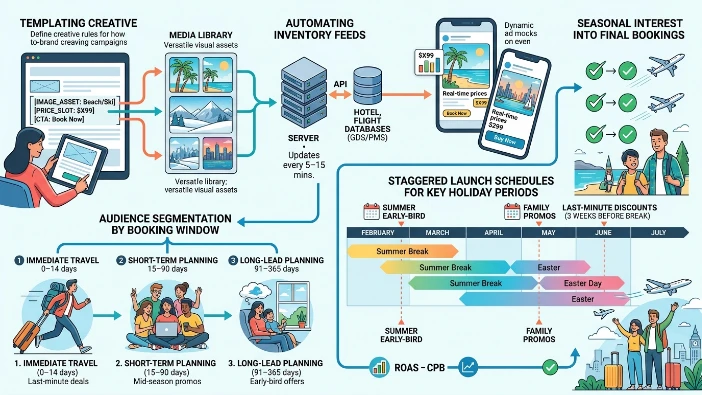
Scale campaigns by templating creative, automating inventory feeds, segmenting audiences by booking window, and running staggered launch schedules for key holiday periods. Templates store creative rules for images, price slots, and CTAs. Automated feeds push inventory updates every 5–15 minutes. Segments align to booking windows: immediate travel (0–14 days), short-term planning (15–90 days), and long-lead planning (91–365 days). Stagger launches so early-bird offers, last-minute deals, and mid-season promos run at defined times to avoid audience fatigue. Launch early-bird for summer in February, push family-focused ads in May, and last-minute discounts three weeks before summer school break.
Discover More Insights:
How Travel Brands Drive Seasonal Bookings Using Banner Campaigns
Holiday travel ads that turn seasonal interest into final bookings require precise audience signals, dynamic creative, real-time inventory linkage, conversion-optimised pages, and rigorous attribution. Implement specific price and availability disclosures, integrate CRM and loyalty data, and test incrementally. Measure CPB, ROAS, and incremental lift to validate campaign effectiveness and scale via templates and automated feeds.
Explore the Complete Guide:
How Travel Brands Increase Holiday Consideration Using Banner Campaigns