
Paid advertising no longer provides sufficient growth security because rising acquisition costs, weaker targeting signals, limited consumer trust, and platform dependence reduce profitability. E-commerce brands need diversified demand generation, stronger brand visibility, owned audiences, and credible third-party exposure to support sustainable revenue.
Paid advertising is the practice of paying digital platforms to display promotional content to selected audiences. Common formats include search adverts, social media adverts, display campaigns, shopping adverts, and retargeting.
For many e-commerce businesses, paid media once delivered predictable customer acquisition. A brand could launch a campaign, measure clicks, calculate sales, and increase spending when returns remained profitable. That model now faces greater pressure.
Advertising costs have increased across competitive product categories. Fashion, beauty, homeware, consumer technology, and wellness brands compete for the same audience attention. More advertisers bidding for similar users increase the cost of reaching potential customers.
Paid campaigns also produce temporary visibility. Traffic often falls when spending stops. A brand that depends entirely on advertising therefore rents access to its audience rather than building a durable source of demand.
What has changed in digital advertising?
Digital advertising now operates with less precise user data. Privacy controls, cookie restrictions, consent requirements, and mobile operating-system changes reduce the amount of information available for audience targeting and campaign measurement.
Platforms also control campaign delivery. Changes to algorithms, advertising policies, bidding systems, and attribution models affect performance without changing the product, website, or customer experience.
A business that receives 80% of its website visits from paid channels carries concentrated platform risk. A higher cost per click or lower conversion rate can quickly reduce campaign profitability.
How do rising advertising costs affect e-commerce survival?
Rising advertising costs reduce the margin available from each customer, especially when product prices remain fixed and repeat purchases stay low. Brands must measure customer acquisition cost, contribution margin, and lifetime value together to identify whether paid growth produces sustainable revenue.
Customer acquisition cost, or CAC, is the total marketing and sales expenditure required to gain one new customer.
A simple calculation is:
Customer acquisition cost = Total acquisition spending ÷ Number of new customers
An online retailer spends £20,000 on advertising and gains 1,000 new customers. Its advertising-based customer acquisition cost is £20.
That figure alone does not show profitability. The retailer must also account for product costs, fulfilment, delivery, payment processing, returns, discounts, and operating expenses.
Why revenue does not equal profitable growth
A campaign can generate strong sales while reducing business profitability.
For example, an online retailer sells a product for £60. The product, packaging, fulfilment, and payment costs total £32. The initial contribution before advertising is £28. If customer acquisition costs reach £25, only £3 remains before overheads.
If the customer never purchases again, the campaign creates limited long-term value.
This is why e-commerce brands track customer lifetime value, or CLV. Customer lifetime value estimates the total value generated during the customer relationship.
A brand with repeat purchases every 90 days can support a higher acquisition cost than a brand that sells a one-time product. However, projected future purchases must not hide losses from the first transaction.
Why does dependence on paid platforms create business risk?
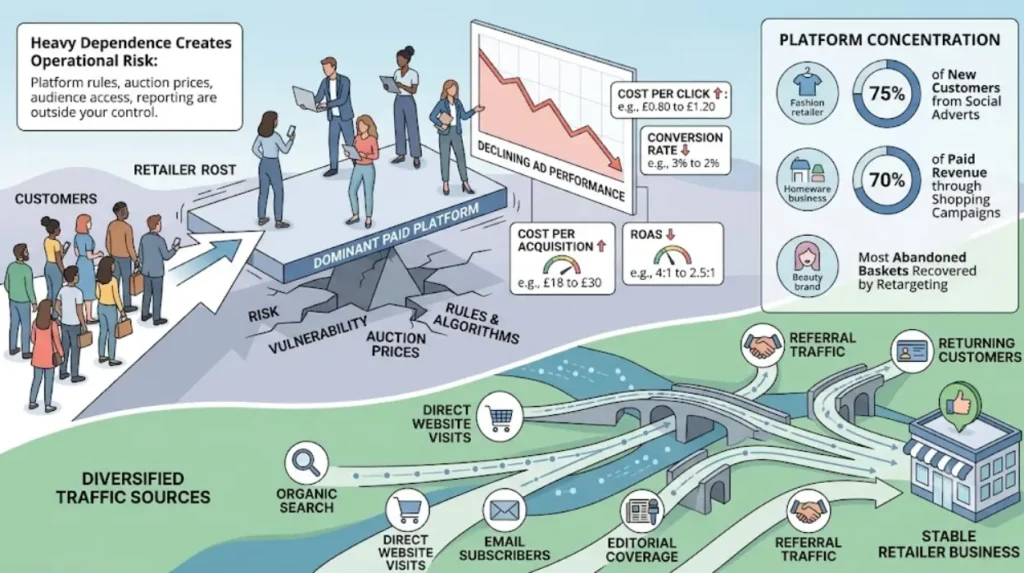
Heavy dependence on one advertising platform creates operational risk because platform rules, auction prices, audience access, and reporting systems remain outside the retailer’s control. Diversified traffic sources reduce exposure and create more stable routes through which customers discover products.
Platform concentration occurs when a large share of traffic or revenue comes from one source.
Examples include:
- A fashion retailer receiving 75% of new customers from social adverts
- A homeware business generating 70% of paid revenue through shopping campaigns
- A beauty brand relying on retargeting to recover most abandoned baskets
These businesses face immediate pressure when campaign performance changes.
What happens when advertising performance declines?
A decline can appear through several metrics:
- Cost per click increases from £0.80 to £1.20
- Conversion rate falls from 3% to 2%
- Cost per acquisition rises from £18 to £30
- Return on advertising spend declines from 4:1 to 2.5:1
Each change affects the economics of customer acquisition.
A retailer can respond by increasing budgets, reducing bids, changing creative assets, improving landing pages, or narrowing audiences. These actions address campaign efficiency, but they do not remove platform dependence.
Organic search, direct website visits, email subscribers, editorial coverage, referral traffic, and returning customers provide additional routes into the business.
Why does consumer trust reduce the effectiveness of paid adverts?
Consumers increasingly compare products across several information sources before buying, making advertising only one part of the decision process. Independent reviews, editorial coverage, customer feedback, search visibility, and consistent brand information strengthen credibility throughout the purchase journey.
Paid adverts identify products and communicate commercial offers. They do not automatically establish trust.
Many shoppers investigate a retailer after seeing an advert. They search the brand name, read reviews, compare prices, examine product information, and check delivery or return policies.
A weak search presence creates friction during this research stage.
What information do online shoppers look for?
Customers commonly review:
- Product specifications
- Independent reviews
- Customer ratings
- Delivery times
- Return conditions
- Company information
- Expert recommendations
- Editorial mentions
These sources serve different purposes. Product pages explain features. Reviews report customer experiences. Editorial content provides independent context. Clear policies reduce purchase uncertainty.
A paid advert that leads to an incomplete website or inconsistent information can generate clicks without generating sales.
How does organic visibility support e-commerce growth?
Organic visibility creates discoverability without requiring payment for every visit. Search content, editorial mentions, product-focused resources, and brand searches build long-term audience access while supporting customer research, trust, and conversion across multiple stages of the buying journey.
Organic visibility refers to unpaid exposure across search engines, editorial websites, social sharing, and direct brand discovery.
Unlike a paid campaign, an indexed article or established product guide can continue attracting visitors after publication. Performance depends on relevance, search demand, content quality, authority, and technical accessibility.
Which content supports organic discovery?
E-commerce brands use several content formats:
- Buying guides, such as “How to Choose a Winter Coat”
- Product comparisons, such as “Electric vs Manual Coffee Grinders”
- Seasonal resources, such as “Christmas Gift Ideas for Home Cooks”
- Educational articles, such as “How to Measure Ring Size at Home”
- Product care guides, such as “How to Clean Leather Trainers”
Each format answers a defined customer question.
Search-focused content also supports product discovery before a customer knows a specific retailer. A shopper searching “best reusable water bottle for commuting” is researching a category rather than looking for one brand.
What role does earned media play in e-commerce visibility?
Earned media provides independent exposure when journalists, editors, publishers, or recognised publications feature a product or business. This visibility supports brand discovery, strengthens credibility, generates referral traffic, and creates information that customers can find during online research.
Earned media is unpaid editorial coverage selected by a publisher or journalist.
Examples include product reviews, gift-guide features, expert commentary, trend articles, business profiles, and category round-ups.
Earned media differs from paid advertising because the publisher controls editorial selection and presentation.
Why are product features valuable?
A product feature can introduce an e-commerce business to an audience that has not previously encountered the brand.
A holiday gift guide can place products within a seasonal buying context. A specialist publication can connect a product with a defined interest group. A product review can explain features in greater detail than a standard advert.
For seasonal planning,
Online retailer’s guide to crafting high-conversion pitches for holiday gift guides provides a focused framework for preparing relevant editorial submissions.
Earned coverage also creates additional search results. When customers search for a brand, independent articles can appear alongside the company website, social profiles, and review platforms.
Why is owned audience data important for e-commerce brands?
Owned audiences give retailers direct communication channels that are not controlled by advertising algorithms. Email subscribers, customer accounts, loyalty members, and opted-in messaging audiences support repeat purchases, personalised communication, and lower-cost customer retention.
An owned audience is a group that a business can contact through information collected with permission.
Email remains a central owned channel because the retailer controls its subscriber database and campaign schedule.
A customer who purchases once can receive product education, replenishment reminders, related product recommendations, and relevant seasonal information.
How does retention improve marketing economics?
Retention increases the value generated from existing customers.
A retailer spends £24 to acquire a customer. The customer makes an initial £70 purchase and returns twice during the next 12 months. The total relationship value becomes higher than the first order alone.
Retention activity includes:
- Post-purchase emails
- Replenishment reminders
- Loyalty programmes
- Product education
- Personalised recommendations
- Customer service follow-ups
Retention does not eliminate acquisition costs. It improves the economic value of successful acquisition.
What does a diversified e-commerce growth strategy include?
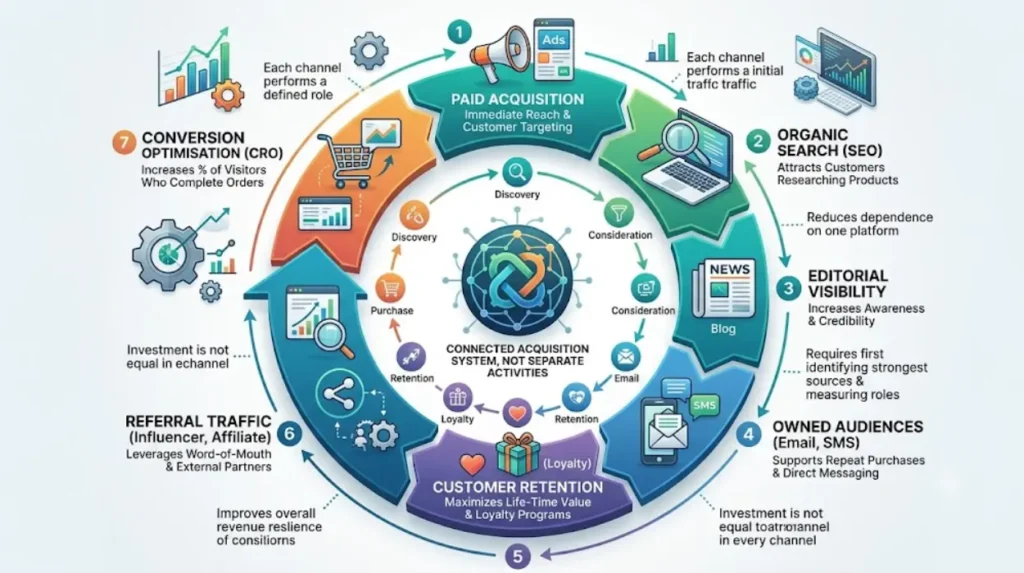
A diversified e-commerce growth strategy combines paid acquisition with organic search, editorial visibility, owned audiences, customer retention, referral traffic, and conversion optimisation. Each channel performs a defined role, reducing dependence on one platform and improving overall revenue resilience.
Diversification does not require equal investment in every channel.
A retailer first identifies its strongest customer acquisition sources. It then measures the role of each source across discovery, consideration, purchase, and retention.
How do channels work together?
Paid advertising can create immediate reach.
Organic search can attract customers researching products.
Editorial coverage can increase awareness and credibility.
Email can support repeat purchases.
Customer reviews can reduce purchase uncertainty.
Website optimisation can increase the percentage of visitors who complete an order.
These channels create a connected acquisition system rather than separate marketing activities.
How can e-commerce brands measure sustainable growth?
Sustainable e-commerce growth is measured through profitable customer acquisition, repeat purchase behaviour, channel diversity, conversion efficiency, and contribution margin. Revenue alone does not show whether growth strengthens the business or increases dependence on costly advertising expenditure.
Retailers need a consistent measurement framework.
Core metrics include:
- Customer acquisition cost
- Customer lifetime value
- Conversion rate
- Average order value
- Repeat purchase rate
- Contribution margin
- Organic traffic share
- Direct traffic share
- Email-generated revenue
- Revenue by acquisition channel
A useful analysis compares new-customer revenue with the cost required to generate it.
What does channel diversification look like?
A retailer receives 60% of new visitors from paid advertising, 15% from organic search, 10% from direct traffic, 10% from email, and 5% from referrals.
The business then improves organic content, customer retention, and editorial visibility. After 12 months, paid traffic represents 40%, while other channels generate the remaining 60%.
The objective is not to remove paid advertising. The objective is to reduce dependence on a single source.
Explore More Expert Insights:
Why Global PR Synergy is Critical for the Success of Newly Launched Investment Funds
How Institutional Investors Discover and Evaluate Disruptive, Under-the-Radar Web3 Innovators
Why must e-commerce brands build visibility beyond paid ads?
Paid advertising remains useful for immediate demand generation, but it does not provide complete growth security. E-commerce survival increasingly depends on diversified discovery, credible information, repeat customers, owned audiences, and measurable profitability across the full customer journey.
Paid advertising performs best when supported by a strong website, clear product information, trusted customer feedback, organic discoverability, and retention systems.
A retailer that depends entirely on paid campaigns remains exposed to higher auction costs, platform changes, and declining campaign efficiency.
A retailer with several acquisition channels has more ways to reach customers and more data for evaluating growth.
For businesses examining scalable distribution as part of a broader visibility strategy,
D2C startups partner with Time Intelligence Media Group for scalable PR distribution provides the next decision-stage topic.
The central issue is not whether e-commerce brands should use paid advertising. The issue is whether paid advertising operates within a balanced and profitable customer acquisition system.
Long-term resilience requires measurable demand sources that continue supporting discovery, trust, conversion, and retention beyond a single advertising platform.