Menu banner advertising appears on digital menus, web menu pages, mobile apps, and PDF or tablet menus in restaurants. Digital menu banners show a hero image, a concise call-to-action, price, and order link. Printed menu banners mirror digital content with QR codes that open an online ordering page. Menu banners use placement, timing, and creative hierarchy to increase visibility for targeted items. Ad placements include top-of-menu headers, section headers (starters, mains), item-level overlays, and checkout reminders.
Menu banners connect intent signals (item views, time spent on page, repeated visits) to actions (add-to-cart, checkout). Systems track impressions, click-throughs, conversion rates, and average order value. Data feeds inform which banners display to which users and when to rotate creatives based on performance.
How do menu banners create order intent?
Menu banners create order intent by increasing item salience, reducing friction to order, and presenting clear ordering pathways that convert attention into commitment.
Banners raise salience by featuring images, short benefit statements, and prices. Visual cues anchor a customer’s choice, moving thought from “what to eat” to “I want this.” Banners reduce friction by providing direct links or QR codes to add items to a cart. They present time-limited offers and recommended pairings to prompt immediate decisions. Banners also leverage social proof ratings or order counts to validate choices.
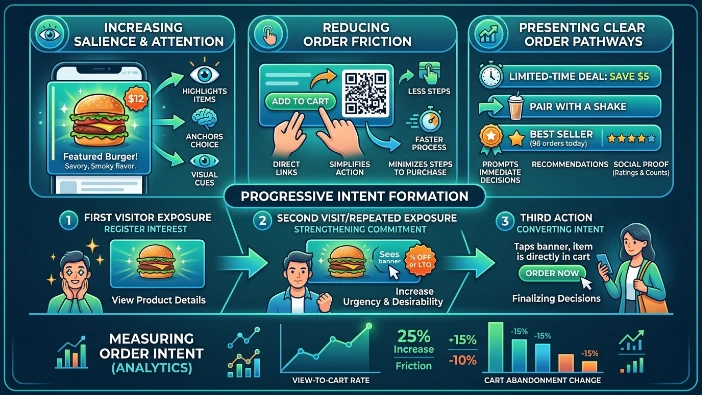
Intent forms through repeated exposure and progressive commitment. A first banner visit registers interest. A second exposure with a discount or limited-time label increases urgency. When the banner links directly to a pre-filled cart or suggested add-ons, conversion probability rises. Analytics measure intent by tracking item view-to-cart rates and cart abandonment changes after banner exposure.
Which elements must a menu banner include to drive orders?
Effective menu banners include a high-quality image, a 5–8 word headline, price or discount, a clear action link or QR code, and contextual placement within the menu.
A high-quality image uses an 800–1200 px width for web banners and 1200×628 px for social-style displays. The headline states the offer: New “Chicken Tikka Wrap £6.50” or “20% Off After 9pm”. Price anchors expectations. A single-step link adds the item to cart or opens an order modal. Mobile banners include a QR code sized at least 2 cm on printed menus.
Placement affects visibility. Top-of-menu banners capture initial attention. Item-level overlays convert readers who scan specific dishes. Checkout banners suggest last-minute add-ons. Rotation frequency depends on traffic: change creatives every 7–14 days for steady menus, every 3–5 days for promotional menus.
How do restaurants target the right customers with menu banners?
Restaurants target customers with banner rules based on device type, time of day, geolocation, past orders, and on-site behavior signals such as item views and session duration.
Device targeting ensures mobile banners show simplified layouts and QR codes; desktop banners include larger images and multi-item suggestions. Time targeting aligns promotions with eating habits: Breakfast banners run 06:00–10:30, lunch banners run 11:00–14:30, dinner banners run 17:00–21:30. Geolocation narrows banners to delivery zones within a specified radius, typically 1–5 miles for urban UK restaurants.
Behavioral targeting uses first-party data. Display the most-viewed dish for repeat visitors or a discounted bundle for users who abandoned a cart within 24 hours. If a user viewed a vegetarian section twice in one week, prioritise vegetarian banner creatives. Targeting rules reduce waste and increase relevance, improving click-to-order rates by measurable percentages.
What metrics measure menu banner performance?
Key metrics are impressions, click-through rate (CTR), add-to-cart rate, conversion rate (orders per click), average order value (AOV), and banner-influenced revenue share.
Impressions count views of the banner on menu pages. CTR equals clicks divided by impressions. Add-to-cart rate equals items added after banner clicks divided by clicks. Conversion rate equals completed orders divided by clicks. AOV measures revenue per order connected to banner interactions. Banner-influenced revenue share compares revenue from orders where a banner click occurred to total online revenue.
Benchmark figures: aim for CTR between 1.5% and 4% for menu pages, add-to-cart rate between 15% and 30% after a banner click, and conversion rate between 8% and 20% on banner-driven carts. Track time-to-order after click; shorter times indicate stronger intent. Use A/B tests to compare creative variants and report uplifts weekly.
How does creative design affect conversion?
Creative design affects conversion through clarity, image quality, concise messaging, and visible pricing that reduces hesitation and guides choices.
Clarity means one visual focus and one action. Images show the plated item, not raw ingredients. Use natural lighting and neutral backgrounds for images; avoid over-styling. Messaging runs 5–8 words and highlights benefit or discount. Price sits within the banner frame in bold type. Colour contrast ensures the action link stands out.
Testing reveals which combinations perform best. For example, a banner with the item photo plus “Free Fries with Meal” increased add-to-cart rates by 22% in one test. A variant with a larger price tag but no discount lowered CTR by 11%. Rotate creatives and measure immediate impacts on CTR and conversion.
What technical components support menu banner ads?
Technical components include a banner management system, dynamic content feed, user event tracking, and an order-linking mechanism that adds items to a cart.
The banner management system schedules creatives, applies targeting rules, and rotates content. A dynamic content feed connects menu item data (name, price, image, availability) to banners in real time. Event tracking records impressions, clicks, cart additions, and conversions to analytics. The order-linking mechanism creates deep links or pre-filled carts so a banner click results in an immediate cart update.
Integration points include the restaurant’s CMS, POS, and order management system. Sync availability and pricing hourly or at menu-change events. Use server-side tagging for reliable event capture. Ensure GDPR-compliant consent for tracking and store session-level keys for linking banner clicks to orders.
Complete Details Available Here:
How Restaurants Increase Orders Using Banner Ad Campaigns
What testing methods confirm banner effectiveness?
Testing methods include A/B testing creatives, time-split experiments, and multi-variant tests that track CTR, add-to-cart, conversion, and AOV across cohorts.
Set a baseline period of 7–14 days, then run the variant for an equal duration. Test single-variable differences first: image change, headline change, or price display. Use time-split tests to control for time-of-day effects by alternating creatives hourly. Run multi-variant tests for larger changes when initial tests show direction.
Analyse results with statistical significance at 95% confidence to avoid false positives. Document sample sizes: for CTR changes expect at least 2,000 impressions per variant to detect a 0.5% absolute difference. Report outcomes and implement the winning creative for at least 14 days before the next test.
What are the benefits for restaurants using menu banners?
Benefits include higher online conversion rates, increased average order value, faster decision-making by customers, and measurable attribution for menu promotions.
Higher conversion rates result from direct add-to-cart links and highlighted items. AOV rises when banners recommend add-ons or bundles. Faster decisions reduce cart abandonment and improve throughput during peak hours. Measurable attribution allows marketing teams to tie specific banner creatives to revenue and ROI, enabling data-led budgeting.
Example: a UK bistro using banners for late-night offers saw a 14% lift in orders between 21:00–23:30 and a 9% increase in AOV from recommended sides. Chain rotating vegetarian-feature banners recorded a 17% rise in vegetarian item sales over four weeks.
Explore More Expert Insights:
How Travel Brands Increase Holiday Consideration Using Banner Campaigns
How Tourism Services Build Excitement Using Destination Ads
Which use cases suit menu banner advertising?
Use cases include promoting new menu items, moving slow-selling inventory, highlighting time-limited discounts, upselling add-ons, and personalising offers for repeat customers.
Promote new dishes during the first 14 days after launch. Use banners to reduce waste by featuring surplus ingredients as specials. Offer time-limited discounts at low-demand hours to increase orders. Suggest add-ons at checkout to raise AOV. Personalise banners for repeat customers to increase frequency.
Example: A pizzeria used a banner to advertise a lunchtime two-for-one pizza deal on weekdays 12:00–14:00 and increased weekday midday orders by 26% in three weeks.
How do privacy and compliance affect banner implementation?
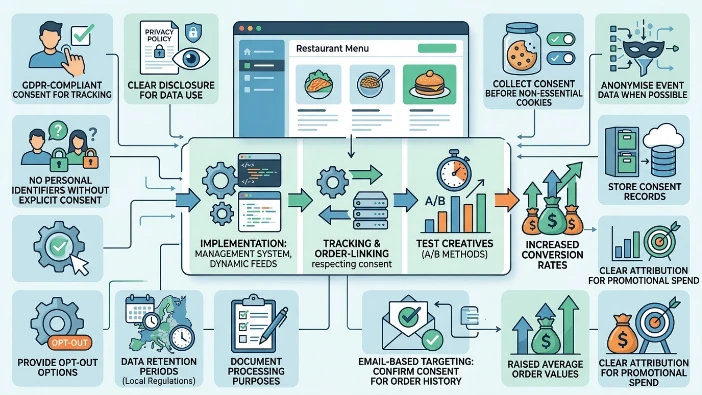
Privacy rules require GDPR-compliant consent for tracking and clear disclosure for data use; do not track personal identifiers without explicit consent.
Collect consent before setting non-essential cookies that enable behavioral targeting. Anonymise event data when possible. Store consent records and provide opt-out options. For email-based targeting, confirm consent records before using order history for personalised banners. Maintain data retention periods aligned with local regulations and document processing purposes.
Check the Complete Explanation:
Restaurant Banner Ads That Convert Menu Views Into Online Orders
Menu banner advertising converts menu views into orders by increasing item salience, simplifying the ordering path, and targeting customers with contextual creatives. Restaurants implement banners using a management system, dynamic feeds, tracking, and order-linking. Test creatives with A/B methods, measure CTR, add-to-cart and conversion rates, and respect GDPR consent for tracking. Properly executed menu banners increase conversion rates, raise average order values, and provide clear attribution for promotional spend.