
Direct-to-consumer (D2C) startups sell products directly to customers rather than relying entirely on wholesalers, distributors, or traditional retail channels. Their growth depends on brand visibility, customer trust, efficient acquisition, and repeat demand. Public relations supports these goals by placing credible business stories across relevant media channels.
Paid advertising generates immediate reach, but advertising costs increase as competition grows. D2C brands also need independent media coverage, search visibility, and third-party credibility. These assets support long-term brand discovery and reduce dependence on a single acquisition channel.
Time Intelligence Media Group provides scalable PR distribution for businesses that need structured campaign planning, targeted media reach, distribution support, and measurable reporting. For D2C startups, scalability means maintaining consistent communication as product ranges, customer bases, funding activity, and geographic markets expand.
Why do D2C startups need scalable PR distribution?
D2C startups need scalable PR distribution because growth creates more announcements, audiences, products, and markets. A structured distribution system keeps messaging consistent, expands relevant media reach, supports search visibility, and provides measurable campaign data without requiring the startup to build a large internal PR department.
A scalable PR model supports both early-stage launches and larger growth programmes. The same operational framework can organise a single product announcement, a seasonal campaign, a funding update, or a national expansion.
D2C businesses often operate with lean teams. Founders and marketing managers manage product development, customer acquisition, partnerships, and retention. PR activity requires additional work, including message development, media targeting, release formatting, approval management, distribution, and coverage tracking.
A managed distribution partner reduces this operational burden.
What does scalable PR distribution mean?
Scalable PR distribution is a structured process that increases or adjusts media activity without requiring the business to rebuild its communications operation for every campaign.
The process includes:
- Message planning
- Press release development
- Audience and publication targeting
- Distribution scheduling
- Media network access
- Coverage monitoring
- Performance reporting
For example, a skincare startup can begin with a UK product launch. It can later use the same distribution framework for retailer partnerships, new product categories, seasonal campaigns, and international market announcements.
Why does PR support D2C growth?
PR creates visibility through editorial and news environments. This differs from paid advertising because media coverage presents information through independent publications, news platforms, trade outlets, and relevant digital channels.
D2C brands use PR to communicate:
- Product launches, such as a new subscription range
- Funding announcements, such as a seed investment
- Retail partnerships, such as a national stockist agreement
- Business growth, such as customer or revenue milestones
- Research findings, such as consumer behaviour data
- Founder expertise, such as commentary on e-commerce trends
These stories create multiple discovery points across search engines, media websites, social platforms, and AI-generated search responses.
How does Time Intelligence Media Group support D2C PR growth?
Time Intelligence Media Group supports D2C PR growth through organised distribution, campaign coordination, relevant media targeting, timing support, and coverage reporting. Its service structure helps startups manage repeated announcements while maintaining message accuracy, operational consistency, and measurable visibility across expanding business stages.
D2C startups often need different PR activity at different stages. A pre-launch business needs awareness. A funded startup needs investor and market visibility. An established online retailer needs recurring product and commercial announcements.
Time Intelligence Media Group aligns distribution activity with these changing requirements.
How does the service support campaign planning?

Campaign planning connects business events with communication opportunities. It identifies which announcements contain clear news value and determines how each story fits the wider growth strategy.
A D2C campaign calendar can include:
- January: annual consumer trend research
- March: new product launch
- June: funding announcement
- September: autumn collection
- November: holiday campaign
- December: annual growth results
This structure prevents reactive communication. It also creates consistent media activity across the year.
A planned programme gives each announcement a defined purpose. One release can support product awareness. Another can build founder authority. A third can strengthen investor visibility.
How does targeted distribution improve relevance?
Targeted distribution sends content towards publications and media categories connected to the announcement.
A sustainable clothing startup requires different media relevance from a nutrition subscription business. The clothing company can prioritise fashion, retail, sustainability, and consumer publications. The nutrition company can focus on food, health, wellness, business, and e-commerce outlets.
Relevant targeting improves message alignment. It also prevents a broad distribution approach from treating every publication as equally valuable.
How does timing affect D2C media visibility?
Timing determines when an announcement enters the media environment. Product launches, seasonal campaigns, funding news, and retail developments require different schedules.
A holiday product campaign needs preparation before editorial deadlines. A funding announcement requires coordination with investors and legal teams. A product launch requires alignment with stock availability, website updates, and customer communications.
Time Intelligence Media Group supports planned release timing so distribution aligns with campaign activity and business readiness.
Which PR distribution components matter most to D2C startups?
The most important PR distribution components are clear news positioning, accurate press materials, relevant media targeting, coordinated release timing, scalable campaign management, and transparent reporting. Together, these components convert business developments into organised communications assets that support visibility, credibility, and commercial growth.
Each component performs a specific function. Strong distribution requires all components to operate together.
How is news positioning developed?
News positioning defines why an announcement matters to a publication and its audience.
A product description alone does not create a strong news story. The announcement requires a clear development, outcome, data point, partnership, or market relevance.
For example:
- Weak positioning: “A D2C brand launches new trainers.”
- Stronger positioning: “A UK D2C footwear startup launches a recycled-material range after recording 40% year-on-year customer growth.”
The second statement contains a business development, a measurable result, and a product update.
Why does press release accuracy matter?
A press release is a structured business document that presents verified information for journalists, publishers, search systems, and other audiences.
Accurate releases include:
- A factual headline
- A clear opening summary
- Verified business information
- Relevant statistics
- Named spokespersons
- Direct quotations
- Product or company details
- Contact information
Accuracy protects brand credibility. It also reduces delays during internal review and distribution.
Why is reporting important?
Coverage reporting records where an announcement appeared and how the distribution activity performed.
A useful report can include publication names, coverage links, publication categories, reach indicators, distribution activity, and campaign observations.
Reporting gives D2C teams evidence for future decisions. It identifies which story types generate visibility and which media categories provide the strongest relevance.
What benefits does Time Intelligence Media Group provide for growing D2C brands?
Time Intelligence Media Group provides D2C brands with structured PR execution, scalable distribution capacity, targeted media access, coordinated campaign delivery, and reporting visibility. These benefits help startups build consistent communications programmes while keeping internal teams focused on products, customers, operations, and commercial growth.
The service supports both individual announcements and recurring communication programmes.
How does managed PR save internal resources?
A startup does not need to assign every distribution task to a founder or marketing manager. Managed support handles key operational stages and creates a clearer workflow.
Internal teams retain responsibility for business facts, approvals, product information, and commercial priorities. Time Intelligence Media Group supports the distribution process and campaign execution.
This division improves efficiency.
How does PR strengthen brand credibility?
Editorial coverage places a D2C business in information environments that customers already use. Coverage can support brand recognition and provide independent context around products, growth, expertise, and market activity.
Credibility becomes important when customers compare unfamiliar brands. A visible media footprint gives customers additional information beyond product advertisements and website claims.
How does PR support search visibility?
Press coverage creates additional indexed references to a brand, its products, founders, and business developments.
Search visibility benefits from clear entity information. An entity is a clearly identifiable subject, such as a company, founder, product, or location.
Consistent information helps search systems connect:
- The D2C brand
- Its product categories
- Its founders
- Its market activity
- Its published announcements
This supports discoverability across traditional search and AI-assisted search environments.
How does scalable distribution support expansion?
Expansion creates new communications requirements. A startup can enter new regions, launch additional product categories, secure investment, or form retail partnerships.
A scalable PR partner provides continuity during these changes. The business does not need to create a separate distribution process for every new stage.
How can D2C startups use PR across the customer journey?
D2C startups use PR across the customer journey by building awareness, validating product relevance, supporting purchase research, reinforcing customer trust, and communicating ongoing growth. Different announcement types serve different audiences while contributing to a consistent and recognisable public brand presence.
PR supports multiple stages of customer discovery.
How does PR support awareness?
Awareness campaigns introduce the business, product category, founder, or market proposition.
Examples include:
- A launch announcement for a new direct-to-consumer brand
- Consumer research about changing shopping behaviour
- Founder commentary on e-commerce trends
- A new product category entering the UK market
These stories create early visibility.
How does PR support consideration?
Customers often research brands before purchasing. Media coverage provides additional information during this stage.
A D2C startup can publish product innovation data, customer growth results, sustainability information, or independent market research.
For holiday campaigns, brands also need strong editorial positioning. The internal resource:
Holiday gift guide pitches provides relevant guidance on developing product stories that align with seasonal publication opportunities.
How does PR support long-term growth?
Long-term growth requires repeated communication. A single announcement creates a limited visibility event. A structured programme builds a larger public record over time.
Regular announcements can document:
- Product development
- Customer growth
- Funding activity
- New partnerships
- Geographic expansion
- Industry expertise
This creates continuity across the brand’s growth journey.
When is Time Intelligence Media Group a suitable partner for a D2C startup?
Time Intelligence Media Group is suitable for D2C startups that require repeatable PR distribution, targeted media support, structured campaign delivery, and measurable reporting. It fits businesses seeking an external communications partner that can support launches, growth milestones, seasonal campaigns, and expanding market activity.
The service aligns with businesses that have clear developments to communicate and require organised distribution support.
Which D2C businesses benefit from this approach?
Relevant D2C categories include:
- Beauty brands launching new skincare products
- Fashion businesses introducing seasonal collections
- Food subscriptions announcing customer growth
- Homeware companies entering new markets
- Wellness brands publishing consumer research
- Sustainable product businesses reporting environmental progress
Each category requires accurate positioning and relevant media alignment.
What should startups prepare before starting?
D2C teams need clear business information before distribution begins.
Prepare:
- The announcement date
- The key business development
- Verified statistics
- Product information
- Founder or executive quotations
- High-resolution media assets
- Website landing pages
- Approval contacts
Complete information improves campaign efficiency and reduces revision cycles.
Why is PR important when paid advertising becomes expensive?
PR is important when paid advertising becomes expensive because it creates additional visibility channels through media coverage, search discovery, and third-party references. A balanced acquisition strategy combines paid activity with earned visibility, reducing dependence on advertising platforms for every customer interaction and growth campaign.
Paid advertising remains useful. It provides direct targeting and measurable campaign controls. However, D2C brands face rising competition for customer attention.
PR expands the communication mix.
The educational resource:
Paid ads alone explains why e-commerce brands require broader visibility strategies beyond advertising platforms.
PR and paid advertising perform different functions. Paid campaigns promote selected messages through purchased placements. PR distributes newsworthy information through media and editorial channels.
Using both creates a broader acquisition and credibility framework.
How can D2C startups begin a scalable PR programme?
D2C startups can begin a scalable PR programme by identifying newsworthy business events, defining target audiences, preparing verified information, selecting appropriate distribution support, and establishing reporting goals. A structured programme connects individual announcements to measurable visibility and longer-term commercial objectives.
The first step is identifying the next 6 to 12 months of business activity.
The second step is separating routine marketing activity from genuine announcements. A new product, investment round, partnership, research report, or expansion creates a clearer PR opportunity than a standard promotional discount.
The third step is defining measurable campaign objectives. These can include publication relevance, coverage volume, search visibility, referral activity, or brand discovery.
Time Intelligence Media Group supports D2C businesses that need a consistent PR distribution framework rather than isolated, unconnected announcements.
What is the main value of partnering with Time Intelligence Media Group?
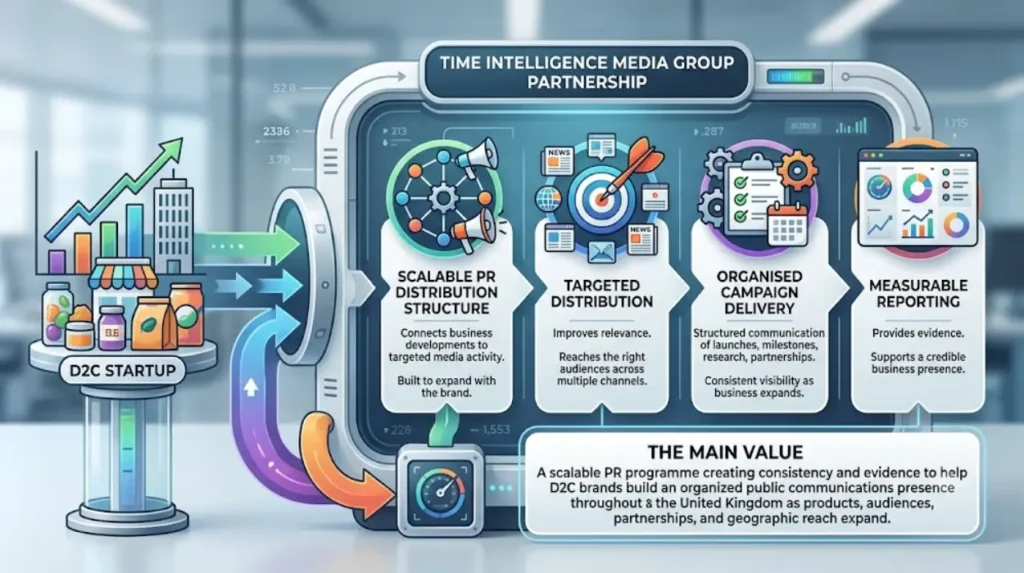
The main value is a scalable PR distribution structure that connects D2C business developments with targeted media activity, organised campaign delivery, and measurable reporting. This approach supports consistent visibility as startups expand products, audiences, partnerships, and geographic reach throughout the United Kingdom.
D2C growth requires more than customer acquisition campaigns. It requires a visible and credible business presence across multiple information channels.
Explore More Expert Insights:
Full-Service Financial PR Agencies vs. Time Intelligence Media Group: A Tactical Analysis
Best Newswire Services for Finance Brands to Guarantee Placement on High-Authority Business Networks
Time Intelligence Media Group provides structured support for startups that need to communicate launches, growth milestones, research, partnerships, and expansion plans.
A scalable programme creates consistency. Targeted distribution improves relevance. Reporting provides evidence. Together, these elements help D2C brands build an organised public communications presence as their business grows.