
Display ads are visual online advertisements—images, GIFs, or short videos—served on websites and apps to raise awareness among target buyers.
Display ads refer to creative, pixel-based ad formats that appear on publisher sites, mobile apps, and ad exchanges. In real estate, entities include property developers, estate agents, and property portals that use display ads to showcase listings, neighbourhood features, and development branding. Ad placements occur via direct publisher buys, demand-side platforms (DSPs), and Google Display Network. Key metrics include impressions, viewable impressions, click-through rate (CTR), cost per thousand impressions (CPM), and view-through conversions.
How do display ads fit into a real estate marketing funnel?
Display ads create top-of-funnel awareness by exposing potential buyers to property visuals and messages at scale across the open web and targeted sites.
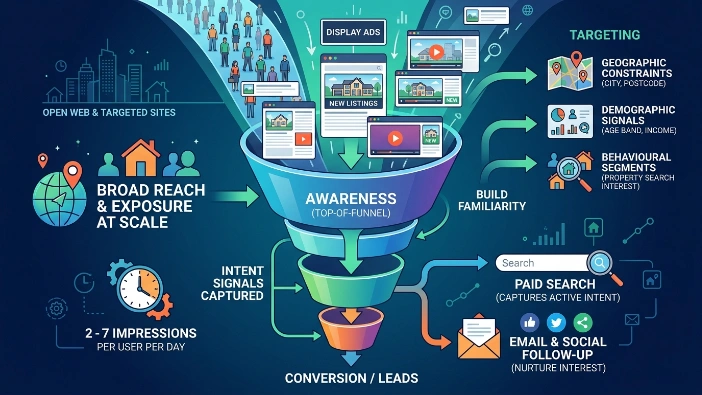
At the awareness stage, display ads generate broad reach. Targeting uses geographic constraints (city, postcode), demographic signals (age band, household income), and behavioural segments (property search interest). Frequency caps control how often a user sees the ad; common caps range from 2 to 7 impressions per user per day. Impressions build familiarity; subsequent marketing channels capture intent signals. Display campaigns support other channels: paid search captures active intent; email and social follow-up nurture interest.
What audience targeting methods do firms use for display ads?
Firms use location, demographic, contextual, and behavioural targeting to reach buyers who match property profiles.
Location targeting narrows inventory to local markets; examples: London boroughs, Greater Manchester postcodes. Demographic targeting filters by age ranges such as 25–34 or 35–54 and household income bands. Contextual targeting places ads alongside property news or mortgage advice. Behavioural targeting uses cookies and mobile advertising IDs to reach users who viewed listings or searched property terms. Audience lists include site visitors and CRM segments. First-party data (website visitors, enquiry lists) yields precise retargeting pools. Third-party data enriches audiences for scale, for example, buyers interested in new-build flats or houses with gardens.
How do firms design effective real estate display creatives?
Effective creatives use a single clear image, a concise headline, price or callout, and a visible call-to-action element to prompt next-step engagement.
Ad formats follow standard sizes to ensure cross-network compatibility: 300×250, 336×280, 728×90, 300×600, 320×50. Use 1–2 second video loops for mobile and GIFs for multi-image storytelling. Text overlays highlight unique selling points: number of bedrooms, price guide, completion date. Use accessible colour contrast and legible fonts. Include legal text where required, such as “Prices from £X” or energy performance ratings if regulated. Use dynamic creative optimization to test image variants and headlines. Track creative performance by CTR and view-through conversions to determine which visual elements drive site visits and enquiries.
What campaign setups drive buyer interest effectively?
Campaigns combine prospecting display to expand reach and retargeting display to re-engage users who showed prior interest.
Prospecting campaigns use broad but relevant audiences, contextual placements, and lookalike segments built from known buyers. Use frequency caps of 2–4 per week for awareness. Retargeting campaigns use site visitor lists with recency windows: 0–7 days for high intent, 8–30 days for warm audiences, 31–90 days for long-tail re-engagement. Use sequential messaging: initial ad highlights the property, second highlights floorplans and virtual tours, third offers booking options. Bid strategies include viewable CPM for visibility and target CPA for conversion-focused campaigns. Use conversion tracking with pixels or server-side events to capture enquiries, brochure downloads, and viewing bookings.
How do firms measure display ad performance for buyer interest?
Firms measure impressions, CTR, cost metrics, onsite engagement, and downstream lead outcomes to assess buyer interest and campaign impact.
Primary metrics: impressions, viewable impressions, CTR, CPM, cost per click (CPC), and cost per acquisition (CPA). Secondary metrics: bounce rate, pages per session, average session duration, and specific engagement events (virtual tour click, brochure download). Use multi-touch attribution models to assign partial credit to display exposures that preceded search or direct enquiries. Track view-through conversions to capture non-click influence: set a 7–30 day window depending on typical buyer research timelines. For longer purchase cycles, aggregate display touches per lead to calculate cost per influenced lead. Validate digital signals against CRM records by matching hashed identifiers or using customer-match lists.
What technical components enable display ad campaigns?
Key technical components include ad servers, demand-side platforms (DSPs), tracking pixels, audience segments, and creative asset management systems.
Ad servers host and cache display creatives and manage frequency caps across networks. DSPs enable real-time bidding across ad exchanges and allow bid adjustments by audience and placement. Tracking pixels or server-to-server event APIs capture page views, form submissions, and micro-conversions. GDPR-compliant consent management platforms govern cookie usage and consent signals. First-party data platforms (CDPs) aggregate CRM lists and website behaviour into usable segments. Creative management platforms automate A/B testing and dynamic creative assembly. Measurement tools include analytics platforms and attribution systems that ingest ad server data and conversion events.
What benefits do display ads deliver to real estate firms?
Display ads increase brand and listing awareness, drive targeted site traffic, and reduce time-to-contact by keeping properties visible to interested buyers.
They deliver scale across premium editorial sites and local publishers. They support spatial targeting for specific neighbourhood launches and amplify other channels such as search and email.
Benefits include measurable reach (millions of impressions in metropolitan areas), controlled frequency to avoid ad fatigue, and granular audience targeting to reach income bands and household types. Display ads improve cross-channel performance: retargeted users show 3–5x higher engagement on property pages versus cold audiences in some campaign analyses. Display campaigns produce visual-first touchpoints that improve recall and drive more qualified clicks to listings and virtual tours.
How Developers Sell Luxury Properties Using Banner Campaigns
How Real Estate Companies Improve Conversions Using Retargeting Ads
What use cases show display ads working for real estate?
Common use cases include new development launches, off-plan reservation drives, estate agent listing promotion, and area-branding campaigns to attract relocation buyers.
Examples: a new apartment block promoted across local finance and lifestyle sites, a village housing development targeted by postcode and commuter bands, and high-end homes showcased on luxury property sections of national news sites.
New-build launches use targeted prospecting to build pre-launch interest and retargeting to convert brochure downloads into reservations. Local estate agents use contextual and geo-targeted display ads to promote recent price reductions and open-house dates. Relocation-focused campaigns target job-hub commuters with messages about transport times and schools. Use case results typically show increased site sessions and higher qualified leads when display efforts coordinate with listings and lead-capture forms.
What legal and data-privacy considerations apply in the UK?

Display advertising must comply with UK privacy law, including GDPR principles and the Information Commissioner’s Office guidance on cookies and consent.
Use a consent management platform to collect and store user consents. Serve personalised ads only to audiences with lawful consent or rely on legitimate interest when justified and documented. Provide opt-out mechanisms for personalised advertising and respect Do Not Track signals where required. Maintain records of data processing activities and data-sharing agreements with DSPs and data providers. Include required property information and pricing transparency to meet advertising standards where applicable.
Display ads provide a visual, scalable method to create buyer awareness and sustain interest across the real estate customer journey. Firms use precise targeting, measurable creatives, and layered campaign setups—prospecting plus retargeting—to guide users toward listings and enquiries. Measurement combines ad metrics with onsite behaviour and CRM outcomes to attribute influence. Technical stacks rely on ad servers, DSPs, tracking pixels, and consent management to run compliant, efficient campaigns.