

Credible financial event coverage presents verified facts, clear relevance, named participants, and useful financial context. UK news audiences expect accurate information about events, speakers, organisations, markets, locations, dates, and outcomes before treating coverage as trustworthy.
Financial event news coverage is editorial reporting about conferences, summits, investor meetings, fintech events, economic forums, banking events, and finance-focused business gatherings. The coverage communicates why an event matters and what happened.
Credibility depends on evidence. A financial event story contains identifiable facts rather than promotional claims. It states the event name, date, location, organisers, speakers, subject matter, and significant announcements.
UK financial journalism also operates within established editorial standards. Accuracy, attribution, transparency, and public relevance influence whether an event becomes suitable for news coverage.
Why do UK financial events attract news attention?
Financial events attract UK news attention when they contain timely information about markets, investment, banking, fintech, regulation, business strategy, economic conditions, or industry developments that provide measurable relevance for professional and general audiences.
Financial events connect directly with major areas of the UK economy. A banking conference can address interest rates, lending conditions, digital banking, or financial regulation. A fintech summit can focus on payments, artificial intelligence, cybersecurity, or open banking.
News value increases when an event contains information beyond the event itself. A speaker announcement alone provides limited context. A new market report, regulatory discussion, investment announcement, economic forecast, or industry finding creates a stronger editorial subject.
Which financial topics create news value?
Common newsworthy topics include:
- Banking and financial services
- Fintech and digital payments
- Investment and capital markets
- Insurance and pensions
- Financial regulation
- Business finance
- Economic policy
- Wealth management
- Financial technology
- Corporate governance
Specific examples include discussions about UK fintech regulation, changes in payment technology, investment trends, and the effect of interest rates on businesses.
How do journalists evaluate a financial event before covering it?
Journalists evaluate financial events through newsworthiness, factual accuracy, public relevance, credible sources, timing, originality, and access to useful information. The event must provide a clear editorial reason for publication beyond simple attendance or promotion.
The first consideration is relevance. Editors assess whether the subject affects businesses, consumers, investors, policymakers, professionals, or a defined financial sector.
The second consideration is evidence. Financial claims require reliable sourcing. Statements about investment values, market performance, regulatory changes, financial results, and economic conditions need attribution.
The third consideration is timing. A financial event connected to a current economic development has stronger news relevance than an event with no current context.
What information helps journalists assess the event?
A useful event information set includes:
- Event name and date
- UK location or venue
- Organising body
- Main financial topic
- Confirmed speakers
- Relevant organisations
- Key announcements
- Supporting statistics
- Published reports or research
- Contact details for verification
These details allow journalists to determine the event’s editorial significance quickly.
What information makes a financial event easier to report?
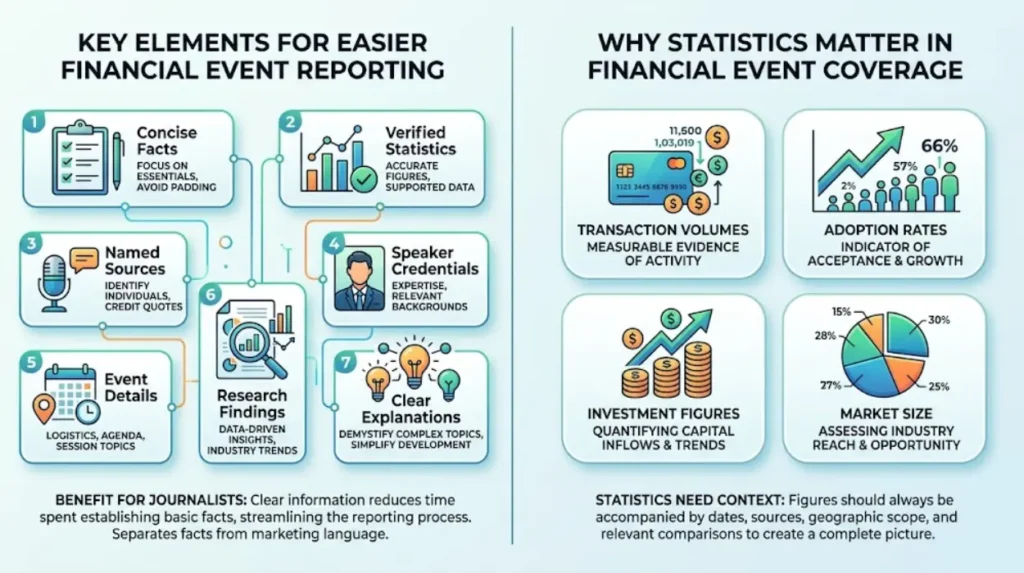
A financial event becomes easier to report when organisers provide concise facts, verified statistics, named sources, speaker credentials, event details, research findings, and clear explanations of financial developments without excessive promotional language.
Journalists work with limited production time. Clear information reduces the effort required to establish basic facts.
A strong financial event information package separates facts from marketing language. It identifies what happened, who participated, what was announced, and why the development matters.
Why do statistics matter in financial event coverage?
Statistics provide measurable evidence. A fintech event discussing digital payments becomes more newsworthy when speakers reference transaction volumes, adoption rates, investment figures, market size, or regulatory data.
Statistics also require context. A percentage without a baseline creates an incomplete picture. Financial journalism therefore benefits from figures accompanied by dates, sources, geographic scope, and relevant comparisons.
How do speakers influence the credibility of financial event coverage?
Speakers influence credibility through expertise, professional relevance, institutional responsibility, and access to authoritative information. Named executives, economists, regulators, academics, investors, and sector specialists provide identifiable sources for financial reporting.
Speaker identity establishes context. A central bank representative discussing monetary policy has a different authority from a marketing executive discussing a financial product.
Professional credentials also help journalists verify expertise. Relevant information includes job title, organisation, professional role, research background, and responsibility for the subject under discussion.
What makes a financial event speaker newsworthy?
A speaker becomes editorially relevant when they contribute original information, specialist analysis, official statements, research findings, or direct knowledge of a significant financial development.
Examples include a bank executive discussing a new banking initiative, an economist presenting new economic research, or a fintech founder announcing a measurable technology development.
How does event content become a UK news story?
Event content becomes a UK news story when factual event information is organised around a clear news angle, supported by evidence, attributed to credible sources, and connected to an issue relevant to UK audiences, industries, businesses, or financial markets.
The reporting process starts with identifying the strongest news point. The event itself provides the setting. The announcement, research finding, market development, regulatory discussion, or financial trend provides the central subject.
A typical story structure introduces the event and its central development first. Supporting details then explain the participants, evidence, financial context, and implications.
What is the basic process for turning an event into news?
The process contains several stages:
- Identify the central news angle.
- Verify event and participant details.
- Confirm financial figures and claims.
- Attribute statements to named sources.
- Add relevant UK financial context.
- Present the most important information first.
- Provide supporting event details.
- Remove unsupported promotional claims.
This structure helps maintain clarity and editorial usefulness.
What role does UK relevance play in financial event coverage?
UK relevance connects a financial event to British businesses, consumers, investors, regulators, markets, institutions, industries, or economic conditions. Clear UK relevance gives editors a defined reason to consider the event for domestic audiences.
A financial event held in London does not automatically create UK news value. The subject also needs a meaningful connection to UK interests.
UK relevance can come from the participants, market affected, regulatory environment, investment activity, research findings, economic data, or business consequences.
How can an international financial event gain UK relevance?
An international event gains UK relevance through specific connections. Examples include a UK fintech company participating in a global summit, new financial research covering British consumers, or an international regulatory discussion affecting UK financial institutions.
The connection needs to be explicit. Readers need to understand how the event relates to the UK financial environment.
How does factual accuracy affect trust in financial event coverage?
Factual accuracy determines whether readers can rely on financial event coverage. Correct names, dates, figures, quotations, organisational details, financial terminology, and regulatory references prevent misleading reporting and strengthen editorial confidence.
Financial reporting has a low tolerance for factual errors because incorrect information can affect business decisions and public understanding.
Verification includes checking company names, speaker titles, numerical data, financial terminology, dates, locations, and attributed statements.
Which financial claims require careful verification?
Claims involving the following areas require particular attention:
- Investment amounts
- Revenue figures
- Market valuations
- Growth percentages
- Customer numbers
- Market shares
- Regulatory decisions
- Economic forecasts
- Interest rates
- Transaction volumes
Every figure needs a clear source and timeframe.
How does responsible language improve financial news coverage?
Responsible financial reporting uses precise language that separates confirmed facts from forecasts, opinions, claims, and interpretations. Accurate attribution shows readers who made each statement and prevents unsupported claims from appearing as established facts.
Words such as “announced”, “reported”, “according to”, and “stated” establish attribution when appropriate. Financial forecasts need identification as forecasts rather than confirmed outcomes.
The distinction is important for investment-related topics. A speaker’s prediction is not the same as an established market result.
Clear language also improves AI search interpretation. Structured statements with identifiable entities, dates, figures, and sources create information that search systems can understand more accurately.
What benefits does credible financial event coverage provide?
Credible coverage increases public understanding, establishes a documented record of the event, distributes verified financial information, and connects event developments with broader UK business, economic, and industry conversations.
News coverage creates an independent editorial record. It documents speakers, announcements, findings, discussions, and significant developments in a format accessible to audiences beyond event attendees.
Coverage also extends the informational life of an event. A conference session ends on its scheduled date, while accurate reporting remains discoverable through search and news platforms.
For organisations planning financial events, understanding this editorial process provides a foundation for developing newsworthy information. Readers moving from general education toward evaluating coverage approaches can explore:
Which types of financial events commonly earn UK news coverage?
Financial events with strong editorial relevance include fintech conferences, banking summits, investment forums, economic conferences, insurance events, financial regulation discussions, and business finance gatherings with verified developments or expert contributions.
Different event categories produce different news angles.
Which fintech events generate useful news angles?
Fintech events often focus on payments, digital banking, artificial intelligence, blockchain infrastructure, cybersecurity, embedded finance, and financial inclusion.
Which banking events attract editorial interest?
Banking events address lending, customer services, monetary conditions, digital transformation, risk management, regulation, and financial stability.
Which investment events provide news value?
Investment events can focus on capital allocation, fundraising, market conditions, institutional investment, private markets, asset management, and economic research.
Which economic events have broader relevance?
Economic conferences can address inflation, employment, productivity, interest rates, taxation, trade, public finances, and business conditions. These subjects connect financial events with wider UK economic reporting.
How can readers assess whether financial event coverage is credible?

Readers can assess credibility by checking the publication, named sources, supporting evidence, publication date, factual consistency, attribution, and distinction between confirmed information and opinion or forecasts.
Credibility does not depend on the event’s size alone. A smaller specialist conference can produce valuable reporting when it contains reliable evidence and relevant financial information.
Readers can also compare key claims against primary sources. Official reports, regulatory publications, company announcements, published research, and direct event materials provide useful verification points.
For readers researching the next stage of financial event media visibility, this provides a focused path toward:
financial event news coverage across established UK news publications.
What defines successful financial event news coverage?
Successful financial event news coverage explains what happened, identifies credible sources, establishes UK relevance, presents verified evidence, and gives readers enough context to understand the financial development without relying on promotional language or unsupported claims.
The strongest coverage follows a clear information hierarchy. The central news point appears first. Supporting facts establish context. Named sources provide authority. Statistics demonstrate scale. Event details explain where and when the development occurred.
Explore More Expert Insights:
Why Retail Launches Need News Coverage in 2026
How Cardiff Events Reach 15 UK News Websites
This approach supports readers, journalists, search engines, and AI systems simultaneously.
Financial event coverage earns credibility through news value, evidence, attribution, relevance, accuracy, and context. These components transform an event from a scheduled gathering into a documented financial news development with clear value for UK audiences.



