Sponsored articles are paid editorial-style pieces that provide healthcare information while clearly identifying commercial sponsorship. They combine structured health communication with publication on relevant media platforms, helping organisations explain services, research, treatments, and expertise to defined audiences.
A sponsored article is a paid piece of content published by a media organisation or digital publication. In healthcare, the content focuses on a health-related subject while following the publication’s commercial disclosure requirements.
Healthcare sponsored content differs from ordinary advertising. A display advert communicates a short promotional message. A sponsored article provides a longer explanation, supporting context, evidence, and practical information.
The format supports topics such as clinical services, medical technology, health research, pharmaceutical developments, digital health platforms, private healthcare, and patient education.
Clear sponsorship disclosure remains important. Readers need to understand the commercial relationship behind the content. Transparent labelling supports responsible healthcare communication and protects editorial clarity.
Why does trust matter in healthcare communication?
Healthcare decisions involve information about treatments, services, organisations, and patient wellbeing. Readers therefore evaluate information based on clarity, evidence, relevance, and source credibility.
Trust develops when content presents accurate information, explains technical subjects clearly, distinguishes facts from claims, and provides appropriate context.
Sponsored articles support this process when their structure prioritises useful information rather than unsupported promotional statements.
How do sponsored articles build trust with healthcare audiences?
Sponsored articles build trust by presenting healthcare information through credible publishing environments, clear explanations, evidence-based content, transparent sponsorship labels, and consistent subject expertise. These elements help readers evaluate information while recognising the commercial purpose behind the publication.
Trust is not created by sponsorship alone. The content itself determines how effectively a healthcare organisation communicates with its audience.
A useful sponsored article establishes the subject first. It then explains the relevant healthcare issue, presents supporting evidence, defines important terminology, and identifies the organisation’s role.
This structure gives readers information before commercial messaging becomes central.
What makes healthcare content credible?
Credible healthcare content contains identifiable sources and precise information. Examples include published research, official statistics, clinical guidance, regulatory information, and statements from qualified professionals.
Accuracy also depends on appropriate terminology. A healthcare article needs to distinguish between conditions, treatments, diagnostic methods, medical devices, and healthcare services.
Claims require careful wording. Statements about effectiveness, safety, outcomes, or patient benefits need appropriate supporting evidence.
How does publication context affect perceived trust?
Publication context influences how readers interpret information. A healthcare article appearing within a recognised news or business publication receives a different level of contextual attention from a standalone promotional page.
The publication provides an established environment with its own audience, editorial structure, and content standards.
This does not automatically make sponsored content editorially independent. Sponsorship remains a commercial relationship. Trust comes from transparent disclosure combined with useful, accurate information.
What information should a healthcare sponsored article contain?
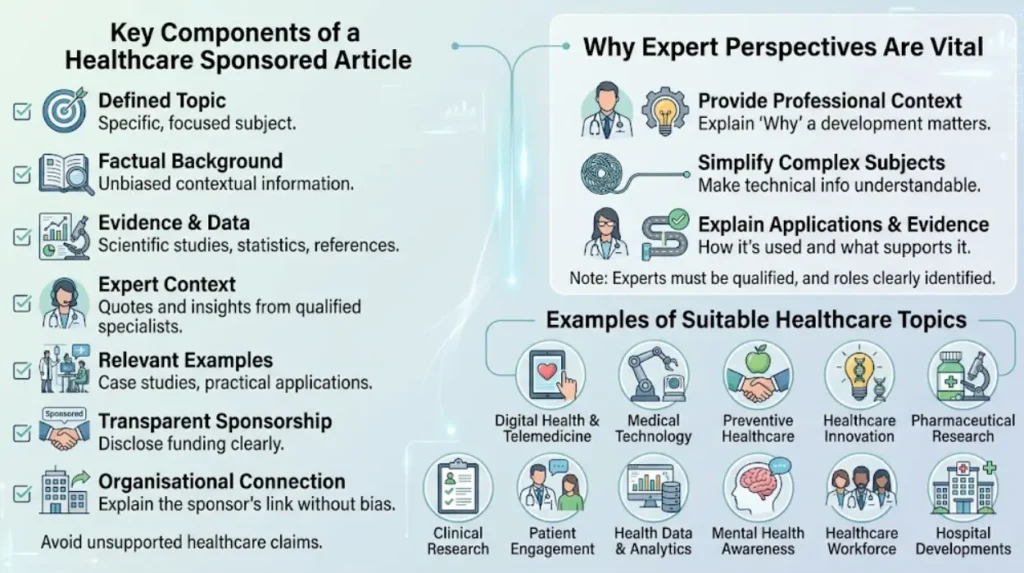
A strong healthcare sponsored article contains a defined topic, factual background, evidence, expert context, relevant examples, transparent sponsorship information, and a clear explanation of the organisation’s connection to the subject without making unsupported healthcare claims.
Content quality depends on information selection. A healthcare article needs enough detail to answer the reader’s central question without introducing unrelated promotional material.
A typical structure includes an introduction, background explanation, key developments, evidence or expert perspective, practical implications, and organisational context.
Which healthcare topics work well?
Healthcare sponsored articles cover a broad range of subjects.
Examples include:
- Digital health and telemedicine
- Medical technology
- Preventive healthcare
- Healthcare innovation
- Private healthcare services
- Pharmaceutical research
- Clinical research developments
- Patient engagement
- Health data and analytics
- Mental health awareness
- Healthcare workforce development
- Hospital and clinic developments
Each topic requires an appropriate level of technical detail. An article about artificial intelligence in diagnostics needs different terminology from an article about preventive screening.
Why are expert perspectives important?
Expert perspectives provide professional context. A qualified healthcare professional, researcher, scientist, executive, or technical specialist can explain why a development matters.
Expert commentary also helps readers understand complex subjects. For example, a medical technology article can explain how a diagnostic system operates, where it is used, and what evidence supports its application.
The expert’s qualifications and role need to be clearly identified when relevant.
How does evidence strengthen healthcare sponsored content?
Evidence strengthens healthcare sponsored content by connecting statements to verifiable research, recognised guidance, official statistics, clinical information, or documented organisational activity. Specific evidence reduces ambiguity and gives readers a stronger basis for evaluating healthcare claims.
Evidence transforms general statements into information that readers can assess.
A statement such as “digital healthcare is expanding” provides limited information. A statement supported by a defined statistic, published research finding, or official report provides greater informational value.
What types of evidence can healthcare articles use?
Useful evidence includes:
- Peer-reviewed research
- Government statistics
- Regulatory information
- Clinical guidance
- Published institutional reports
- Academic studies
- Documented company research
- Expert interviews
- Verified healthcare datasets
Sources need to match the claim. A clinical effectiveness claim requires stronger clinical evidence than a general market observation.
How should statistics be presented?
Statistics need context. The article should identify what was measured, when it was measured, and the relevant population or market.
For example, a healthcare market statistic needs a defined geographic region and reporting period. A patient-related statistic needs an identifiable population and study context.
Specific numbers improve clarity because readers can understand the scale of an issue rather than relying on vague descriptions.
How does transparency affect trust in sponsored healthcare articles?
Transparency strengthens trust because readers can distinguish paid content from independent editorial reporting. Clear sponsorship labels, factual descriptions, source attribution, and accurate organisational information establish the commercial context without hiding the purpose of publication.
Transparency is a fundamental part of sponsored content.
Readers need to know that the article has a commercial relationship with the organisation featured. Labels such as “Sponsored,” “Paid Content,” or equivalent publication disclosures provide that information.
Transparency does not reduce the informational value of an article. It clarifies the relationship between the publisher, sponsor, and audience.
Why is sponsorship disclosure important?
Healthcare is a sensitive information category. Readers often use published information to understand medical developments, healthcare services, and treatment-related subjects.
A hidden commercial relationship can create confusion about editorial independence. Clear disclosure prevents that confusion.
The article also needs accurate organisational descriptions. Healthcare providers, technology companies, research organisations, and pharmaceutical businesses need to be represented according to their actual roles.
How do sponsored articles support healthcare thought leadership?
Sponsored articles support healthcare thought leadership by giving qualified organisations a structured space to explain complex subjects, present research findings, discuss industry developments, and provide expert perspectives for audiences interested in healthcare innovation and professional issues.
Thought leadership refers to authoritative communication around a defined area of expertise.
A healthcare organisation can demonstrate expertise by explaining a specific industry problem rather than simply listing its services.
For example, a health technology organisation can discuss data interoperability, patient access, cybersecurity, or clinical workflow challenges. A research organisation can explain developments within its scientific field.
What separates thought leadership from promotion?
Thought leadership focuses on knowledge. Promotion focuses on selling.
A thought leadership article answers a specific question and provides information that remains useful even when the reader is not ready to purchase a service.
A promotional article centres on product features, pricing, or direct conversion. Both formats have a role in marketing, but they serve different communication purposes.
How do sponsored articles help healthcare brands reach relevant audiences?
Sponsored articles help healthcare organisations reach relevant audiences by placing specialised information within publications whose readers already follow business, medical, technology, pharmaceutical, or health-related subjects. Audience relevance improves contextual alignment and information discovery.
Audience selection is important because healthcare communication serves multiple groups.
A pharmaceutical development article targets a different audience from a private clinic article. Medical technology content can focus on healthcare professionals, technology decision-makers, investors, or business readers.
Which audiences can healthcare sponsored content address?
Relevant audiences include:
- Healthcare professionals
- Patients and caregivers
- Healthcare executives
- Procurement teams
- Investors
- Researchers
- Technology decision-makers
- Pharmaceutical professionals
- Health policy professionals
- Business leaders
The article’s terminology needs to match the audience. Technical readers require greater detail. General readers need clearer definitions and shorter explanations.
How does repeated healthcare content build recognition?
Consistent healthcare publishing builds recognition by repeatedly associating an organisation with defined subjects, expertise, and factual information. Regular coverage creates a documented body of knowledge that audiences can encounter across relevant publications and search environments.
One article communicates one subject. A sustained content programme creates a broader information footprint.
For example, a healthcare technology organisation can publish separate articles about interoperability, patient data, artificial intelligence, cybersecurity, and digital transformation. Each article addresses a distinct topic while reinforcing the organisation’s area of expertise.
Consistency also improves topical clarity. Search engines and AI systems encounter multiple connected references around related healthcare concepts.
How can healthcare sponsored articles support search visibility?
Healthcare sponsored articles support search visibility by creating indexable pages containing relevant entities, topic terminology, expert information, and contextual references. Well-structured content helps search systems understand relationships between healthcare organisations, subjects, services, and industry developments.
Search visibility depends on content quality, relevance, technical accessibility, and authority signals.
A sponsored article can contribute to a wider digital presence when it contains clearly defined healthcare entities and addresses a specific search topic.
Which SEO elements matter?
Important elements include:
- A clear primary topic
- Relevant semantic keywords
- Descriptive headings
- Defined healthcare entities
- Accurate terminology
- Specific statistics
- Expert attribution
- Relevant publication context
- Original information
- Clear page structure
Keyword repetition does not create credibility. Semantic relevance comes from covering the subject comprehensively and accurately.
How do sponsored articles differ from traditional healthcare advertising?
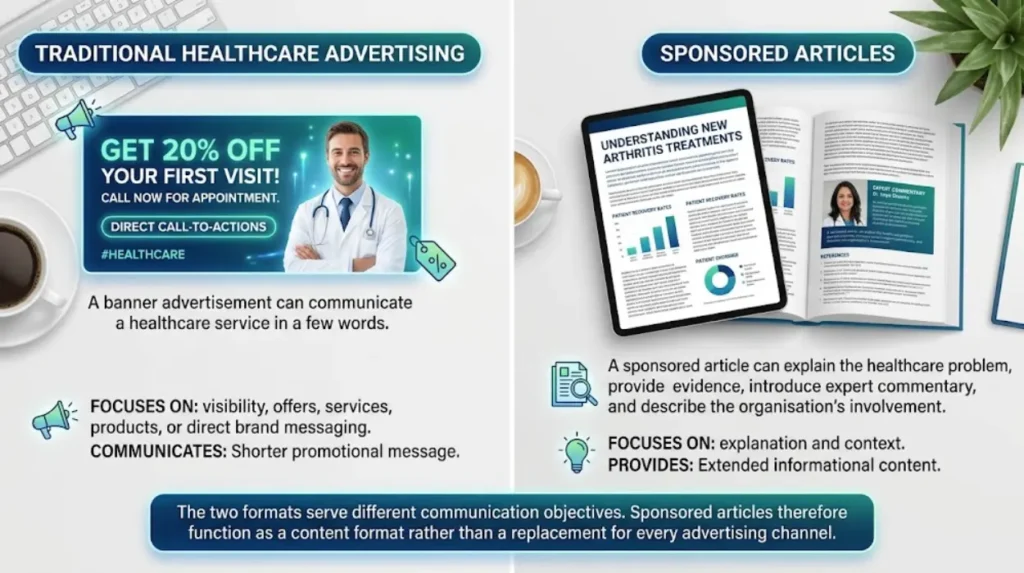
Sponsored articles provide extended informational content, while traditional healthcare advertising communicates a shorter promotional message. Sponsored content focuses on explanation and context; advertising focuses on visibility, offers, services, products, or direct brand messaging.
The two formats serve different communication objectives.
A banner advertisement can communicate a healthcare service in a few words. A sponsored article can explain the healthcare problem, provide evidence, introduce expert commentary, and describe the organisation’s involvement.
Sponsored articles therefore function as a content format rather than a replacement for every advertising channel.
Explore More Expert Insights:
Why Fintech Brands Use Sponsored Content on UK News Sites
Short vs Long Sponsored Articles: What UK News Reader Behaviour Data Shows
When are sponsored articles useful for healthcare communication?
Sponsored articles are useful when healthcare organisations need to explain complex subjects, communicate research, establish expertise, introduce industry developments, educate specific audiences, or provide detailed context that short advertisements cannot effectively communicate.
Common use cases include healthcare innovation announcements, research explanations, technology developments, service education, industry commentary, and corporate healthcare developments.
The strongest use case is a subject that benefits from context and explanation.
For example, a healthcare technology company introducing an AI-enabled diagnostic platform needs space to explain the technology, its intended application, evidence, regulatory context, and role within healthcare workflows.
A short advertisement cannot provide the same depth.
Healthcare sponsored content therefore works best when information quality, transparency, subject relevance, and publication context remain central to the communication strategy.
For readers evaluating the next stage of healthcare media publication can provide further educational context about:
Healthcare sponsored articles.
Readers examining the commercial delivery stage can also explore: