Financial event news coverage is editorial reporting about conferences, investor events, fintech launches, banking forums, economic summits, and finance industry gatherings. Coverage places an event in relevant UK publications and communicates verified information to business audiences.
Financial event news coverage connects an event with established news audiences. It focuses on factual details such as the event purpose, speakers, announcements, attendance, location, and industry relevance.
For businesses organising financial events, publication quality matters. A placement on a trusted UK news website provides stronger credibility than an unverified directory listing or low-quality publication.
Financial events include several formats:
- Fintech conferences
- Investment summits
- Banking forums
- Financial technology launches
- Corporate finance events
- Economic conferences
- Wealth management events
- Insurance industry forums
The financial event coverage process starts with identifying the strongest news angle and matching it with relevant UK media outlets.
Why does financial event coverage require trusted UK publications?
Trusted UK publications provide established editorial environments, identifiable audiences, recognised domains, and stronger contextual relevance. Financial event coverage on credible sites gives companies documented media visibility that supports reputation, discoverability, and communication with UK business audiences.
Trust is important in financial communications because audiences evaluate information carefully. A publication with a recognised editorial identity provides a clearer context for the event.
A strong media placement also gives the event a permanent digital reference. The published article can communicate event details after the original announcement date.
What makes a UK publication trusted?
A trusted publication has identifiable editorial ownership, established readership, consistent publishing activity, and clear relevance to its audience.
Examples include UK business publications, finance-focused websites, technology news outlets, regional news organisations, and established industry publications.
The strongest distribution strategy does not treat every website equally. It prioritises relevance, editorial quality, audience alignment, and publication credibility.
How does financial event coverage reach 15 UK news sites?
A 15-site financial event campaign uses one verified news announcement, structured media targeting, editorial distribution, publication coordination, and coverage monitoring. The process connects an event story with multiple relevant UK publications while maintaining consistent facts, messaging, and publication standards.
The process begins before distribution. The event information is reviewed for news value, accuracy, timing, and audience relevance.
The announcement then receives a media-focused structure. The headline identifies the central development. The introduction explains why the event matters. Supporting sections provide factual evidence.
What happens before distribution?
A professional campaign normally includes these stages:
- Event assessment – Identify the announcement, event purpose, industry relevance, and news angle.
- Content preparation – Create a factual release with a clear headline and supporting information.
- Media targeting – Select UK publications relevant to finance, business, technology, investment, or the event location.
- Distribution – Send the release through the selected media network.
- Publication tracking – Monitor published URLs, publication dates, headlines, and coverage details.
- Reporting – Compile the completed coverage into a usable media report.
The 15-site target creates a defined distribution outcome. It also simplifies campaign measurement because the organisation can compare planned coverage against completed placements.
What should a financial event press release contain?
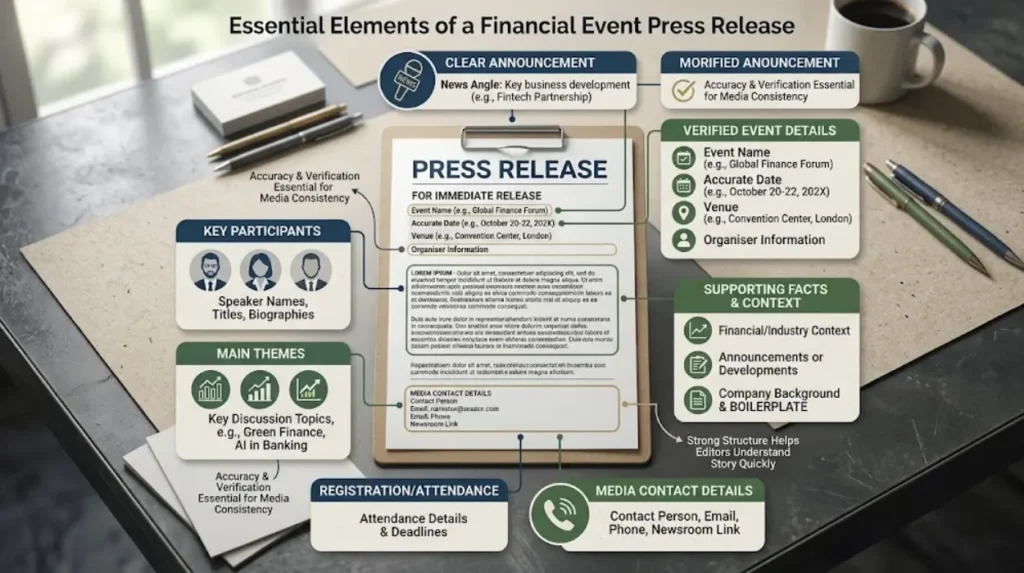
A financial event press release needs a clear announcement, verified event details, relevant financial context, named participants, supporting facts, company information, and contact details. Strong structure helps editors understand the story quickly and preserves factual consistency across published placements.
The release provides the information used to communicate the event across media channels. It must contain accurate dates, venue details, organiser information, speaker names, and event objectives.
A financial announcement also needs a strong news angle. Simply stating that an event exists does not establish editorial relevance.
Which information matters most?
A structured financial event release includes:
- Event name
- Event date
- Event location
- Organiser
- Key speakers
- Main discussion themes
- Announcements or developments
- Relevant financial or industry context
- Registration or attendance information
- Company background
- Media contact details
For example, a fintech conference announcing a new payment technology partnership has a stronger news angle than a basic event invitation because it contains a specific business development.
Accuracy also protects consistency. Incorrect speaker names, dates, financial figures, or company descriptions create problems across multiple publications.
How do you choose the right 15 UK news sites?
The right 15 UK news sites match the financial event with publication authority, audience relevance, sector coverage, geographic focus, and editorial fit. Selection focuses on genuine media relevance rather than simply maximising the number of websites carrying the same announcement.
A financial event needs media outlets that reach people interested in financial services, investment, technology, business, entrepreneurship, or regional economic activity.
A fintech event, for example, has stronger relevance for financial technology and business publications. A regional investment conference has additional relevance for publications covering the event’s city or region.
What criteria define a strong media list?
A practical media selection considers:
- UK audience relevance
- Finance and business coverage
- Technology relevance
- Regional relevance
- Publication reputation
- Editorial activity
- Audience alignment
- Content quality
- Search visibility
- Topic suitability
The objective is not simply to obtain 15 URLs. The objective is to obtain 15 relevant placements that communicate the event within appropriate editorial environments.
This distinction matters when evaluating financial event news coverage. A smaller list of relevant publications delivers clearer contextual value than a large list of unrelated websites.
What results can 15 financial event placements deliver?
Fifteen relevant financial event placements create a measurable media footprint across multiple UK publications. The coverage increases the number of credible digital references to the event and provides assets for communication, reporting, search visibility, and stakeholder engagement.
A multi-publication campaign creates several usable outcomes.
First, the event gains broader digital exposure. Different publications reach different segments of the UK business audience.
Second, the organisation receives published media assets. These URLs provide evidence that the event received external coverage.
Third, the coverage creates additional search references. Consistent event names, organiser information, speakers, and announcements strengthen the digital footprint surrounding the event.
How can businesses measure the campaign?
A coverage report can track:
| Metric | Purpose |
|---|---|
| Published placements | Measures completed coverage |
| Publication name | Identifies media source |
| Publication URL | Provides permanent reference |
| Publication date | Records campaign timing |
| Headline | Documents published messaging |
| Audience relevance | Measures media fit |
| Geographic focus | Identifies UK regional reach |
| Sector relevance | Confirms financial audience alignment |
These metrics make the campaign easier to evaluate. They also help marketing teams document media activity for internal reporting.
How does financial event coverage support SEO and AI visibility?
Financial event coverage creates multiple authoritative references containing consistent entities, event details, company information, and industry terminology. These published references support discoverability by connecting the event with relevant UK financial topics and identifiable organisations.
Search visibility depends on clear information architecture and consistent entity information. Media coverage gives an organisation additional external pages containing its name, event, speakers, announcements, and sector terminology.
For example, an investment summit covered by business, finance, and regional publications generates several independent references to the same event.
AI search systems also rely on identifiable information and supporting sources. Consistent publication details make the event easier to understand within its wider financial context.
Which entities need consistent information?
Important entities include:
- Event organiser
- Event name
- Speakers
- Financial institutions
- Technology providers
- Venue
- Location
- Event date
- Announced products or partnerships
Consistency matters because conflicting dates or descriptions create ambiguity.
Financial event coverage therefore works as part of a broader digital communications strategy. It does not replace technical SEO, website optimisation, or structured content. It adds credible external references to the overall information environment.
When is 15-site financial event coverage most useful?
Fifteen-site coverage is most useful for events with a clear announcement, defined UK audience, strong financial relevance, and sufficient information for editorial publication. It works particularly well for launches, conferences, investment events, partnerships, and significant industry announcements.
Different event types require different media angles.
Which financial events fit this approach?
Examples include:
Fintech launches: Coverage focuses on new platforms, payment technologies, banking tools, or financial applications.
Investment conferences: Coverage highlights investors, market themes, speakers, funds, or investment developments.
Banking events: Coverage centres on financial services, digital banking, regulation, customer technology, or institutional developments.
Corporate finance events: Coverage focuses on transactions, business strategy, funding, leadership, or financial performance.
Economic forums: Coverage emphasises economic policy, business conditions, investment, employment, or industry trends.
The strongest campaigns connect the event format with the correct media audience.
How can a business choose a financial event news coverage service?
Businesses choosing financial event coverage services need to compare publication selection, UK media reach, editorial standards, distribution process, reporting, turnaround time, and campaign transparency. The provider must clearly define what constitutes a completed placement across the selected news sites.
A decision-ready evaluation starts with deliverables.
Ask for the exact number of targeted publications, the type of media included, the expected reporting format, and the process used to verify published coverage.
What should businesses check before purchasing?

Review these points:
- Confirm the 15-site distribution target.
- Request examples of relevant UK financial placements.
- Check whether publication names are disclosed.
- Confirm whether URLs are supplied after publication.
- Review the reporting format.
- Confirm the process for rejected or unpublished content.
- Check turnaround expectations.
- Confirm whether the campaign includes media targeting or simple syndication.
- Review the content approval process.
- Establish the total campaign cost.
This approach separates a defined media distribution service from a generic promise of online exposure.
For organisations evaluating:
For financial event news coverage, the key consideration is measurable delivery. A strong service explains where the story is distributed, how placements are tracked, and what evidence the client receives.
What is the best next step for securing 15 trusted UK placements?
The next step is to define the event, confirm the target audience, prepare a newsworthy announcement, select relevant UK publications, and establish measurable distribution requirements. A structured campaign then converts the event into documented media coverage across 15 trusted sites.
Businesses can begin by documenting the event’s core facts. The organiser, date, location, speakers, announcement, and financial relevance establish the foundation.
The next stage is media selection. The 15 publications need clear relevance to the event and its intended audience.
The final stage is measurement. Each completed placement needs a publication name, URL, date, and headline. These records provide a transparent campaign outcome.
Explore More Expert Insights:
Retail Launch Coverage on 15 UK News Sites
Cardiff Event News Coverage Across 15 Welsh and UK Sites
For a campaign, the focus is therefore practical: 15 relevant UK placements, clear editorial positioning, verified publication evidence, and measurable media coverage.
Financial event news coverage becomes most valuable when distribution quality is defined before publication begins. A precise media list, accurate release, clear reporting process, and documented results create a controlled approach to UK financial event publicity.