

Healthcare sponsored content is paid editorial-style content created for a healthcare organisation and distributed through established media channels. It communicates verified information, services, research, or expertise while clearly identifying its sponsored nature to maintain transparency.
Healthcare sponsored content combines healthcare communications with paid media distribution. It gives brands a controlled format for presenting detailed information to relevant audiences.
Typical content includes:
- Healthcare company announcements
- Medical technology launches
- Digital health solutions
- Healthcare research developments
- Hospital and clinic initiatives
- Pharmaceutical industry updates
- Expert-led educational articles
- Healthcare conference announcements
For UK audiences, the content needs clear commercial identification. Sponsored material also requires accurate healthcare claims and responsible wording. Content must distinguish promotional statements from factual medical information.
For organisations evaluating publication options, understanding how:
Healthcare sponsored articles move through UK media channels provides useful context before selecting a distribution provider.
Why do healthcare brands use sponsored content?
Healthcare brands use sponsored content to communicate detailed messages in recognised media environments, reach defined audiences, support brand visibility, and control publication timing. The format also provides space for company expertise, product information, research developments, and healthcare-focused educational content.
Healthcare marketing often involves technical information. Standard advertisements provide limited space for explaining complex subjects. Sponsored articles provide a longer editorial format.
A healthcare technology company, for example, can explain how its patient-management platform works, identify its target users, and describe its operational benefits within one structured article.
Sponsored content also provides greater control over messaging. The organisation supplies the core information, approved claims, brand terminology, and preferred positioning.
This control supports consistency across multiple placements.
For UK healthcare brands, sponsored content also supports communication across specialist and general business audiences. Examples include healthcare publications, business news platforms, technology media, and regional publications.
How does Time Intelligence Media Group publish healthcare sponsored content?
Time Intelligence Media Group supports healthcare sponsored content through a structured process covering content preparation, publication selection, editorial compliance, distribution, and reporting. Each stage focuses on accurate messaging, appropriate media placement, transparent sponsorship, and measurable publication outcomes.
1. Content requirements are established
The process begins with the campaign objective. The healthcare organisation identifies the subject, audience, geographic focus, preferred publication types, and required publication timing.
The content brief defines the central topic and supporting information.
A healthcare software company, for example, can focus its article on electronic patient records, clinical workflow technology, or healthcare data management.
2. Content is prepared
The article is developed around the approved subject. Healthcare terminology remains precise. Claims remain evidence-based. Company information remains consistent with the supplied brief.
The article structure normally includes:
- A clear headline
- An introduction
- Supporting healthcare information
- Company or solution context
- Relevant facts and evidence
- A concise conclusion
- Appropriate commercial disclosure
3. Suitable media placements are selected
Publication selection depends on the target audience and campaign objectives.
A campaign targeting healthcare professionals requires a different publication mix from one targeting investors, business decision-makers, or consumers.
Time Intelligence Media Group can position sponsored content according to the intended UK media audience and campaign requirements.
4. Publication requirements are checked
Each publication has its own requirements for sponsored material. These requirements can cover article length, formatting, disclosure, links, images, claims, and subject suitability.
The content is prepared according to the requirements of the selected media environment.
5. Articles are published and documented
Once approved, the sponsored article is published through the selected media placements. Publication details provide evidence of where the campaign appeared.
Reporting can include published URLs, publication names, dates, and other available campaign information.
What does a healthcare sponsored content campaign include?
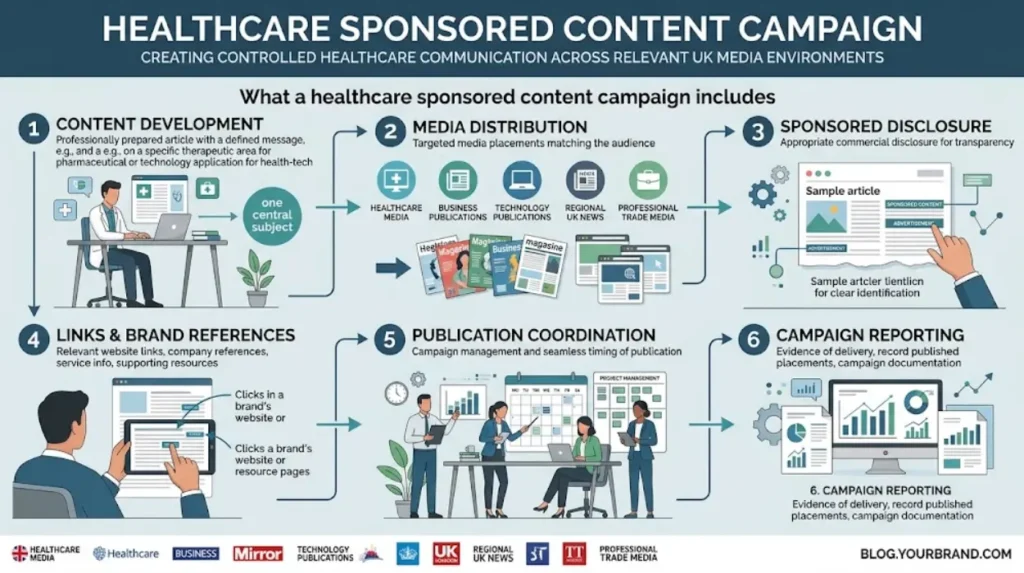
A healthcare sponsored content campaign includes a defined message, professionally prepared article, targeted media placements, appropriate commercial disclosure, publication coordination, and campaign reporting. The components work together to create controlled healthcare communication across relevant UK media environments.
Content development
The article provides the foundation of the campaign. Strong healthcare content explains one central subject clearly instead of combining unrelated messages.
For example, a pharmaceutical company can focus on a specific therapeutic area, while a health-tech company can focus on a defined technology application.
Media distribution
Distribution determines where the article reaches readers. Media selection needs to match the campaign audience.
Relevant categories include:
- Healthcare media
- Business publications
- Technology publications
- Regional UK news
- Professional trade media
Sponsored disclosure
Sponsored content requires clear identification of its commercial nature. This distinction supports transparent communication between the publisher, brand, and reader.
Links and brand references
Campaign requirements can include relevant website links, company references, service information, or supporting resources. Links need to remain relevant to the article topic.
Publication reporting
Reporting provides evidence of campaign delivery. It allows marketing teams to record published placements and maintain campaign documentation.
How is healthcare sponsored content different from traditional advertising?
Healthcare sponsored content differs from traditional advertising because it uses a longer-form article format to explain a defined subject. Traditional advertising focuses on concise promotional messages, while sponsored content provides structured information within a clearly identified paid media placement.
A banner advertisement typically communicates one short message. A sponsored article provides substantially more space for context.
For example, a healthcare diagnostics company can use an advertisement to promote a diagnostic service. A sponsored article can explain the technology, its application, the organisation’s expertise, and relevant industry developments.
The two formats serve different communication requirements.
Sponsored content also differs from earned editorial coverage. Earned coverage results from independent editorial decisions. Sponsored content is paid media placement with commercial disclosure.
This distinction matters when evaluating campaign objectives.
How does healthcare sponsored content support UK media visibility?
Healthcare sponsored content supports UK media visibility by placing controlled brand information within selected publications that serve healthcare, business, technology, and professional audiences. The resulting placements create identifiable media assets that organisations can reference across wider marketing activities.
UK media visibility depends on audience relevance and publication quality.
A healthcare company targeting NHS decision-makers requires different media environments from a consumer health brand. A medical technology company targeting investors also requires a different publication strategy.
Sponsored distribution gives marketing teams control over the publication environment.
Published articles also create reusable digital assets. Organisations can reference them in company communications, sales materials, social media campaigns, investor communications, and internal reports.
The value comes from the combination of content, placement, audience relevance, and publication evidence.
What outcomes can healthcare brands measure?
Healthcare brands can measure sponsored content through publication delivery, media placements, referral activity, engagement indicators, branded search activity, link performance, and campaign reporting. Measurement starts with defined objectives and uses metrics relevant to the communication purpose.
Publication delivery
The first measurement confirms whether contracted placements were published.
Important records include publication name, article URL, publication date, and campaign identifier.
Referral activity
Tracked links provide information about visitors arriving from published articles.
Healthcare brands can connect these visits with landing pages, enquiry forms, downloads, or other measurable actions.
Search visibility
Published content can contribute to a wider digital footprint. Branded references and relevant links provide additional online locations where an organisation appears.
Search performance remains dependent on the broader website, content quality, technical SEO, authority, and search-engine systems.
Engagement
Available engagement metrics can include page views, referral traffic, social interactions, and other publisher-provided statistics.
The correct metric depends on the campaign objective.
Which healthcare organisations can use sponsored content?
Healthcare sponsored content applies to organisations that need controlled media communication, including health-tech companies, pharmaceutical businesses, medical device manufacturers, private healthcare providers, healthcare consultancies, diagnostics companies, and professional healthcare service providers.
Health-tech companies
Health-tech brands use sponsored content to explain software, digital platforms, artificial intelligence applications, data systems, and patient-management solutions.
Pharmaceutical companies
Pharmaceutical communications require careful handling of medical information and promotional claims. Sponsored articles can focus on corporate developments, research initiatives, industry topics, and approved areas of communication.
Medical device companies
Medical device manufacturers can use sponsored content to explain technology, operational applications, product development, and industry developments.
Healthcare providers
Private clinics and healthcare providers can use sponsored content to communicate expertise, service developments, facilities, and patient-focused initiatives.
Diagnostics companies
Diagnostics businesses can explain testing technologies, laboratory developments, screening services, and healthcare technology applications.
What should healthcare brands check before choosing a sponsored content provider?
Healthcare brands need to evaluate publication relevance, UK media reach, content standards, disclosure practices, reporting, campaign coordination, pricing, and delivery requirements before selecting a sponsored content provider. These criteria establish whether the service aligns with the organisation’s communication and media objectives.
Publication relevance
Check whether the provider reaches the intended healthcare, business, technology, or professional audience.
Media transparency
Request clear information about publication names and placement types. Avoid evaluating a campaign only through a total publication count.
Healthcare content standards
Check how the provider handles medical terminology, factual claims, commercial references, and editorial requirements.
Reporting
Confirm which publication information appears in the final campaign report.
Delivery process
Understand the workflow from briefing and content approval to publication and reporting.
Campaign requirements
Confirm article length, links, images, disclosure, turnaround times, revisions, and publication requirements before starting.
When is Time Intelligence Media Group suitable for healthcare sponsored content?
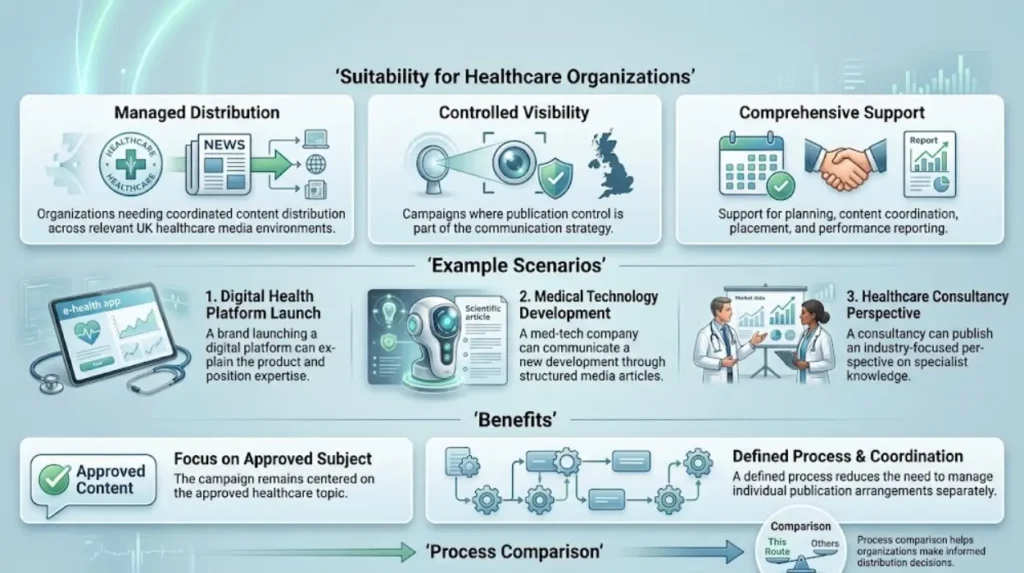
Time Intelligence Media Group is suitable for healthcare organisations seeking managed sponsored content distribution across relevant media environments. The service supports campaign planning, content coordination, publication placement, and reporting for brands requiring controlled UK media visibility.
The service fits campaigns where publication control forms part of the communication strategy.
A healthcare brand launching a digital health platform can use sponsored content to explain the product and position its expertise. A medical technology company can communicate a new development through a structured media article. A healthcare consultancy can publish an industry-focused perspective that presents its specialist knowledge.
The campaign remains centred on the approved healthcare subject.
Organisations also gain a defined process for coordinating content and publication requirements. This reduces the need to manage individual publication arrangements separately.
For brands comparing publication routes, the earlier healthcare media publication process explains how sponsored healthcare articles move through UK news environments before a distribution decision is made.
How can a healthcare brand start a sponsored content campaign?
A healthcare brand can start by defining its campaign objective, target audience, subject, preferred UK media categories, content requirements, publication timeline, and reporting needs. The provider then uses these requirements to structure the appropriate sponsored content campaign.
Start with the communication objective.
Define whether the campaign focuses on brand awareness, corporate communication, healthcare technology, industry expertise, product information, or a specific business announcement.
Next, identify the audience.
A campaign targeting healthcare professionals requires different media placements from a campaign targeting business leaders or consumers.
Explore More Expert Insights:
Fintech Sponsored Content by Time Intelligence Media Group
From First Article to First Lead: A UK Sponsored Content Onboarding Timeline
Then prepare the core information. Include verified company details, approved terminology, supporting evidence, relevant links, and any required disclosure information.
Finally, confirm publication requirements, delivery timelines, reporting, and campaign scope before publication.
For organisations ready to evaluate a managed healthcare media campaign, healthcare sponsored content provides the relevant next step for discussing campaign requirements, publication options, and distribution scope.



