Healthcare sponsored articles are paid editorial-style pieces published by news websites to communicate information about a healthcare brand, service, product, organisation, or industry issue. In the UK, publication involves content preparation, compliance checks, publisher selection, editorial review, and placement.
For healthcare organisations, sponsored publishing sits between traditional advertising and earned media. The advertiser controls the core message, while the publishing environment provides access to an established news audience. The article remains commercially funded and requires appropriate disclosure under UK advertising and media standards.
Understanding the publication process helps healthcare brands evaluate publishers, content requirements, compliance expectations, and distribution options before committing to a sponsored article campaign. Readers exploring the wider educational role of this format can also review:
Healthcare sponsored articles to understand how sponsored content supports trust-building.
What is a healthcare sponsored article?
A healthcare sponsored article is paid content created for a healthcare organisation and published on a news or specialist media website. It presents approved information in an editorial format while clearly identifying its commercial sponsorship to readers.
Healthcare sponsored articles cover subjects such as medical technology, digital health, private healthcare, pharmaceuticals, diagnostics, health services, medical research, wellness, and healthcare business developments.
The content differs from earned editorial coverage because the organisation pays for publication. It also differs from a standard display advert because the message appears as a structured article rather than a banner or short promotional placement.
What does sponsored content mean in UK media?
Sponsored content refers to publisher content funded by an advertiser or commercial organisation. The publisher provides the media environment, publication specifications, and disclosure requirements.
UK audiences must receive clear information about the commercial nature of advertising content. Labels such as “Sponsored”, “Paid Content”, or “Advertiser Content” identify the relationship between the advertiser and publisher.
Why does the distinction matter?
The distinction establishes transparency. Healthcare brands operate in a sensitive information environment where readers evaluate claims about treatments, services, technologies, and health outcomes.
Clear sponsorship labelling protects audience trust and separates commercial communication from independent journalism.
How do healthcare sponsored articles get published on UK news websites?
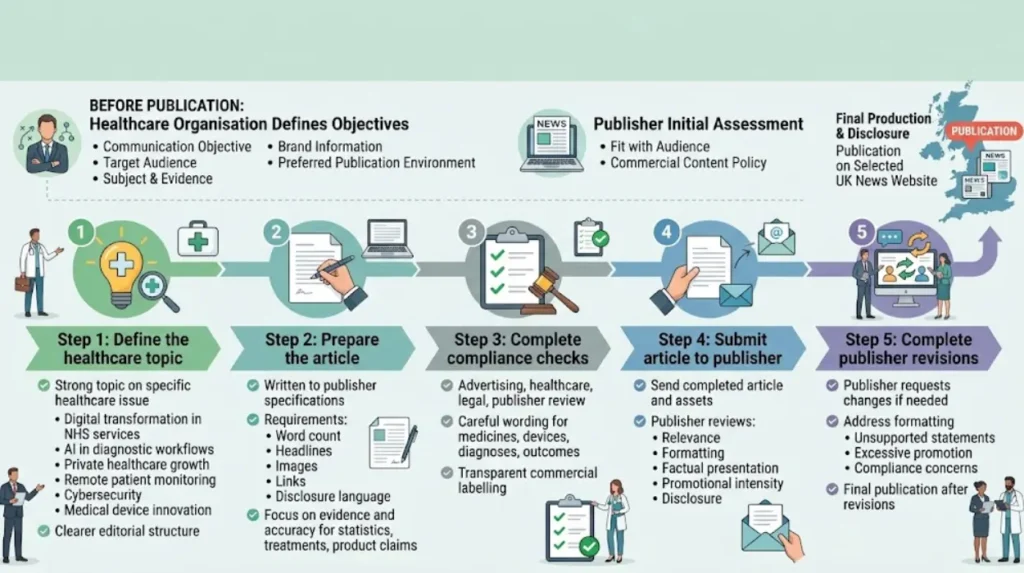
Healthcare sponsored articles move through a defined publication process covering topic selection, content development, compliance review, publisher approval, revisions, final production, disclosure, and publication on the selected UK news website.
The process starts before an article reaches a publisher. The healthcare organisation defines its communication objective, target audience, subject, evidence, brand information, and preferred publication environment.
The publisher then assesses whether the proposed content fits its audience and commercial content policy.
Step 1: Define the healthcare topic
The topic determines the article’s relevance. A strong topic addresses a specific healthcare issue rather than presenting a general company promotion.
Examples include:
- Digital transformation in NHS supplier services
- AI applications in diagnostic workflows
- Growth in private healthcare demand
- New approaches to remote patient monitoring
- Healthcare cybersecurity
- Medical device innovation
A focused subject creates a clearer editorial structure and improves audience relevance.
Step 2: Prepare the article
The article is written according to the publisher’s specifications. Requirements often cover word count, headline length, image dimensions, links, formatting, author information, and disclosure language.
Healthcare claims require particular attention to evidence and accuracy. Statistics, treatment statements, product descriptions, and performance claims need reliable supporting information.
Step 3: Complete compliance checks
The content passes a review for advertising, healthcare, legal, and publisher requirements.
Claims involving medicines, treatments, medical devices, diagnoses, or health outcomes require careful wording. The content also requires transparent commercial labelling.
Step 4: Submit the article to the publisher
The completed article and supporting assets are submitted to the selected publication. The publisher reviews the material against its commercial content policy.
The review checks relevance, formatting, factual presentation, promotional intensity, links, imagery, and disclosure requirements.
Step 5: Complete publisher revisions
Publishers sometimes request changes before publication. These changes address formatting, unsupported statements, excessive promotional language, headline structure, or compliance concerns.
The article reaches publication after the required revisions are completed.
What does a UK publisher check before accepting healthcare sponsored content?
UK publishers check healthcare sponsored content for audience relevance, factual accuracy, advertising disclosure, prohibited claims, formatting, promotional intensity, external links, imagery, and compliance with their commercial publishing requirements.
Publisher standards differ between national news websites, regional publications, business media, trade publications, and specialist healthcare outlets.
A healthcare article therefore requires publisher-specific preparation.
Audience relevance
The subject needs a clear connection with the publication’s readers. A healthcare technology announcement fits a business or technology audience when its commercial and industry implications are clear.
Factual accuracy
Healthcare information requires precise presentation. Claims need credible sources, supporting evidence, and accurate terminology.
For example, a digital health company describing a platform’s adoption rate needs to state the relevant period, population, and measurement basis.
Promotional balance
Sponsored content contains a commercial message, but excessive sales language reduces editorial quality. Publishers typically require useful information alongside brand references.
A useful structure includes an industry problem, supporting evidence, expert context, the organisation’s response, and relevant company information.
Links and disclosures
Publishers review outbound links and commercial references. Sponsored articles also require clear disclosure so readers understand that the content has commercial backing.
What healthcare content works best for sponsored publication?
Healthcare sponsored content performs best when it addresses a defined industry issue, provides factual information, uses credible evidence, explains a practical development, and connects the healthcare organisation to a relevant subject without excessive promotional language.
The strongest topics provide information before presenting the commercial message.
Industry analysis
Healthcare brands can publish analysis about regulatory developments, digital transformation, patient experience, operational efficiency, or technology adoption.
For example, a healthcare software provider can explain how electronic patient records affect data workflows before introducing its own platform.
Expert-led content
Expert commentary gives a sponsored article a clear professional perspective. A medical director, technology specialist, compliance professional, or healthcare executive can provide context around a defined issue.
The content still requires transparent sponsorship.
Research-based articles
Research gives healthcare sponsored content measurable substance. Surveys, market data, published studies, internal research, and documented industry statistics provide evidence for the central argument.
Each source needs accurate attribution.
Company-led announcements
Healthcare organisations also use sponsored articles to communicate launches, partnerships, expansion, investment, awards, research developments, and service updates.
The announcement gains greater context when the article explains the wider industry relevance.
How do healthcare brands choose the right UK news publication?
Healthcare brands choose UK publications by comparing audience relevance, sector authority, geographic reach, content standards, publication format, audience profile, commercial disclosure, estimated visibility, and the publication’s suitability for the specific healthcare subject.
Publication selection needs to match the communication objective.
A national publication provides broad UK exposure. A regional newspaper targets a defined location. A healthcare trade publication reaches professionals within a specific sector.
National news publications
National platforms suit campaigns targeting broad UK business or consumer audiences.
A private healthcare provider launching a nationwide service can prioritise publications with broad geographic reach.
Regional publications
Regional media suits organisations with location-specific objectives.
A healthcare provider opening a new clinic in Manchester can prioritise publications serving Greater Manchester audiences.
Healthcare trade media
Trade publications target professional readers. These include healthcare executives, clinicians, procurement professionals, technology specialists, and other industry stakeholders.
A medical technology company launching a B2B platform gains stronger contextual relevance from a publication serving healthcare professionals.
What compliance rules affect healthcare sponsored articles in the UK?
Healthcare sponsored articles require transparent commercial disclosure, accurate claims, responsible presentation of health information, appropriate advertising treatment, and compliance with relevant UK rules governing advertising, consumer protection, medicines, medical devices, and publisher standards.
Healthcare communication involves multiple regulatory considerations.
The Advertising Standards Authority oversees advertising standards through the CAP Code. Specific healthcare claims also fall within rules covering medicines, medical devices, health services, and consumer protection.
Publishers apply their own editorial and commercial policies alongside applicable UK requirements.
Why are health claims closely reviewed?
Health claims influence decisions about products and services. Unsupported statements therefore create regulatory and reputational risks.
A statement such as “clinically proven” requires appropriate evidence. A claim about treatment effectiveness requires a suitable factual basis.
Why is sponsorship disclosure important?
Disclosure tells readers that the article represents paid commercial content. It separates sponsored material from independent editorial reporting.
Transparent labelling also establishes a clear relationship between the healthcare organisation and publisher.
What benefits do healthcare sponsored articles provide?
Healthcare sponsored articles provide controlled messaging, targeted media exposure, contextual brand visibility, thought leadership opportunities, audience education, searchable content, and a structured route for communicating healthcare developments through established UK publishing environments.
The value comes from combining message control with a recognised media setting.
Controlled communication
The organisation develops the core message and selects the information included in the article.
This control is useful for complex subjects that require technical explanation.
Audience targeting
Publication selection determines the audience environment. Healthcare trade media targets professionals, while regional news targets local readers.
Search visibility
Published articles create indexable web assets. Relevant headlines, structured content, entities, and contextual links contribute to the online presence of the organisation.
Search visibility depends on the publication, indexing status, content quality, competition, and search engine treatment.
Long-term content value
A published article remains a reference point on the web while the publisher keeps it accessible. The page can support brand discovery and provide a source of information for readers researching the organisation or topic.
When should healthcare brands consider sponsored news publication?
Healthcare brands consider sponsored publication when they need controlled communication around a healthcare development, targeted UK audience access, industry education, thought leadership, product explanation, corporate news, or a structured media placement strategy.
The format suits several communication situations.
Product or service launches
A healthcare organisation launching a technology platform can explain the problem, solution, development, and business relevance in one structured article.
Corporate expansion
Expansion into new UK regions creates a clear news angle. The article can explain investment, employment, services, facilities, or partnerships.
Industry education
Healthcare brands with specialist expertise can publish educational content addressing a defined sector issue.
Thought leadership
Senior executives and subject experts can use sponsored articles to explain industry developments and present informed perspectives.
For organisations evaluating providers,
Healthcare Sponsored Content provides a decision-stage route for exploring a specific sponsored content solution.
What should healthcare brands prepare before commissioning sponsored content?
Healthcare brands need a defined objective, target audience, topic, evidence base, approved claims, brand information, preferred publication type, content assets, disclosure requirements, and publication timeline before commissioning a sponsored article campaign.
Preparation reduces revision cycles and improves publisher alignment.
A basic campaign brief includes:
- Primary communication objective
- Target UK audience
- Healthcare topic
- Key supporting evidence
- Approved company information
- Expert contributor details
- Required images
- Relevant links
- Preferred publication categories
- Publication deadline
The brief also establishes whether the campaign targets national, regional, business, technology, or healthcare trade media.
How can healthcare brands evaluate sponsored article opportunities?
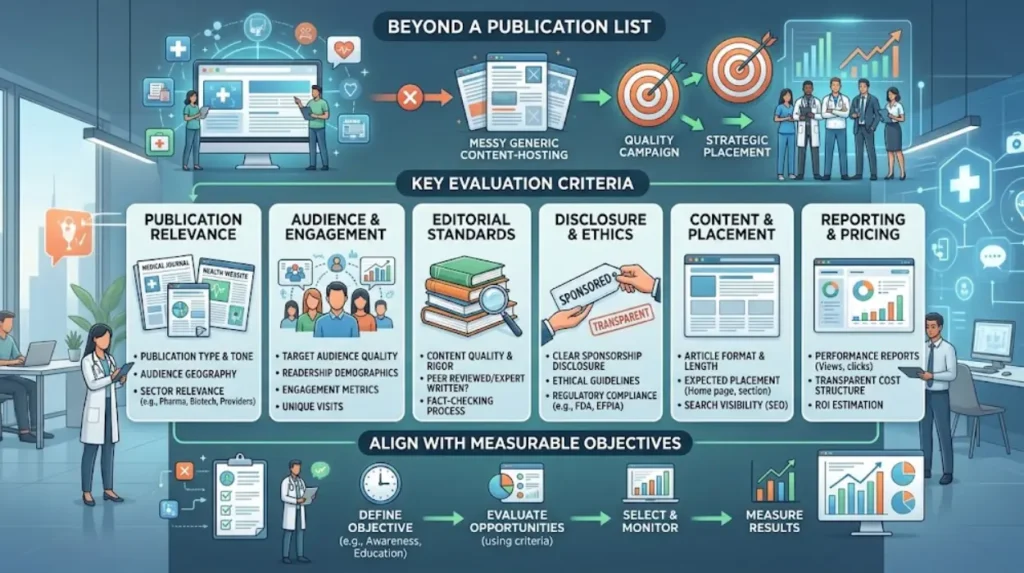
Healthcare brands evaluate sponsored article opportunities by comparing publication relevance, audience quality, editorial standards, disclosure practices, content specifications, expected placement, search visibility, reporting, pricing, and alignment with the campaign’s measurable communication objectives.
A publication list alone does not establish campaign quality.
Brands need to assess whether each placement reaches the intended audience and supports the communication objective.
Relevant evaluation criteria include publication type, audience geography, sector relevance, article format, link policy, disclosure, reporting, and content approval procedures.
The evaluation process also separates genuine media placement from generic content-hosting opportunities.
Healthcare organisations benefit from a structured comparison before selecting a publication route. This approach keeps the campaign aligned with audience needs, regulatory expectations, editorial standards, and measurable media objectives.
What is the next step after understanding the publication process?
The next step is to define the healthcare campaign objective, select suitable UK publication categories, prepare evidence-led content, confirm compliance requirements, and compare sponsored content providers based on placement quality, transparency, reporting, and audience relevance.
A clear process turns sponsored publishing from a simple content purchase into a defined media activity.
The organisation first establishes the subject and audience. It then identifies appropriate publications and confirms their commercial content requirements.
Explore More Expert Insights:
How Fintech Sponsored Content Reaches UK Business Readers
Sponsored Content and GEO: How to Write Articles That Win AI Overview Citations
Content development follows with evidence, expert input, approved claims, and clear sponsorship disclosure. Publisher review completes the route to publication.
The central principle remains consistent: effective healthcare sponsored articles combine accurate information, transparent sponsorship, relevant UK audiences, suitable publishers, and disciplined content production.