
Cardiff event news coverage is the publication of event information across relevant Welsh and UK news websites. It connects one event with multiple editorial audiences through newsworthy details, accurate information, location relevance, timely distribution, and publication formats suited to different news platforms.
Cardiff event coverage refers to the process of turning an event into information that news organisations can publish. The event itself remains the primary subject. Coverage focuses on what happened, who participated, where it occurred, and why it matters.
Cardiff is the capital of Wales and a major UK events location. Its event ecosystem includes business conferences, cultural programmes, sporting events, university activities, entertainment programmes, charity events, exhibitions, and public-sector gatherings.
News websites evaluate these events through editorial criteria. These criteria include relevance, timeliness, public interest, geographic significance, available facts, and the quality of supporting information.
Coverage across 15 UK news websites does not mean that every website publishes identical material. Each publication has its own audience, editorial focus, geographic reach, and publishing standards.
How does a Cardiff event become newsworthy?
A Cardiff event becomes newsworthy when it contains a clear event development, identifiable participants, relevant location, timely information, public interest, and verifiable facts. Strong news value gives editors a defined reason to publish the event for their audience.
What creates news value?
Several characteristics increase the informational value of a Cardiff event:
- Location: Cardiff provides a clear Welsh geographic connection.
- Timing: Upcoming, current, or recently completed events have stronger news relevance.
- Participants: Speakers, organisations, performers, athletes, academics, and public figures provide identifiable entities.
- Subject: Business, technology, healthcare, education, culture, sport, and community subjects create distinct editorial contexts.
- Scale: Attendance figures, programme size, venue capacity, or regional participation establish measurable significance.
- Impact: Economic, cultural, educational, community, or professional effects provide additional context.
For example, a Cardiff fintech conference involving 500 professionals has a different news profile from a private networking meeting involving 20 attendees.
The distinction matters because news websites select stories according to their editorial audiences. A technology publication focuses on technology developments. A regional publication focuses more heavily on Cardiff, Wales, and surrounding communities.
How does Cardiff event information reach multiple UK news websites?
Cardiff event information reaches multiple UK news websites through a structured publication process involving news preparation, editorial targeting, distribution, review, publication, and indexing. Each stage connects the original event information with suitable news audiences.
The process begins with collecting accurate event information. Core details include the event name, date, venue, organisers, speakers, purpose, programme, registration information, and relevant statistics.
The information is then structured into a news format. A standard event announcement contains a headline, introduction, supporting facts, quotations where relevant, event details, and organisational information.
What happens before publication?
Before publication, event information is checked for factual accuracy and editorial suitability. Dates, names, locations, figures, titles, and descriptions require consistency.
The content then enters a distribution process. Distribution connects the prepared news material with selected publications or news networks.
A 15-site campaign uses multiple publication destinations rather than treating the UK media landscape as one audience. Welsh regional publications, UK business websites, specialist publications, and broader news platforms represent different audience groups.
Publication also depends on each website’s editorial requirements. Some websites prioritise regional relevance. Others organise content by industry, event category, business sector, or geographical location.
Which types of Cardiff events attract UK news attention?

Cardiff events attract different levels of UK news attention according to their subject, participants, geographic relevance, audience size, timing, and measurable impact. Business, cultural, sporting, educational, healthcare, charity, and public events each create distinct editorial contexts.
Which business events receive coverage?
Business events include conferences, trade exhibitions, networking programmes, investment events, product launches, and industry forums.
For example, a Cardiff technology conference involving Welsh technology companies and UK investors contains business, regional, and industry relevance.
Which cultural events generate news content?
Cultural events include festivals, exhibitions, theatre programmes, music events, literary gatherings, and heritage programmes.
A Cardiff cultural festival involving multiple performers and venues provides several identifiable details for regional coverage.
Which sporting events create news value?
Sporting events include tournaments, competitions, charity runs, club events, and major sporting programmes.
The news value increases when an event involves recognised participants, measurable results, significant attendance, or a clear Cardiff or Welsh connection.
Which professional and educational events are covered?
Universities, professional organisations, training providers, research institutions, and industry bodies host conferences, seminars, awards, and academic events.
For example, a Cardiff university research conference involving researchers from several UK institutions has an educational and national context.
Why do Welsh and UK publications treat Cardiff events differently?
Welsh and UK publications approach Cardiff events according to audience geography, editorial purpose, sector relevance, and publication scope. Welsh outlets emphasise local and national Welsh relevance, while UK publications prioritise broader developments and specialist subject interest.
Cardiff has a distinctive position within the UK media landscape. It is simultaneously a local city, a Welsh capital, and a location within the wider UK economy.
This creates several editorial layers.
How does regional relevance work?
Welsh publications often focus on Cardiff developments that affect local communities, Welsh organisations, public institutions, businesses, and cultural activity.
A Cardiff charity event supporting local communities has strong regional relevance because its location and audience are directly connected to Wales.
How does national relevance work?
UK publications require a broader connection. National relevance can come from an event topic, participating organisations, notable speakers, industry significance, research findings, or wider economic implications.
For example, a Cardiff cybersecurity conference involving UK technology leaders provides a subject that extends beyond Cardiff’s geographic boundaries.
What information does a Cardiff event article contain?
A Cardiff event article normally contains the event identity, date, location, purpose, participants, programme information, relevant statistics, quotations, organisational context, and practical details. These elements establish what happened, who participated, and why the event deserves editorial attention.
What are the essential event details?
A complete event article commonly includes:
- Event name
- Cardiff venue
- Event date
- Organiser
- Main participants
- Event purpose
- Key activities
- Attendance information
- Relevant quotations
- Supporting organisational information
Accuracy is central to every element. An incorrect venue or date reduces the reliability of the article.
Specific numbers also strengthen factual clarity. “More than 300 delegates” provides measurable information. “Many delegates” does not provide the same level of detail.
The article also benefits from clear entity identification. Names of venues, organisations, speakers, institutions, and event programmes establish identifiable subjects for readers and search systems.
How do 15 news websites create broader Cardiff event visibility?
Fifteen news websites create broader event visibility by exposing the same underlying event to separate audiences, geographic communities, industry readers, and search environments. The combined coverage creates multiple publication points while preserving the event’s core factual identity.
The number 15 represents a multi-publication coverage model. It does not represent 15 identical articles.
Each website contributes a separate publication environment. One site can reach Cardiff readers. Another can serve Welsh business audiences. A third can focus on technology or healthcare.
What audiences can one Cardiff event reach?
A single event can interest several audience groups:
- Cardiff residents
- Welsh businesses
- UK industry professionals
- Event attendees
- Investors
- Journalists
- Researchers
- Students
- Public-sector professionals
- Specialist trade audiences
The relevance of each audience depends on the event’s subject.
A healthcare conference in Cardiff, for example, has stronger relevance for healthcare professionals and medical organisations than for audiences interested only in entertainment.
How does search visibility connect with Cardiff event coverage?
Search visibility connects Cardiff event coverage with queries involving event names, Cardiff locations, Welsh organisations, speakers, event subjects, and related topics. Clear entity information helps search systems understand the relationship between the event and its geographic or industry context.
Search engines process multiple signals when interpreting news content. Textual relevance, entity relationships, publication authority, freshness, geographic references, and structured information contribute to understanding.
A Cardiff event article can contain connected entities such as Cardiff, Wales, the event venue, organiser, speaker, industry, and event category.
Which search queries can event coverage address?
Examples include:
- Cardiff business events
- Cardiff technology conference
- Wales healthcare conference
- Cardiff cultural events
- Cardiff networking events
- Welsh business conference
- Cardiff industry exhibition
The exact search demand depends on the event and its audience.
Consistent factual references also help establish topical relationships. If an article clearly identifies Cardiff, Wales, the event category, organiser, and participants, the subject becomes easier to interpret.
Readers interested in the broader educational side of Welsh and UK event visibility can explore:
What benefits come from reaching 15 UK news websites?
Coverage across 15 UK news websites increases the number of publication environments connected to one Cardiff event. It expands geographic and subject exposure, creates multiple reference points, supports discoverability, and separates regional relevance from specialist and national audience reach.
The main benefit is audience diversification.
A Cardiff event does not depend on one publication audience. Multiple websites provide access to different readership groups.
How does geographic diversification work?
Geographic diversification connects the event with Cardiff, wider Wales, and UK audiences.
A local publication can provide Cardiff relevance. A Welsh publication can provide national Welsh context. A UK specialist publication can provide sector-specific exposure.
How does subject diversification work?
Subject diversification depends on the event category.
A Cardiff technology event can reach technology readers. A university conference can reach academic audiences. A business exhibition can reach commercial audiences.
This distinction matters because the same event has different informational value for different groups.
Which Cardiff events fit a 15-site news coverage model?
Cardiff events suited to multi-site news coverage include conferences, exhibitions, festivals, sporting programmes, awards, charity events, business launches, university events, healthcare gatherings, and industry forums with clear facts and identifiable audience relevance.
What does this look like in practice?
Consider a fictional Cardiff business conference with 600 attendees.
The event includes 12 speakers, 30 exhibitors, five industry sessions, and participants from across Wales and England.
Its coverage structure contains several distinct information points:
- Cardiff provides geographic relevance.
- The 600 attendees provide measurable scale.
- The 12 speakers provide identifiable entities.
- The 30 exhibitors provide commercial context.
- Five sessions provide substantive event content.
- Welsh and UK participation creates wider geographic relevance.
A Cardiff cultural festival provides a different structure. Its relevant details include performers, venues, attendance, programme dates, cultural themes, and community participation.
A Cardiff healthcare conference focuses on professional participants, research topics, healthcare institutions, sessions, and sector developments.
These examples demonstrate why event coverage depends on factual structure rather than event category alone.
What determines whether Cardiff event coverage is effective?
Effective Cardiff event coverage depends on accurate information, clear news value, appropriate publication targeting, strong geographic context, identifiable entities, timely publication, and consistent event details across the 15 selected UK news websites.
The effectiveness of coverage can be assessed through measurable factors.
What should be measured?
Useful measurements include:
- Number of published articles
- Number of publication websites
- Geographic distribution
- Industry relevance
- Publication dates
- Search visibility
- Referral traffic
- Article engagement
- Event-related searches
- Audience interactions
These measurements separate publication volume from actual audience exposure.
A campaign with 15 published articles has a defined publication footprint. Additional performance measurements show how audiences interact with that footprint.
The same framework applies to Cardiff business events, cultural programmes, sporting competitions, university conferences, charity initiatives, and professional gatherings.
Readers evaluating the next stage of Cardiff and Welsh media visibility can explore:
How does Cardiff event coverage fit into the wider UK news ecosystem?
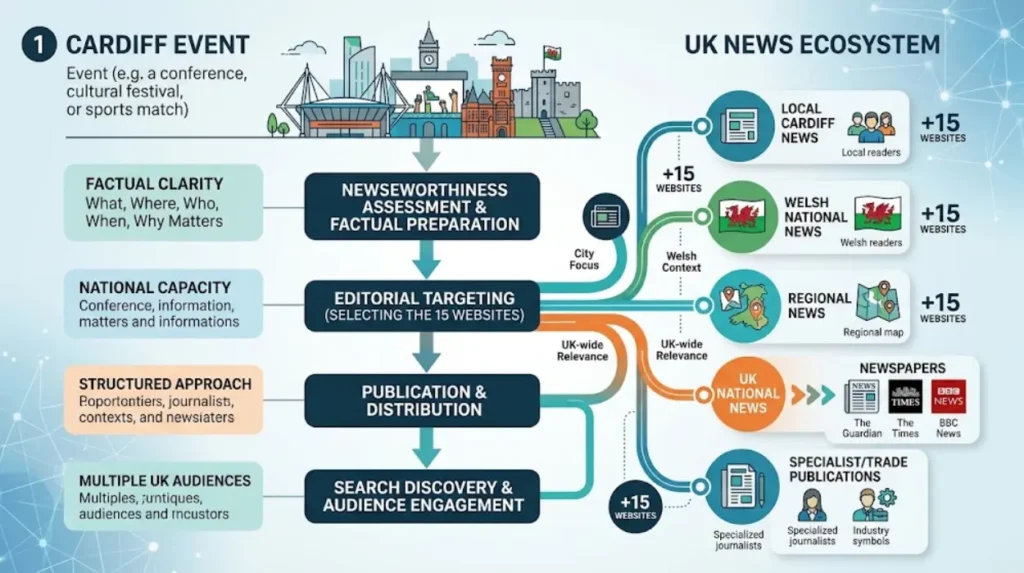
Cardiff event coverage forms part of a wider UK news ecosystem where local, Welsh, regional, national, and specialist publications serve different audiences. Reaching 15 websites connects one event with these distinct editorial environments through structured and factual news information.
Cardiff’s position as the capital of Wales gives its events several layers of relevance. Local audiences focus on the city. Welsh audiences focus on national developments. UK audiences focus on subjects with broader professional, economic, cultural, or public interest.
A structured 15-site approach reflects this layered media environment.
The process begins with the event itself. It then moves through newsworthiness assessment, factual preparation, editorial targeting, publication, search discovery, and audience engagement.
Explore More Expert Insights:
5 Event Types That Win the Most News Coverage
What Event Photography Adds to UK News Coverage
The result is not simply a larger number of published pages. It is a structured connection between one Cardiff event and multiple UK news audiences.
For event organisers, journalists, search systems, and readers, the essential principle remains factual clarity. The strongest event coverage clearly establishes what happened, where it happened, who participated, when it happened, and why it matters within the relevant Cardiff, Welsh, or UK context.



