
Retargeting advertising for finance brands is displaying ads to users who previously visited a site or engaged with content, with the objective of increasing conversion intent through repeated, relevant exposure.
Retargeting uses cookies, mobile IDs, and hashed user identifiers to recognise past visitors. Finance entities set audience segments such as product page viewers, application abandoners, and content engagers. Platforms deliver follow-up banner ads across websites, apps, and social feeds. Typical retargeting windows run from 7 to 90 days. Finance firms combine retargeting with prospecting campaigns to move users from awareness to intent.
How does the retargeting process work for fintech and finance advertisers?
The retargeting process tracks user actions, builds audience lists, creates tailored creatives, and bids for impressions where past visitors are likely to convert.
Tracking begins with a pixel or SDK placed on site pages. Events tracked include page visits, form interactions, onboarding starts, and transaction attempts. Data flows into a demand-side platform (DSP) or ad network, where finance teams define rules: include users who visited pricing pages in last 14 days and exclude converted customers. Audiences receive tiered creative sequences: reminder banners, benefit-focused banners, and offer-oriented banners. Bids adjust by audience value; high-intent segments receive higher CPM bids. Reporting shows view-through conversions and click-through conversions attributed across 7–30-day windows.
What components make a retargeting campaign effective for finance brands?
Effective campaigns combine precise audience segmentation, tailored creative messaging, frequency caps, and measurement tied to business outcomes.
Audience segmentation splits users by intent signals: product-page visitors, calculator users, quote initiators, abandoned applications, and loyal customers. Creative messaging matches intent: product pages get feature-focused banners; abandoned applications get trust-oriented banners with next-step prompts. Frequency caps limit exposure to avoid ad fatigue; common settings range from 3 to 10 impressions per week. Measurement uses conversion metrics tied to revenue: completed applications, funded accounts, and net new customers. Attribution models include last-click and multi-touch models; finance teams compare models to allocate spend.
Which creatives and messages increase conversion intent in finance display ads?
High-converting creatives state a clear product benefit, show a concise value proposition, and include a single, measurable call to action aligned with the tracked event.
Use explicit headlines: “Open an ISA in 5 Minutes” or “Get a Mortgage Quote with No Fee.” Include one supporting metric: interest rate ranges, user rating (out of 5), or average approval time in days. Visuals should include simple icons, feature bullets, and a clear CTA button. For abandoned application segments, present next-step CTAs such as “Resume Application” and highlight saved progress. For users who used a calculator, show pre-filled results or contextual ranges. Implement A/B tests for headline, CTA wording, and image versus illustration. Track conversion lift per creative variant.
How do finance brands measure conversion intent and campaign performance?
Measurement uses event tracking, conversion pixels, and outcome KPIs such as application starts, completed applications, funded accounts, and customer acquisition cost.
Define primary KPI: completed application or funded account. Define secondary KPIs: application start rate, click-through rate (CTR), and view-through conversion rate (VTC). Use server-side conversion events to secure data and reduce attribution loss from ad blockers. Compare cost-per-acquisition (CPA) against lifetime value (LTV) benchmarks. Use lift studies or holdout tests to quantify incremental conversions caused by retargeting. Report results in a dashboard showing cohort conversion rates by audience, creative, and recency window.
What privacy and compliance steps must finance advertisers follow?
Finance advertisers must comply with data protection laws: obtain lawful basis for tracking, provide transparent privacy notices, and implement secure hashing for identifiers.
In the UK, follow the Data Protection Act 2018 and UK GDPR. Use consent management platforms to capture user consent for non-essential cookies. For logged-in users, use hashed email lists (SHA-256) when uploading audiences to platforms. Limit retention: adhere to a 90-day maximum for high-intent segments unless users explicitly consent to longer periods. Maintain audit logs of audience builds and ensure third-party vendors have Data Processing Agreements. Exclude sensitive categories such as health or political data when building audiences.
Which retargeting strategies reduce churn and increase intent for fintech apps?
Strategies include time-based sequenced messaging, product-specific reminders, and incentives for application completion that align with regulatory constraints.
Time-based sequences push initial reminder banners within 24 hours, follow-up benefit banners at day 3, and urgency or incentive banners at day 7. Product-specific reminders target users who viewed particular features: savings tools, mortgage calculators, investment products. For abandoned onboarding, offer friction-reduction prompts such as “Continue where you left off” and highlight identity verification steps required. Use incentives cautiously: fee waivers or cashback offers work for transactional products; always document promotional terms in the ad creative. Monitor churn by tracking reactivation rates and time-to-fund metrics.
What audience windows and frequency settings drive higher conversion intent?
Short windows of 7–21 days for high-intent segments and longer windows up to 90 days for low-intent educational visitors; frequency caps set to 3–7 impressions per week typically maximise intent without causing fatigue.
High-intent actions (started application, quote requested) use a 7–21 day window with higher bid multipliers and 4–7 impressions weekly. Low-intent actions (blog reads, calculator opens) use a 30–90 day window and 2–4 impressions weekly. Adjust based on product purchase cycle: mortgages and pensions use longer windows (30–90 days); short-term loans and card sign-ups use shorter windows (7–21 days). Monitor conversion rate by recency cohort to validate window choices and reduce wasted spend on stale audiences.
How do finance brands optimise bidding and inventory for retargeting?
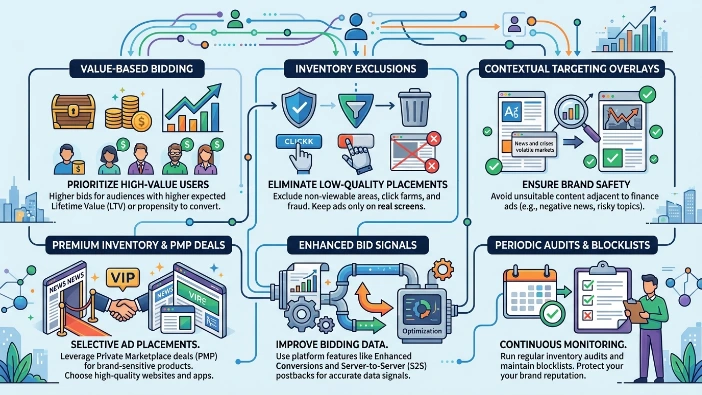
Finance brands optimise by using value-based bidding, inventory exclusions, and platform-specific audience targeting to prioritise high-quality placements and users.
Value-based bidding sets higher bids for audiences with higher expected LTV or propensity to convert. Exclude low-quality inventory such as click farms and non-viewable placements. Use contextual targeting overlays to avoid unsuitable content adjacent to finance ads. Choose premium inventory and private marketplace deals for brand-sensitive products. Leverage platform features like enhanced conversions and server-to-server postbacks to improve bid signals. Run periodic inventory audits and block lists to protect brand safety.
What examples demonstrate retargeting success in finance?
Both campaigns used 14-day high-intent windows and frequency caps set to 5 impressions per week. Both used hashed list uploads for logged-in users and server-side tracking to attribute funded accounts accurately. Results tracked included reduced CPA and improved LTV-to-CPA ratios.
Explore More Expert Insights:
How Fintech Platforms Educate Users Using Feature Banner Campaigns
How Insurance Companies Increase Policy Consideration Using Banner Ads
How do retargeting ads fit within a multi-channel acquisition funnel?
Retargeting complements prospecting by capturing users who engaged with top-funnel content and moving them toward conversion via tailored ads across web, mobile, and social channels.
Start with prospecting to build knowledge and traffic. Use retargeting to address specific barriers: trust, friction, or unclear value. Coordinate messaging across email, display, and social retargeting to create a coherent journey. Use CRM data to unify audiences and suppress converted users. Measure funnel metrics: traffic-to-application conversion and application-to-fund conversion. Optimise by reallocating budget from low-performing prospecting to high-performing retargeting segments.
Learn More Here:
How Fintech Companies Acquire Users Using Banner Ads
How should finance teams set up measurement to prove ROI?
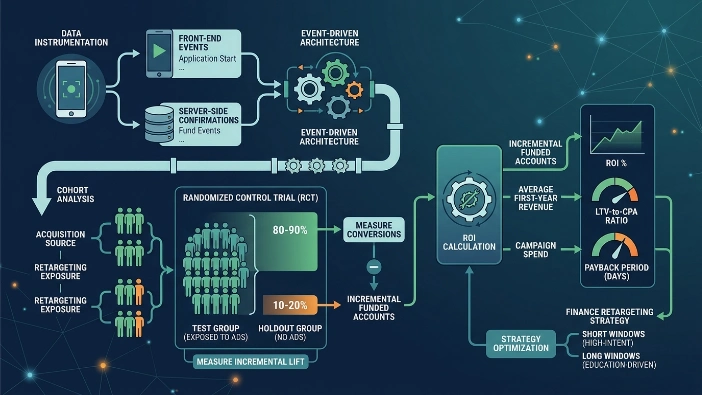
Set up end-to-end tracking with event-driven architecture, define business KPIs, run holdout tests, and calculate incremental lift and LTV-to-CPA ratios.
Instrument front-end events and server-side confirmations for application start and fund events. Create cohorts by acquisition source and retargeting exposure. Run a randomized control trial with a holdout group of 10% to 20% to measure incremental conversions. Compute ROI using net new funded accounts, average first-year revenue, and campaign spend. Report LTV-to-CPA and payback period in days.
Retargeting drives conversion intent for finance brands through precise audience segmentation, tailored creatives, measurable outcome KPIs, and privacy-compliant data handling. Use short windows and higher bids for high-intent users, longer windows for education-driven audiences, and server-side measurement to attribute funded accounts.
Review conversion-focused tactics in the following:
Finance Display Ads That Convert Warm Leads Into High-Intent Customers