
A banner ad is a rectangular digital advertisement that appears on websites and apps; insurance companies use banner ads to raise awareness, present offers, and drive visitors toward quote or information pages.
A banner ad is defined as a static image, animated graphic, or HTML5 creative placed within a web page or app surface. Insurance firms buy placements on news sites, comparison platforms, and niche portals. Common formats include leaderboard (728×90), medium rectangle (300×250), and mobile interstitial (320×480). Insurance advertisers target placements by audience segments (age, location, device), by content context (finance, motoring), and by behaviour (site visitors, recent quote seekers). Campaigns run on programmatic exchanges, direct buys, or private marketplaces. Metrics tracked include impressions, click-through rate (CTR), view-through conversions, and cost per acquisition (CPA).
How does banner advertising increase policy consideration?
Banner ads increase policy consideration by delivering repeated, targeted visual messages that prompt users to evaluate insurance options and visit comparison or provider pages.
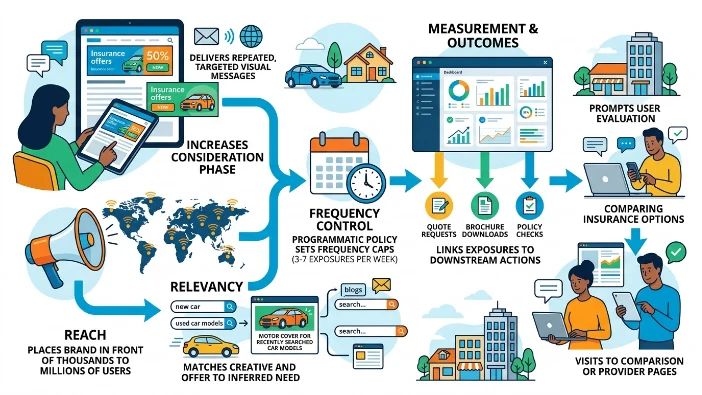
Consideration is the stage where a consumer compares options. Banner ads increase that phase through two mechanisms: reach and relevancy. Reach places the brand or product in front of thousands to millions of users. Relevancy matches creative and offer to a user’s inferred need, such as motor cover for recently searched car models. Frequency controls exposure; a typical programmatic policy sets frequency caps between 3 and 7 exposures per week. Measurement links exposures to downstream actions: quote requests, brochure downloads, and policy checks. For example, a motor insurer using contextual buys across 50 automotive blogs reports increased site visits from users with interest in used cars. Banner ads complement search and comparison activity by keeping the insurer visible while users research.
What are the core components of an effective insurance banner ad?
An effective insurance banner ad contains a clear value proposition, a concise call-to-action, a relevant creative, and tracking pixels for measurement.
Value proposition states the benefit in one line: cost, cover, or speed of quote. A concise call-to-action uses action verbs: “Get a 2‑minute quote” or “Compare premiums now.” Creative uses product imagery (vehicles, homes) or data visualisation (price comparison bars). Landing pages must match the ad message to avoid drop-off; mismatched destinations reduce conversion rates by 30% or more in typical campaigns. Tracking pixels and UTM parameters capture clicks, view-throughs, and assisted conversions across devices. Technical requirements include responsive creatives, under 150 KB file size for image ads, and fallback images for unsupported environments. Use of dynamic creative optimisation (DCO) allows real-time swaps of headlines, images, and offers based on audience signals.
How do insurers target audiences with banner ads?
Insurers target audiences with demographic, contextual, behavioural, and first-party data to reach users with high intent or relevant profiles.
Demographic targeting uses age, gender, and location; for motor insurance in the UK, regional segmentation can direct motor creatives to high-density cities like London and Birmingham. Contextual targeting places ads on pages with relevant content, such as travel pages for travel insurance. Behavioural targeting uses inferred interests from browsing history, for instance, targeting users who visited used-car listings. First-party data includes past site visitors and quote abandoners; retargeting these users yields higher conversion rates. Lookalike modelling extrapolates new prospects from profiles of converters. Privacy rules in the UK and EU affect match rates and require consent for personalised targeting. Cookieless strategies use contextual signals and publisher-provided cohorts to maintain delivery without third-party identifiers.
How do banner ads fit into the broader customer journey?
Banner ads serve awareness and consideration phases by keeping insurers visible during research and by driving qualified traffic toward quote or comparison pages.
At top-of-funnel, large-reach banner buys create category awareness. In the middle-of-funnel, targeted banners present offer details and comparison messages to users who already express interest. Retargeting banners re-engage users who viewed pricing, started but did not finish a quote, or compared plans. Programmatic guaranteed buys on comparison sites ensure presence where shoppers compare multiple insurers. Cross-channel coordination aligns banner messages with search ads, email, and on-site content to create consistent messaging. Measurement of assisted conversions attributes a portion of signups to banner exposures that occurred prior to the final conversion touchpoint.
What creative strategies increase consideration for insurance products?
Use clear pricing cues, benefit-led headlines, social proof, and tailored imagery to increase user interest and prompt consideration actions.
Pricing cues include example premiums or percentage savings to provide tangible anchors. Benefit-led headlines highlight speed, simplicity, or breadth of cover, for example “Instant online quotes for comprehensive motor cover.” Social proof uses customer counts or ratings, such as “Over 250,000 UK customers,” where factual. Tailored imagery matches the product: motor creatives show vehicles; home insurance shows properties. Variants for different life stages (student, families, retirees) increase relevance. Dynamic creative swaps headlines and images based on audience segment to improve CTR. A/B tests with incremental changes to headlines or CTA wording typically produce measurable CTR lifts; insurers test at least 2 creatives per placement and iterate weekly for 4–8 weeks.
How do insurers measure the effectiveness of banner campaigns?
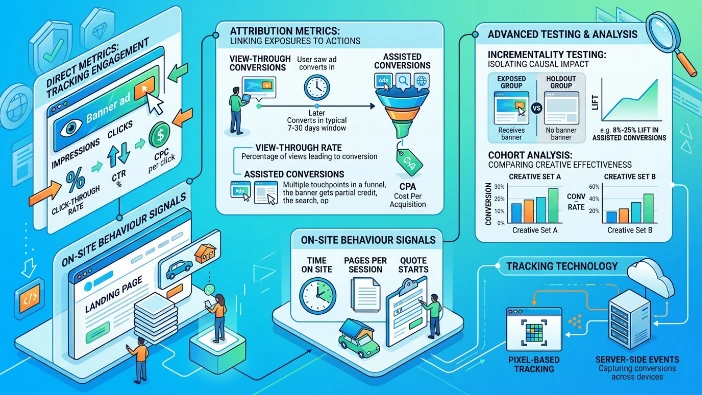
Insurers measure banner effectiveness using direct metrics (CTR, CPC) and attribution metrics (view-through rate, assisted conversions, CPA) plus on-site behaviour signals.
Direct metrics track engagement: impressions, clicks, CTR, and cost per click (CPC). Attribution metrics link exposures to downstream actions: view-through conversions count users who saw an ad and converted within a time window, typically 7–30 days. Assisted conversion analysis ties banner exposures to partial credit in multi-touch funnels. On-site behaviour signals examine time on site, pages per session, and quote starts. Pixel-based tracking and server-side events capture conversions across devices. Incrementality testing, such as holdout groups where a segment does not receive banner exposure, isolates causal impact; typical lift studies show banners contribute between 8% and 25% of assisted conversions depending on campaign design. Use cohort analysis to compare conversion rates among users exposed to different creative sets.
What are common optimisation practices for banner ad campaigns?
Optimise by refining audience segments, rotating creatives, adjusting frequency caps, and re-allocating budget to high-performing placements.
Start with broad segments, then narrow to converting cohorts. Rotate creatives every 7–14 days to prevent creative fatigue. Lower frequency caps for low-intent placements and raise them for retargeting segments to maintain visibility among high-intent users. Shift budget from placements with low conversion rates to ones with higher ROI. Use bid strategies aligned to objectives: CPM for awareness, CPC or CPA for performance. Apply viewability filters to ensure a minimum of 50% viewability for at least one second for standard display and two seconds for video. Regularly audit landing page match to ensure message continuity. Run periodic incrementality tests to confirm the campaign produces net new consideration rather than simply harvesting existing demand.
Explore More Expert Insights:
How Banks Nurture Loan Leads Using Informational Display Ads
How Financial Services Build Trust Using Educational Banner Advertising
What real use cases show banner ads increasing policy consideration?
Examples include motor insurers using retargeting to convert quote abandoners, home insurers using contextual buys on property sites, and travel insurers using seasonal placements on booking sites.
A motor insurer retargets users who abandoned a quote form on a comparison site. The retargeting sequence shows progressively specific banners: initial reminder, then price example, then an urgency message with deadline. Conversion rates from retargeted cohorts typically double compared with non-retargeted cohorts. A home insurer places contextual banners on property listing sites during peak moving months and reports higher quote starts in months with increased placement spend. A travel insurer increases banner presence on flight-booking pages during peak holiday booking periods and sees higher policy searches tied to specific destination creatives. Each use case aligns creative, placement, and timing to user intent signals.
For more detail explore:
How Insurance Companies Generate Leads Using Banner Ads
How do banner ads interact with other marketing channels?
Banner ads complement search, email, social, and on-site channels by providing visual continuity, reinforcing messages, and re-engaging users between channel interactions.
Search captures users with active query intent. Banner ads keep insurers present while users research across publishers. Email reactivation sequences benefit from preceding banner exposures that prime recipients to open messages. Social campaigns broaden reach among demographic cohorts that show interest on publisher sites. On-site remarketing converts visitors who started a quote. Use a unified measurement stack and consistent UTM tagging to track cross-channel journeys. Attribution models should assign credit across channels to evaluate true contribution to consideration.
The use of banner ads increases policy consideration by combining targeted reach, relevant creative, and measurement practices. Programmatic buys, DCO, frequency controls, and cross-channel integration deliver scalable exposure. Campaign optimisation relies on audience refinement, creative testing, and attribution analysis to show how visual display moves users from awareness into active comparison and quote activity.
For more information explore:
Insurance Retargeting Ads That Convert Policy Consideration Into Active Signups