
Finance display ads that convert warm leads into high-intent customers are targeted banner or rich media ads designed to move users who already know the brand toward a purchase-ready decision. They use focused creative, clear offers, and tracking signals to drive measurable conversions.
Finance display ads are digital image or video placements on web pages, apps, and connected TV. They include standard banners, native units, and responsive rich media. Warm leads are users who engaged before—visited a pricing page, started an application, opened an email, or added products to a cart. High-intent customers are users who meet predefined behavioral thresholds and show readiness to convert, such as completing an application or submitting payment details. Effective ads combine audience signals, creative tailored to stage, bid strategies, and post-click conversion paths.
How do finance display ads identify warm leads and high intent signals?
Campaign systems identify warm leads using first-party events, CRM matches, and cookie or device IDs and classify intent by actions like repeated visits, form starts, and cart abandonment. These signals feed audience segments and trigger targeted creative.
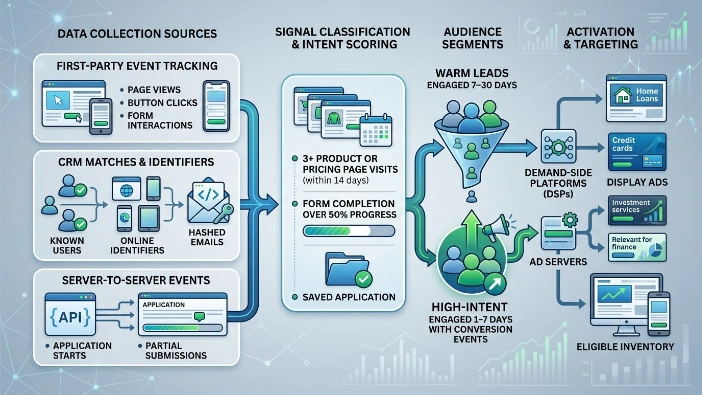
First-party event tracking captures page views, button clicks, and form interactions. CRM matches link known users to online identifiers via hashed emails. Server-to-server events record application starts and partial submissions. Intent signals include three or more product or pricing page visits in 14 days, form completion over 50% progress, or a saved application. Platforms use these signals to create segments: warm leads (engaged 7–30 days) and high-intent (engaged 1–7 days with conversion events). Advertisers upload segments into demand-side platforms (DSPs) or ad servers to target eligible inventory.
What creative elements increase conversion for finance display ads?
Effective creative uses a clear value proposition, one numeric offer, trust indicators, and a single strong CTA to shorten decision time. Design focuses on legible typography, brand-consistent colors, and concise copy.
Value proposition states the benefit in one line, e.g., “0.95% APR for 24 months.” Numeric offers use exact figures: interest rate, fee amount, cashback percentage. Trust indicators include regulated license numbers, FCA references, or review ratings with counts (e.g., 4.6/5 from 12,400 users). CTA labels use action verbs plus outcome: “Start Application” or “Get Rate Now.” Creative variants test headline, offer, and image. Include progressive disclosure: initial banner shows headline and offer; expanded rich media shows benefits, eligibility checklist, and a two-step form. Use animated formats to increase attention but keep file sizes under 150 KB for web banners and under 2 MB for rich media.
Which targeting and bidding strategies drive the best ROAS for finance display ads?
Combine remarketing audiences, lookalike expansion from high-intent converters, contextual targeting for finance inventory, and conversion-optimised bidding (CPA or ROAS) to maximize return. Use time-decay and frequency caps to control exposure.
Target warm leads with audience windows of 7–30 days and high-intent windows of 1–7 days. Create lookalike audiences at 0.5%–1% match rate from high-intent customers. Add contextual layers: pages about mortgages, investing, or retirement planning. Use bid strategies that optimize for conversions: target CPA with historical conversion data of at least 500 events per week, or target ROAS when average order value exceeds £500. Apply time-decay weighting to recent events: weight events from the last 48 hours at 3x. Set frequency caps of 3–5 impressions per user per day and cap reach to avoid fatigue. Monitor CPM and adjust bids when conversion rate drops by more than 15% week-over-week.
How should landing pages and post-click flows be structured for conversion?
Landing pages must match ad messaging, present a short form (3 fields max initially), and display clear trust signals and next steps to reduce friction and increase completion rates. Use progressive profiling for further data capture.
Match headline and offer exactly between ad and landing page. Place the form above the fold on desktop and within first screen on mobile. Initial form fields: name, email, and one qualifying variable (e.g., loan amount). Use an instant eligibility checker or calculator to show personalized results in under 10 seconds. Show trust elements near the form: regulatory badge, encrypted icon, and sample review snippet with count. Use server-side validation and autofill. After form completion, show a clear next step: time to decision, required documents, and contact details. Measure micro-conversions: form start, form completion, and document upload. Reduce post-click redirects; use one domain to avoid cross-domain tracking loss. Ensure page load under 3 seconds on mobile.
What measurement and attribution models validate high-intent conversions?
Use multi-touch attribution with event-weighting, view-through and click-through windows, and server-to-server conversion ingestion to attribute warm lead progression accurately. Validate with cohort analysis and LTV tracking.
Define conversion events: form start, form completion, funded account, and deposit. Use multi-touch models that assign 40% to last touch, 30% to assist touches, and 30% to first touch for performance reporting. Set click-through window at 30 days and view-through window at 1–7 days depending on ad type. Ingest conversions via server-to-server APIs to avoid browser cookie loss. Use cohort analysis to compare conversion rates and time-to-funding between users exposed to finance display ads and unexposed control groups. Track 90-day LTV and CAC to calculate payback period. Require at least 1,000 conversion events to stabilize ROAS estimates.
Which compliance and privacy practices must finance advertisers follow in the UK?
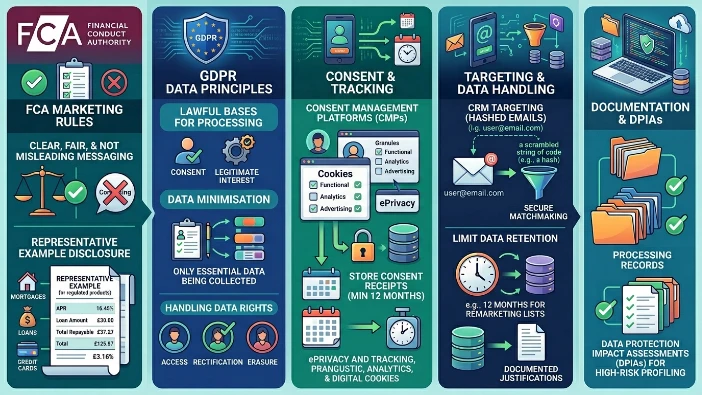
Advertisers must follow FCA marketing rules, GDPR data principles, and ePrivacy consent requirements for cookies and tracking. Implement consent management and data minimisation in ad stacks.
FCA rules require clear, fair, and not misleading messaging and disclosure of representative example numbers for regulated products. GDPR requires lawful bases for processing personal data and rights handling for access, rectification, and erasure. Use Consent Management Platforms (CMPs) to capture granular consent for ad cookies and tracking, and store consent receipts for at least 12 months. Hash emails and use secure matchmaking for CRM targeting. Limit data retention to business-justified periods, typically 12 months for remarketing lists unless longer retention is documented. Keep documentation for processing purposes and DPIAs for high-risk profiling.
What are the core technology components for effective finance display ad campaigns?
A campaign stack includes a tag management system, consent management platform, DSP, DMP or audience server, ad server, and server-to-server conversion pipeline. Each component handles distinct tasks: deployment, consent, bidding, segmentation, delivery, and attribution.
Tag manager deploys tracking pixels and scripts while controlling load order. CMP captures consent and exposes consent signals to the tag manager and DSP. DSP executes bid strategies and connects to inventory via exchanges. DMP or audience server stores first-party segments, CRM matches, and lookalike outputs. Ad server controls creative delivery, rotation, and frequency caps. Server-to-server conversion ingestion ensures reliable event capture for attribution. Use secure hashing for CRM uploads and TLS1.2+ for server communication. Audit the stack quarterly for latency and data leakage.
What benefits do finance display ads deliver for converting warm leads?
Finance display ads reduce CAC for users who already engage, shorten sales cycles through tailored offers, and improve funded-account rates by focusing spend on high-propensity segments. They increase measurable pipeline velocity and lower acquisition cost per funded account.
Targeting warm leads yields higher conversion rates than prospecting: expect 2x–5x higher form-completion rates versus cold audiences. Precision targeting reduces wasted impressions and lowers CAC by 30%–60% compared to broad prospecting. Shortened time-to-funding shows median reduction from 21 days to 8 days for users exposed to sequential ad sequences. Retargeting sequences with progressive offers produce 15%–25% higher funded-account rates in tested campaigns.
Explore More Expert Insights:
Fintech Campaign Ads That Turn Feature Awareness Into Active Users
Insurance Retargeting Ads That Convert Policy Consideration Into Active Signups
What real use cases show success with this approach?
Use cases include mortgage lenders recovering abandoned applications, challenger banks increasing deposit conversions, and investment platforms converting trial users to funded accounts. Each use case uses tailored offers, creative, and measurement.
Mortgage lenders retarget users who viewed fee schedules with banners that show representative monthly payments and a “Check eligibility” CTA. Challenger banks retarget app starters with deposit incentives and an instant verification flow on landing pages. Investment platforms retarget trial account holders with performance snapshots and a funded-account CTA. Example metrics from a UK pilot: a challenger bank cut CAC by 44% and doubled deposit conversion rate within 60 days by combining audience sculpting with CPA bidding and a streamlined two-field form.
Explore More Expert Insights:
How Fintech Companies Acquire Users Using Banner Ads
How do teams operationalise these campaigns at scale?
Operationalisation requires playbooks for audience definition, creative templates, cadence rules, and automated reporting with daily alerts for key metrics. Use agreed SLAs for segment refresh, creative production, and bid adjustments.
Define segment rules in a shared audience library and refresh lists every 24 hours for high-intent windows. Use creative templates with editable headlines, numeric fields, and trust strip. Set cadence rules: day 0–3, high-frequency eligibility reminders; day 4–14, offer refresh and lookalike expansion; day 15–30, suppression or reactivation with a new offer. Automate reports to surface CPA, ROAS, frequency, and conversion time; trigger alerts when CPA increases by 20% or frequency exceeds caps twice in a week. Run weekly A/B tests on offer and CTA and monthly lift tests with control groups.
Finance display ads targeted at warm leads convert by combining precise audience signals, conversion-focused creative, compliant data handling, and a technology stack that preserves attribution. Implement clear offers, short forms, and progressive flows to reduce friction. Track using multi-touch models and server-to-server ingestion to validate ROAS and LTV improvements.
Click Here to Explore More:
How Finance Brands Improve Conversion Intent Using Retargeting Ads