Feature banner campaigns are targeted on-site or in-app visual messages that highlight a single product capability or update in 20–40 words to drive user learning and trial. Feature banner campaigns display concise feature names, one-line benefits, and a single action prompt. They run at the top or within product flows. They link to deeper learning pages, interactive demos, or short sign-up flows. Major components include creative, audience targeting, placement rules, and measurement tags.
Feature banners act as micro-education units. They isolate one capability such as instant transfers, budgeting insights, or card controls and present it in a scannable format. Fintech platforms use them inside dashboards, onboarding sequences, and transactional pages. Banners target users by behaviour, product usage, lifecycle stage, or demographic attributes. They reduce cognitive load by showing one feature at a time and guiding users to explore through a single path.
How do fintech teams design an effective feature banner campaign?
Design follows five steps: objective definition, user segmentation, creative specification, technical setup, and measurement planning. Teams set one measurable objective per campaign, for example, 15% lift in feature clicks or 8% increase in feature activation within 14 days. Segments use product telemetry: active users, dormant users, high-balance accounts, or users who complete a specific flow. Creative specifies headline, 8–12-word subtext, single visual element, and one action link. Technical setup includes feature flag rules, A/B test parameters, and tracking pixels. Measurement defines primary metric (click-through rate or activation rate), secondary metrics (time-to-activation, churn impact), and analysis windows (7, 14, 30 days).
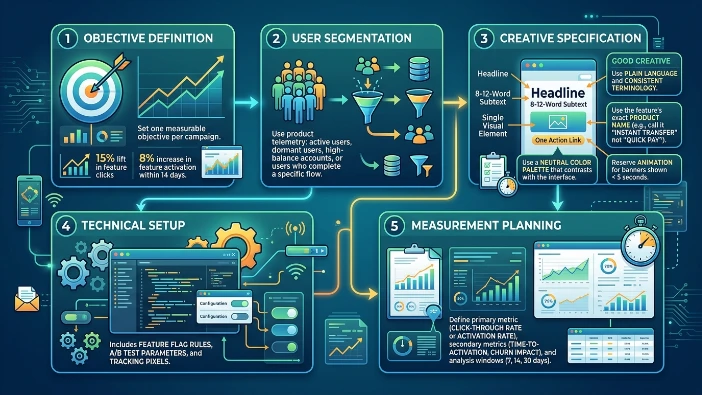
Good creative follows plain language and consistent terminology. Use the feature’s product name exactly as defined in the product taxonomy. For example, call it “Instant Transfer” not “Quick Pay” if the product taxonomy uses “Instant Transfer.” Use a neutral color palette that contrasts with the interface and reserve animation for banners shown under 5 seconds.
What components make up a feature banner campaign?
Components include creative assets, audience targeting rules, placement logic, link destinations, experiment framework, and analytics instrumentation. Creative assets: headline, supporting line, icon or micro-illustration, and a 40×40 to 80×80 pixel asset for compact placements. Audience targeting rules: activation status, transaction frequency, balance thresholds, and recent event triggers. Placement logic: top-of-dashboard, within transaction flow, post-auth modal, or email header render. Link destinations: knowledge articles, quick-start flows, sandbox demos, or one-click activation screens. Experiment framework: randomized control groups, sample size calculations, and significance thresholds. Analytics instrumentation: custom events, UTM parameters, conversion windows, and funnel visualizations.
Campaign that promotes a “Budget Planner” feature uses an audience of users with 3+ recurring expenses and no prior use of budgeting tools. Placement appears in the dashboard between balance and recent transactions. The banner links to a 90-second interactive demo and a one-click enable flow. Measurement tracks demo completion and feature enablement within 14 days.
Why do fintech platforms use feature banners for user education?
Feature banners scale concise education across product audiences while preserving user context and reducing friction to trial. Banners reach users during relevant moments, such as right after a deposit or during monthly statements. This timing increases relevance and comprehension. They require minimal engineering to deploy compared with full product tours. Banners also integrate with personalisation engines to show the right feature to the right user. This targeted visibility increases the probability that users will notice and engage with capabilities they previously overlooked.
Banners support incremental learning. Presenting one feature at a time reduces cognitive load. Users process a single message in under 5 seconds. This format fits mobile screens and session-limited use. Banners also create traceable intent signals: a click records interest; a follow-up conversion proves learning translated into action.
How do teams measure success of feature banner education campaigns?
Success metrics include click-through rate, feature activation rate, time-to-activation, retention lift, and downstream revenue impact measured over 7–30 days. Primary metric selection depends on the campaign objective. For awareness objectives, use click-through rate (CTR) and impressions-to-click ratio. For trial objectives, use feature activation rate within a 14-day window. For retention or monetisation objectives, measure 30-day retention lift and incremental revenue per user. Use randomised controlled trials to isolate campaign effect. Cohort analysis isolates users who saw the banner versus those who did not, controlling for prior behavior.
Statistical rigor requires minimum sample sizes. For expected effects of 5–10% lift, plan for at least 2,000 users per cell. Use pre-registered analysis windows and guardrails for multiple comparisons. Instrument analytics to capture micro-conversions: click, demo start, demo complete, enable event, and first usage. Attribute revenue impact only after confirming feature usage paths that directly influence monetisable events.
What content and copy practices improve learning in banners?
Use single-feature focus, exact product terminology, one clear action label, and 8–12-word supporting text to explain value in measurable terms. Keep headlines to 3–5 words. Use supporting text to quantify benefit when possible: “Save £50 monthly on fees,” “Reduce manual reconciliation by 60%.” Replace vague verbs with precise verbs: enable, start, view, enable now. Avoid compound claims; state one measurable outcome per banner. Use accessible language at a 9–10 year reading level. Provide a one-click path to a short demo or a one-step enablement flow to reduce friction.
Real-time Balance Alerts. Supporting line: “Receive push alerts for balances under £50.” Action label: “Enable Alerts.” Link destination: one-step toggle on notification settings.
How do personalisation and segmentation improve banner relevance?
Personalisation maps feature relevance to user signals such as transaction patterns, balances, lifecycle stage, and recent product events. Match features to behavioural triggers: show travel-insurance-related banners to users with travel purchases in the last 90 days. Use lifecycle signals: show onboarding banners to accounts under 7 days old. Use monetary signals: show premium card features to users with average monthly balances above £2,000. Use negative targeting to exclude users who already use the feature. Combine signals into simple rule sets or a machine learning model for ranking candidate banners by relevance. Monitor for bias and over-targeting; rotate creative to avoid banner fatigue.
What technical and privacy considerations apply in the UK?
Deploy banners with consent-aware tracking, data minimisation, and clear links to privacy notices to comply with UK GDPR and ePrivacy standards. Collect only necessary attributes for targeting. Use hashed identifiers for cohort assignment where possible. Provide opt-outs for personalised banners in preference settings. Log processing activities and retention periods for feature metadata. Ensure analytics and third-party solutions have appropriate data processing agreements and subprocessors listed. For email or cross-device rendering, use consented channels only. Maintain an internal register of banner experiments for auditability.
What are common use cases where feature banners drive learning?
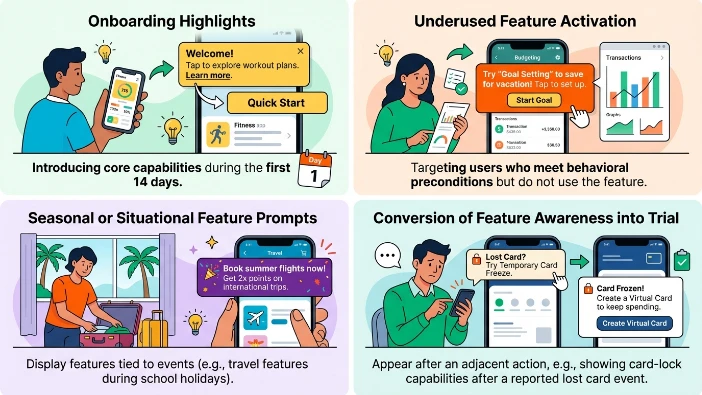
Common use cases include onboarding highlights, underused feature activation, seasonal/situational feature prompts, and conversion of feature awareness into trial. Onboarding highlights introduce core capabilities during the first 14 days. Underused feature activation targets users who meet behavioral preconditions but do not use the feature. Seasonal or situational prompts display features tied to events, for example tax tools during fiscal year-end or travel features during school holidays. Conversion prompts appear after a user completes an adjacent action, such as showing card-lock capabilities after a reported lost card event.
Check the Complete Explanation:
How Finance Brands Promote Credit Cards Using Display Campaigns
How do feature banners connect to deeper learning paths?
Banners link directly to microlearning units: short demos, step-by-step enable flows, micro-courses, and contextual help articles. Design destination content for 90–180 seconds of consumption on mobile. Use interactive demos that simulate the feature within the banner context. Provide inline progress tracking and a clear next step: enable, schedule, or try. Track completion events and feed them back into the personalisation engine to avoid redundant messaging.
A 90-second interactive demo for a fraud alert feature; a one-click toggle screen to enable multi-factor authentication; a knowledge article with screenshots and a short checklist.
Explore More Expert Insights:
How Insurance Companies Increase Policy Consideration Using Banner Ads
How Banks Nurture Loan Leads Using Informational Display Ads
What risks and failure modes should teams monitor?
Monitor banner fatigue, incorrect targeting, broken enable flows, and privacy violations. Banner fatigue appears as declining CTR across successive exposures. Use frequency caps: limit exposure to 3 shows per 30 days. Test targeting logic on shadow cohorts before rollout to avoid exposing irrelevant banners. Validate enable flows end-to-end in staging and production. Periodically audit tracking to ensure no unauthorised data transfers occur.
Get the Full Insights Here:
Fintech Campaign Ads That Turn Feature Awareness Into Active Users
How do feature banner campaigns fit into broader fintech education strategies?
Feature banners provide low-friction awareness and trial opportunities that complement longer-form education like tutorials, webinars, and product tours. Use banners to surface immediate relevance and send interested users to longer formats for deeper learning. Orchestrate multi-touch campaigns: a banner to drive demo starts, an email to deliver deeper content, and an in-app checklist to guide adoption. Use measurement to link micro-conversions from banners to macro outcomes like retention, feature adoption rates, and revenue per user.