Banner ads are rectangular display ads on websites and apps; fintech companies use them to reach target audiences, raise brand awareness, and drive clicks to landing pages or app stores.
Banner ads are image- or HTML-based creatives that appear within web page layouts and mobile apps. Fintech entities use banner ads to present a concise value proposition, a promotional offer, or an app-install prompt. Typical placements include financial news sites, comparison portals, lifestyle blogs, and mobile ad networks. Creatives run across desktop, tablet, and mobile formats using standard sizes such as 300×250, 728×90, and 320×50 pixels. Ad delivery occurs via Demand-Side Platforms (DSPs), ad exchanges, or hosted ad networks that connect publisher inventory with advertiser demand.
How do fintech companies target audiences with banner ads?
Fintech targeting uses demographic, contextual, behavioural, and intent signals to reach high-probability prospects at scale.
Targeting begins with audience segmentation. Fintech teams define segments by age ranges, income bands, employment status, and financial behaviours. Advertisers add contextual criteria: article topics like mortgages, investing, or small-business banking. Behavioural signals include past visits to finance comparison sites, recent searches for loan rates, and app-install history. Intent signals derive from search keywords and recent transactional events, such as completed credit checks or opened investment accounts.
Programmatic platforms map these segments to available impressions in real time. Fintech bidders set bid multipliers for high-value placements and use frequency caps to control exposure per user. Cross-device identifiers link mobile and desktop interactions to form unified user profiles. Fintechs also use lookalike modeling: they upload anonymised lists of existing customers and request audiences with similar attributes from data partners. This approach increases reach while preserving campaign relevance.
What creative elements make banner ads effective for fintech?
Effective fintech banners feature clear headlines, numeric offers, concise benefits, strong visual contrast, and a single visible action.
Headlines state the core benefit in fewer than seven words. Numbers communicate credibility: interest rates, cashback percentages, estimated savings, or time-to-approval in days. Visuals use brand color contrast and minimal text overlay. Calls-to-action (CTA) use verbs like “Apply,” “Open,” or “Learn” and match the landing page action. Landing pages replicate creative messaging and remove navigation friction. For app-install campaigns, creatives include platform badges and file-size expectations.
A/B testing validates creative choices. Tests compare headline variants, imagery, size formats, and CTA labels. Fintechs track click-through rates (CTR), view-through conversions, and post-click conversion rates. High-performing creatives achieve CTRs above 0.5% in financial categories on premium placements, and narrower messages with concrete figures deliver the highest conversion lift.
How do fintech companies measure banner ad performance?
Fintech measurement uses click, view-through, and conversion tracking integrated with analytics to evaluate acquisition cost and downstream value.
Primary metrics include impressions, clicks, CTR, cost-per-click (CPC), cost-per-impression (CPM), and cost-per-acquisition (CPA). View-through attribution measures conversions from users who saw an ad but clicked later. Post-install or post-signup events track quality: account completions, first deposits, funded loans, or KYC clearance. Lifetime value (LTV) and churn rates determine whether acquisition cost is sustainable.
Tracking architecture uses pixels, server-to-server events, and mobile attribution SDKs. Fintech teams reconcile ad network reports with internal CRM and transaction systems. They compute return on ad spend (ROAS) for short-term offers and customer LTV-to-CPA ratios for long-term acquisition. Statistical methods include uplift testing and incrementality experiments to isolate the causal impact of banner ads on conversions.
What campaign structures do fintech companies use in banner advertising?
Fintech campaigns use layered structures: awareness buys for reach, prospecting for new users, retargeting for engagement, and lookalike expansion for scale.
Awareness buys prioritise high-reach premium inventory and viewability targets, measured by cost-per-thousand viewable impressions (vCPM). Prospecting uses audience segments and contextual filters with higher bid rates for top-performing placements. Retargeting focuses on past site visitors and app engagers with tailored creatives based on prior behaviour. Lookalike expansion derives new audiences from seed lists of high-value customers.
Budgets allocate 20–40% to awareness, 40–60% to prospecting, and 10–30% to retargeting for many fintech campaigns. Time windows vary: short windows (1–7 days) for product launches and longer windows (30–90 days) for lifecycle nurturing. Frequency caps prevent ad fatigue; typical caps range from 3 to 8 impressions per user per week depending on audience segment.
What privacy and compliance requirements affect fintech banner ads in the UK?
UK fintech banner advertising requires data protection compliance, fair financial promotions, and transparent consent for targeting.
Data processing must follow UK GDPR and the Data Protection Act 2018. Advertisers must record lawful bases for processing personal data, provide transparent privacy notices, and enable subject access rights. For cookie-based targeting, campaigns must implement consent management platforms (CMPs) to capture and store consent records. Advertisers must remove users who withdraw consent from targeting pools.
Financial promotions regulation applies: ads that advertise financial products must be fair, clear, and not misleading under FCA rules. Ads for regulated products require risk warnings and key information. Claims about fees, interest rates, or returns must include accurate figures and clear qualifiers. Specialist legal review checks ad copy against regulatory expectations before launch.
What optimisation techniques improve user acquisition with banner ads?
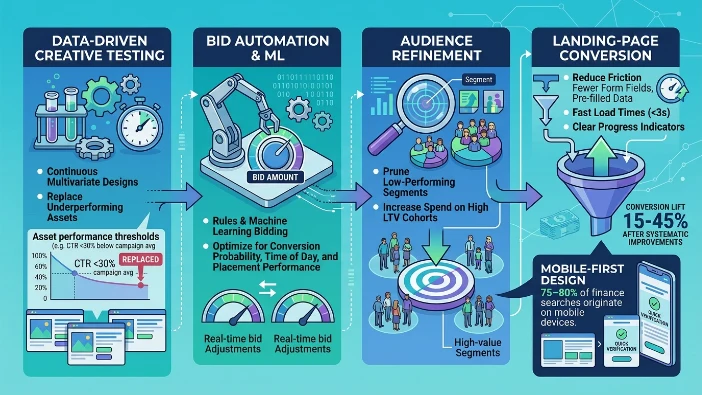
Optimisation focuses on data-driven creative testing, bid automation, audience refinement, and landing-page conversion improvements.
Creative testing cycles run continuously with multivariate designs. Fintech teams replace underperforming assets after predefined thresholds, such as CTR 30% below campaign average. Bid automation uses rules and machine-learning bidding to adjust for conversion probability, time of day, and placement performance. Audience refinement prunes low-performing segments and increases spend on cohorts with higher LTVs.
Landing-page optimisation reduces friction: fewer form fields, pre-filled data, clear progress indicators, and fast load times under three seconds. Mobile-first design matters: 75–80% of finance searches originate on mobile devices, so pages must prioritise responsive layouts and quick verification flows. Conversion lifts of 15–45% are common after systematic landing-page improvements.
Discover More Insights:
How Finance Brands Improve Conversion Intent Using Retargeting Ads
What are the benefits of banner ads for fintech user acquisition?
Banner ads deliver scalable reach, measurable performance, precise targeting, and efficient retargeting pathways for fintech products.
Fintechs obtain broad exposure across relevant publisher ecosystems, enabling message testing at scale. Measurement systems provide granular insights into user journeys from impression to funded account. Targeting reduces waste by focusing on temperature-based audiences—cold, warm, and hot—allowing appropriate creative and offer sequencing. Retargeting reconnects interested users, improving conversion rates and reducing overall CPA.
Banner ads also support multi-channel funnels. They integrate with search, social, and email campaigns to create coherent acquisition paths. For regulated product launches, banners deliver compliant, measurable outreach that supports documented marketing records.
Explore More Expert Insights:
How Finance Brands Promote Credit Cards Using Display Campaigns
How Insurance Companies Generate Leads Using Banner Ads
What use cases show banner ads working for fintech companies?
Use cases include new app installs, credit product signups, savings account openings, investment account acquisition, and small-business finance lead generation.
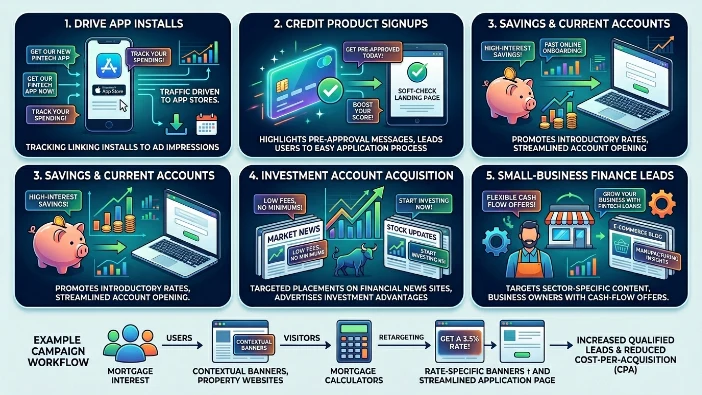
For app installs, banners drive users to app stores with tracking linking installs to ad impressions. For credit products, banners highlight pre-approval messages and lead users to soft-check landing pages. For savings and current accounts, banners promote introductory rates and fast online onboarding. For investment platforms, banners advertise low fees and account minimums with targeted placements on financial news sites. For small-business finance, banners target sector-specific content and business owners with cash-flow offers.
Example: a campaign that segments users by interest in mortgages runs contextual banners on property websites, then retargets visitors who viewed mortgage calculators with rate-specific creatives and a streamlined application page. This sequence increases qualified leads and reduces CPA compared with single-touch campaigns.
Dive Deeper Into This Topic:
Finance Display Ads That Convert Warm Leads Into High-Intent Customers
How do banner ads fit into a larger fintech acquisition strategy?
Banner ads integrate with search, email, social, and affiliate channels to form a multi-touch acquisition funnel that moves users from awareness to application.
Initial banner impressions generate awareness and create measurable audiences. Prospecting banners supply new leads to search and social channels, which capture intent signals. Retargeting banners re-engage users who interacted with search landing pages or email links. Attribution models assign credit across interactions to optimise budget allocation. Data flows from ad platforms feed CRM segmentation and inform lifecycle marketing, such as onboarding emails or in-app messages that increase activation metrics.
For deeper analysis, teams run incrementality tests that compare cohorts exposed to banners with control groups. Results inform budget reallocation across channels and validate banner contribution to net new customers.
Banner ads remain a core, measurable channel for fintech user acquisition in the UK. They require precise targeting, compliant data practices, continually tested creatives, and integrated measurement systems. When structured as awareness, prospecting, and retargeting layers, banners scale reach and efficiently convert prospects into applicants and app users.