
Educational institutes use informational banner ads as structured communication tools within the consideration stage of the admission funnel. These ads do not focus on final enrolment. They focus on education pathways, course understanding, and structured academic comparison. In the United Kingdom, this system supports students who already know general study options and now evaluate detailed academic choices.
Informational banner ads operate across education websites, search networks, and digital learning platforms. They provide structured academic information such as programme types, qualification levels, subject depth, and career-aligned outcomes. This stage builds understanding before decision making begins.
Learn foundational concepts:
How Educational Institutes Use Banner Ads to Increase Admissions
Explore:
How Educational Institutes Convert Interested Students Into Paid Enrollments Using Banner Ads
What are informational banner ads in student nurturing?
Informational banner ads in student nurturing are structured digital display advertisements that deliver academic details such as course structure, subject areas, and qualification levels to students in the consideration stage. They support deeper evaluation of educational options without direct enrolment messaging or promotional pressure.
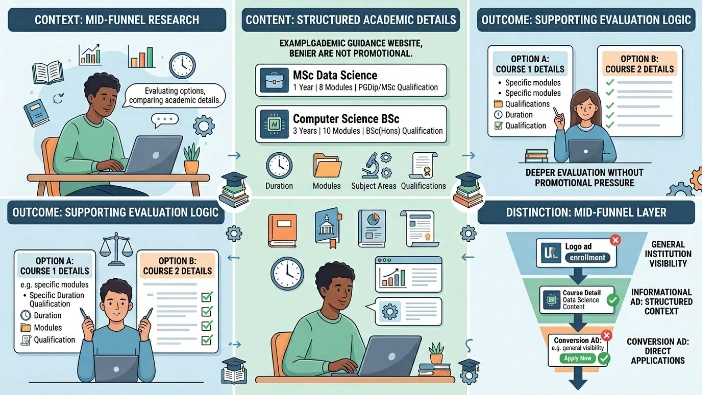
Informational banner ads represent a mid-funnel communication layer in education marketing systems. They differ from awareness ads because they provide structured academic context instead of general institution visibility. They differ from conversion ads because they do not push direct applications.
These ads focus on clarity of academic pathways. Students view structured information such as course duration, module structure, and qualification outcomes. This helps them compare multiple academic options in a structured environment.
In the UK education ecosystem, these ads appear on academic portals, research platforms, and student guidance websites. Their function is to support evaluation logic during the research phase of student decision making.
How do informational banner ads guide students during consideration stage?
Informational banner ads guide students during the consideration stage by presenting structured academic comparisons, course details, and subject clarity. They support evaluation of multiple education pathways, allowing students to organise preferences and refine choices based on structured academic information delivery systems.
Guidance occurs through repeated exposure to structured academic content. Students who have already identified general study interests receive detailed programme information across multiple platforms. This helps refine their understanding of subject scope.
These ads present comparative academic structures. For example, business programmes may show differences in modules such as finance, marketing, or management. This supports clearer evaluation between similar courses.
Guidance also occurs through progressive information layering. Initial ads introduce course names, while later ads provide deeper academic breakdowns. This structured progression supports informed comparison during the consideration phase of student decision making.
What components make informational banner ads effective for nurturing?
Effective informational banner ads use structured academic messaging, clear typography, programme-specific details, and consistent visual hierarchy. They include subject clarity, qualification level indicators, and concise academic outcomes that support structured understanding of educational pathways during consideration stage evaluation processes.
Components define how information is organised and interpreted. Academic clarity is the primary component. Course names, subject categories, and qualification types must be clearly visible and structured.
Visual hierarchy determines information processing speed. Important academic details such as programme title appear first, followed by supporting details like duration or study mode. This ensures readability during quick browsing sessions.
Consistency across multiple ads strengthens comprehension. When students repeatedly see structured academic formats, they develop familiarity with course categories and qualification frameworks. This improves evaluation efficiency during the consideration phase of education research.
How does audience segmentation improve student nurturing with banner ads?
Audience segmentation improves student nurturing by dividing learners based on academic interests, age group, geographic region, and behavioural data. This ensures informational banner ads display relevant course structures and academic pathways aligned with student intent and education preferences across digital environments.
Segmentation defines which students receive specific academic content. For example, science-focused students receive STEM-related course ads, while humanities-focused students receive arts or social science programme details.
In the UK education system, segmentation also considers qualification stage. Undergraduate and postgraduate students receive different academic structures based on study level requirements.
Behavioural segmentation improves relevance further. Students who previously viewed engineering courses receive more detailed engineering programme breakdowns. This ensures that nurturing messages remain aligned with evolving academic interests during the consideration stage.
How do educational institutes structure content in informational banner ads?
Educational institutes structure informational banner ads using layered academic messaging, concise programme descriptions, subject categorisation, and qualification clarity. Content is arranged in hierarchical order to support fast comprehension and enable structured evaluation of academic programmes during consideration phase research activity.
Content structure begins with programme identification. The course name appears prominently to establish immediate academic context. This ensures recognition of subject area within seconds.
Supporting details include course duration, qualification level, and study mode. These elements provide additional academic clarity. They help students compare multiple programmes efficiently.
Some ads include subject breakdowns such as module themes or core study areas. This structured presentation supports deeper academic understanding without overwhelming the viewer with excessive information. The goal is clarity during evaluation, not persuasion.
What benefits do informational banner ads provide in the MOFU stage?
Informational banner ads provide benefits such as structured academic comparison, improved course understanding, increased engagement with educational content, and better decision readiness. They support students by simplifying evaluation of multiple academic pathways during consideration stage research processes across digital environments.
One key benefit is structured comparison. Students can evaluate multiple programmes based on consistent information formats. This reduces confusion during course selection research.
Another benefit is clarity in academic expectations. Students understand what each programme includes before committing to further action. This improves decision accuracy.
Engagement increases because students receive relevant academic details aligned with their interests. This leads to longer interaction with educational content.
Decision readiness improves when students reach the final stages of evaluation. They already understand course structures, reducing uncertainty in later application stages.
Explore More Expert Insights:
How Tech Companies Drive Trial Consideration Using Display Remarketing Ads
How SaaS Platforms Improve Lead Qualification Using Mid-Funnel Ads
How are informational banner ads integrated into education marketing funnels?
Informational banner ads are integrated into education marketing funnels at the middle stage, between awareness and conversion. They function as structured nurturing tools that transition students from general interest to detailed academic evaluation through repeated exposure and structured educational messaging systems.
Integration occurs when banner ads connect awareness campaigns with decision-focused campaigns. After students first encounter general course information, they enter a stage where deeper academic details are required.
At this stage, informational ads provide structured learning pathways. They expand on initial awareness by offering course breakdowns, subject comparisons, and qualification structures.
These ads align with funnel progression logic. Awareness ads introduce options, informational ads explain options, and conversion ads support final decisions. This structured sequence ensures continuity in student engagement across the admission journey.
What metrics measure nurturing performance of informational banner ads?
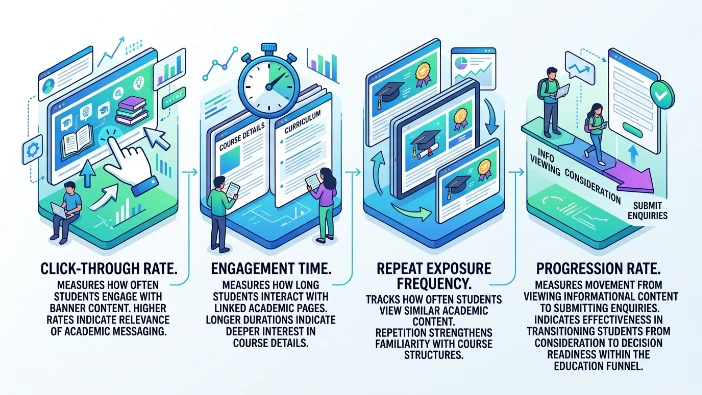
Metrics for measuring nurturing performance include click-through rate, engagement time, repeat exposure frequency, content interaction depth, and progression rate toward enquiry actions. These indicators evaluate how effectively informational banner ads support student consideration and academic evaluation processes.
Click-through rate measures how often students engage with banner content. Higher rates indicate relevance of academic messaging.
Engagement time measures how long students interact with linked academic pages. Longer durations indicate deeper interest in course details.
Repeat exposure frequency tracks how often students view similar academic content. Repetition strengthens familiarity with course structures.
Progression rate measures movement from viewing informational content to submitting enquiries. This indicates effectiveness in transitioning students from consideration to decision readiness within the education funnel.