
Display remarketing ads reconnect technology-focused audiences with previously viewed products, services, or software platforms through targeted visual advertising. These campaigns increase trial consideration by maintaining visibility during product evaluation stages and encouraging users to revisit solutions they already explored online.
Display remarketing is a digital advertising strategy that targets users who previously interacted with a website, application, landing page, or product-related content. The advertisements appear across websites, mobile applications, video platforms, and digital publishing networks.
In technology marketing, remarketing supports long evaluation cycles. Business software buyers often compare multiple solutions before starting a free trial. Repeated visual exposure keeps a platform visible throughout that process.
A display advertisement is a visual banner containing headlines, graphics, product messaging, and engagement prompts. Remarketing systems personalise these ads according to user behaviour.
A visitor reviewing cloud storage features receives different advertisements than a visitor exploring cybersecurity integrations. Behavioural alignment increases message relevance and improves engagement quality.
For readers exploring early-stage audience acquisition, read to understand:
How SaaS Products Increase Signups Using High-Intent Banner Campaigns
Why do tech companies use remarketing to increase trial consideration?
Tech companies use remarketing because software buyers require repeated research, feature comparisons, and operational evaluation before starting product trials. Display remarketing maintains product awareness during these stages and encourages users to continue evaluating solutions already connected to their business requirements.
Software evaluation journeys involve multiple sessions across different devices and websites. A potential customer rarely begins a free trial during the first interaction. Most users compare pricing, integrations, functionality, and operational compatibility before progressing further.
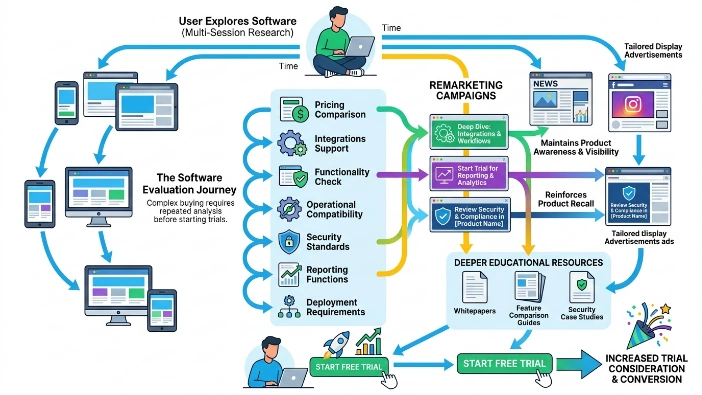
Remarketing campaigns address this delay by keeping products visible. A visitor exploring workflow automation today often receives feature-focused advertisements during later browsing sessions. This visibility reinforces product recall.
Technology buyers also conduct detailed operational analysis. They review security standards, integration support, reporting functions, and deployment requirements. Remarketing campaigns guide these users toward deeper educational resources.
Repeated exposure increases familiarity with the product category and the platform itself. Familiarity improves recognition during competitive comparison stages.
Display remarketing additionally improves marketing efficiency. Instead of targeting broad internet audiences, campaigns focus on users already connected to the software category through measurable behaviour.
Mid-funnel marketing specifically benefits from remarketing because users already understand the product category. Campaign messaging therefore shifts toward feature relevance, operational value, and implementation clarity instead of basic awareness.
How do display remarketing ads work for SaaS and tech platforms?
Display remarketing ads work by tracking website interactions, grouping users into behavioural audiences, and delivering targeted advertisements across digital platforms. SaaS and technology businesses use these campaigns to guide evaluation-stage visitors toward deeper engagement and trial-related product exploration.
Remarketing begins when a user visits a website or interacts with product content. Tracking technologies record behavioural signals such as page visits, session duration, pricing-page engagement, or content downloads.
The advertising system then categorises users into audience segments. Users reviewing analytics dashboards enter analytics-focused segments. Users exploring collaboration features enter productivity-focused groups.
After segmentation, advertisements appear across digital publishing networks. These ads contain messaging related directly to earlier user interactions. This behavioural relevance improves engagement accuracy.
Dynamic remarketing systems automate message personalisation further. A visitor comparing reporting features receives banners focused on reporting functionality instead of generic platform messaging.
Audience timing also influences performance. Short-term remarketing sequences target users within 24 to 72 hours after engagement. Longer campaigns support evaluation cycles lasting several weeks.
Cross-device functionality strengthens continuity. A user researching software on mobile devices often continues evaluation later on desktop systems. Remarketing campaigns maintain visibility across both environments.
Behavioural exclusions improve efficiency as well. Existing trial users, converted customers, or inactive visitors are removed from acquisition-focused campaigns to reduce unnecessary advertising spend.
What types of remarketing ads improve trial consideration?
Feature-focused banners, educational display ads, product comparison advertisements, webinar promotions, and dynamic remarketing creatives improve trial consideration by providing relevant information aligned with user interests and evaluation-stage research behaviour within software purchasing journeys.
Feature-focused banner ads highlight specific product capabilities. A project management platform often promotes workflow tracking, collaboration tools, or reporting systems based on audience behaviour.
Educational display advertisements guide users toward informational resources. Examples include implementation guides, onboarding tutorials, security documentation, and operational use cases.
Comparison-focused advertisements support evaluation-stage buyers. These ads explain product differences, workflow advantages, or integration capabilities relevant to operational decision-making.
Webinar promotion campaigns attract audiences interested in practical demonstrations. Users attending product-focused webinars frequently represent stronger trial-stage prospects because they actively seek implementation knowledge.
Dynamic creative ads personalise visuals and messaging automatically. A visitor reviewing cybersecurity pages receives security-focused creative assets, while another visitor exploring analytics functions receives reporting-focused messaging.
Sequential remarketing also supports trial consideration. Users first receive awareness-oriented educational ads, followed by comparison-focused messaging and later trial-oriented reminders.
Video remarketing campaigns increase engagement duration. Product walkthroughs, workflow demonstrations, and integration tutorials help users understand operational functionality before entering trial stages.
How do tech companies identify high-consideration audiences?
Tech companies identify high-consideration audiences through behavioural analytics, engagement tracking, content interaction patterns, and return-visit frequency. These indicators reveal which users actively evaluate software solutions and demonstrate stronger interest in product trials or operational implementation research.
Behavioural analytics measure how users interact with websites and product resources. Pricing-page visits, feature comparisons, and repeated return sessions indicate active evaluation behaviour.
Content engagement also reveals intent quality. A visitor downloading technical documentation demonstrates stronger consideration than a visitor reading introductory content briefly.
Time-on-page metrics improve audience qualification further. Users spending several minutes reviewing integrations, compliance resources, or implementation guides typically represent evaluation-stage prospects.
Return-visit frequency strengthens consideration analysis. Multiple visits within seven days often indicate active internal discussions or competitive comparisons inside businesses.
Audience scoring systems combine behavioural actions into measurable qualification values. Product-demo views, webinar registrations, and resource downloads increase consideration scores.
Industry segmentation improves targeting precision. A financial software platform targets accounting professionals differently than operational managers or procurement teams.
Device behaviour also provides useful insight. Desktop users frequently demonstrate higher evaluation depth because business software research often occurs during professional workflows.
Readers studying conversion-focused remarketing can review:
How Tech Companies Maximize Trial Conversions Using High-Performance Remarketing Ads
Why does repeated exposure increase software trial interest?
Repeated exposure increases software trial interest because consistent visibility strengthens product recognition, reinforces feature familiarity, and maintains engagement throughout long evaluation cycles. Technology buyers frequently compare multiple solutions, making repeated advertising exposure important during operational decision-making processes.
Software buyers interact with large amounts of technical information during research stages. Remarketing campaigns maintain product visibility while users compare alternative platforms.
A user seeing the same reporting software across several trusted websites develops stronger recognition than a user exposed only once. Recognition improves recall during evaluation discussions.
Repeated exposure also reinforces feature understanding. Campaigns frequently rotate messages focusing on integrations, workflow automation, analytics dashboards, or collaboration tools. This sequencing expands product familiarity gradually.
Visual consistency improves memory retention. Repeated use of similar colours, layouts, and headlines helps users associate advertisements with a specific platform more quickly.
Frequency control remains important. Effective campaigns balance visibility without overwhelming users. Excessive repetition reduces engagement quality and increases advertising fatigue.
Educational repetition also improves comprehension. Buyers often require multiple exposures to understand technical workflows, deployment methods, or integration capabilities fully.
Remarketing campaigns support these learning processes by connecting users with progressively deeper informational content during the evaluation journey.
Explore More Expert Insights:
How SaaS Platforms Improve Lead Qualification Using Mid-Funnel Ads
How Software Brands Build Trust Using Case Study Banner Campaigns
How do display remarketing ads support lead nurturing?
Display remarketing ads support lead nurturing by delivering ongoing educational messaging aligned with user behaviour, operational interests, and software evaluation stages. These campaigns guide prospects through structured learning journeys that improve product understanding and increase readiness for trial participation.
Lead nurturing is the process of building engagement with prospective customers over time. In technology marketing, nurturing focuses on education, operational alignment, and solution relevance.
Remarketing campaigns support nurturing through sequential communication. A first advertisement introduces operational value. Later advertisements explain integrations, reporting systems, or implementation workflows.
Educational assets strengthen this process further. Display ads frequently direct users toward product guides, webinars, comparison pages, and feature documentation.
Audience segmentation improves nurturing accuracy. Users researching automation features receive different educational pathways than users exploring analytics systems or customer support functions.
Behaviour-triggered campaigns increase relevance. A visitor downloading onboarding resources later receives implementation-focused advertisements rather than introductory messaging.
Lead nurturing campaigns also improve trial quality. Users entering trial stages after extended educational engagement often demonstrate stronger operational understanding and product alignment.
Marketing automation systems frequently support these workflows by adjusting messaging according to behavioural engagement patterns and qualification scores.
What metrics measure success in display remarketing campaigns?
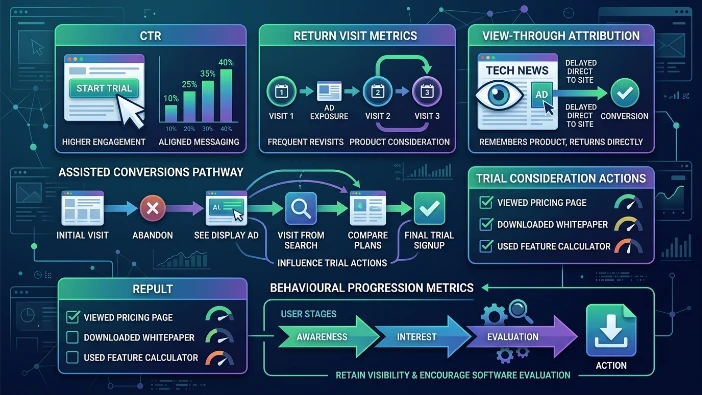
Display remarketing success is measured through engagement rates, return visits, assisted conversions, trial consideration actions, view-through interactions, and behavioural progression metrics. These measurements reveal how effectively campaigns maintain visibility and encourage software evaluation among targeted technology audiences.
Click-through rate measures advertisement engagement. Higher interaction rates indicate stronger alignment between messaging and audience intent.
Return-visit metrics track how frequently remarketing users revisit websites after exposure. Increased return traffic reflects stronger product consideration.
Assisted conversions reveal the influence of remarketing on later trial actions. Many users convert after multiple interactions instead of single advertisement clicks.
View-through attribution also matters in display advertising. Users frequently see advertisements, remember products, and later return directly without clicking immediately.
Trial-focused engagement metrics provide deeper insight. Webinar registrations, pricing-page visits, feature-page interactions, and implementation-resource downloads indicate evaluation-stage progression.
Audience retention analysis identifies which segments continue engagement over extended periods. Long-duration engagement often reflects higher-quality consideration behaviour.
Device-level reporting improves campaign optimisation. Technology marketers frequently identify stronger desktop trial progression compared with mobile engagement patterns.
Geographic reporting also supports regional targeting improvements. UK-based campaigns often perform differently across industries, operational sectors, and business environments.
Display remarketing ads help tech companies increase trial consideration through behavioural targeting, repeated exposure, educational engagement, and operational relevance. These campaigns maintain visibility during software evaluation5 journeys and guide users toward deeper product understanding before conversion-stage decisions occur.