
BOFU Insight Line: Explore how decision-stage banner ads convert interested students into confirmed enrolments by using structured messaging, fee clarity, urgency signals, and application-driven digital pathways across education funnels.
Educational institutes in the United Kingdom use banner ads at the bottom of the funnel to convert students who already evaluated courses and institutions. These students already understand programme structure and academic fit. The final stage focuses on action, payment, and enrolment confirmation.
Banner ads in this stage shift from information delivery to decision activation. They present structured conversion elements such as application deadlines, fee breakdowns, intake cycles, and enrolment pathways. The objective is final commitment rather than exploration.
What are BOFU banner ads in education marketing?
BOFU banner ads in education marketing are conversion-focused digital advertisements designed to turn already interested students into enrolled applicants. They display application steps, fees, deadlines, and enrolment instructions, supporting final decision making within structured education marketing funnels in the United Kingdom system.
BOFU banner ads represent the final stage of student acquisition. They appear after awareness and consideration stages are completed. At this point, students already know the course, institution, and academic structure.
These ads function as conversion triggers. They provide direct instructions for application submission or enrolment completion. Unlike earlier funnel stages, they avoid general information and focus on decision execution.
In UK education systems, BOFU ads appear on retargeting networks, education portals, and search remarketing placements. Their role is to convert high-intent students into confirmed admissions.
How do banner ads convert students into paid enrollments?
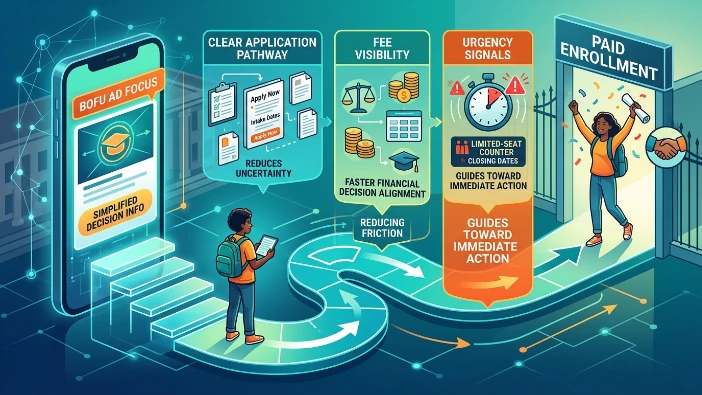
Banner ads convert students into paid enrollments by presenting structured application pathways, highlighting fees, showing deadlines, and reinforcing urgency through intake cycles. They reduce decision friction by providing direct access to enrolment processes and clear academic commitment steps for students.
Conversion occurs when students receive simplified decision information. BOFU ads remove complexity by focusing only on final steps required for enrolment.
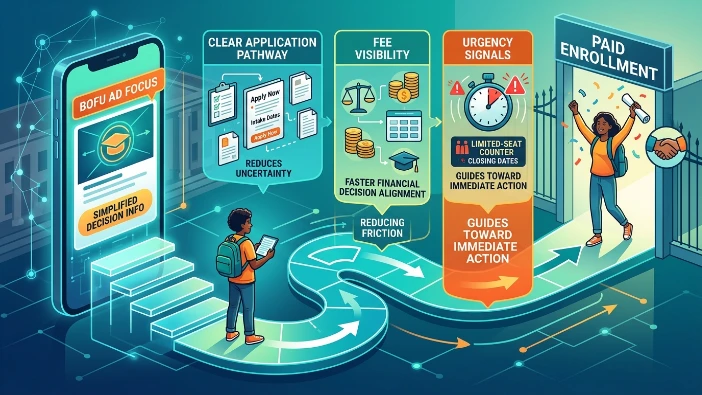
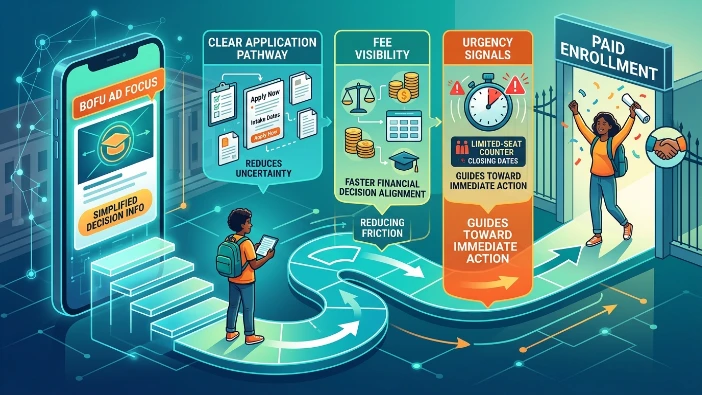
Application pathways are clearly structured. Students see instructions such as “apply now,” course intake dates, and required documentation. This reduces uncertainty during final decision making.
Fee visibility is another conversion driver. Students compare tuition cost, payment structure, and scholarship availability. This clarity supports faster financial decision alignment.
Urgency signals such as closing dates or limited intake seats increase conversion readiness. These structured signals guide students toward immediate action instead of delayed evaluation.
What elements make BOFU banner ads effective for enrolment?
Effective BOFU banner ads include clear fee structures, application deadlines, intake schedules, programme confirmation, and strong call-to-application messaging. These elements ensure decision clarity and reduce friction during final enrolment stages in digital student acquisition systems.
Fee clarity is a core component. Students receive exact tuition values, payment cycles, and available financial options. This removes uncertainty during final decision making.
Deadline communication supports urgency. Ads display exact dates for application submission or intake closure. This ensures students understand time sensitivity.
Programme confirmation reinforces choice certainty. Students see course titles and qualification levels again to validate their decision before applying.
Call-to-application messaging provides structured instruction. It directs students toward application portals or enrolment systems without requiring additional research steps.
Read:
How Educational Institutes Use Banner Ads to Increase Admissions
How does retargeting improve conversion in education banner ads?
Retargeting improves conversion by re-engaging students who previously interacted with course pages or informational content. It ensures repeated exposure to application-focused messaging, reinforcing decision readiness and increasing likelihood of enrolment completion across digital education funnels effectively.
Retargeting focuses on users who already demonstrated interest. These students visited course pages, viewed programme details, or engaged with earlier funnel content.
BOFU banner ads then reappear across digital platforms. This repeated exposure strengthens decision memory and reduces hesitation during application stages.
Retargeting ensures message consistency. Students see the same course information combined with application steps, fees, and deadlines.
This repetition reduces dropout between consideration and enrolment. It maintains engagement until final application submission occurs.
What role do fees and funding details play in BOFU conversions?
Fees and funding details play a central role in BOFU conversions by providing financial transparency. Students evaluate tuition costs, repayment structures, scholarships, and funding options, enabling final decision alignment between academic interest and financial capability before enrolment completion.
Financial clarity is essential in conversion decisions. Students compare tuition fees directly before submitting applications.
Banner ads display structured cost breakdowns. This includes yearly fees, total programme cost, and payment schedules.
Funding options support affordability evaluation. Students assess scholarships, instalment plans, and financial assistance structures.
This information reduces uncertainty and supports final enrolment confidence. Clear financial communication directly influences conversion completion rates.
How do deadlines and intake cycles influence student enrolment decisions?
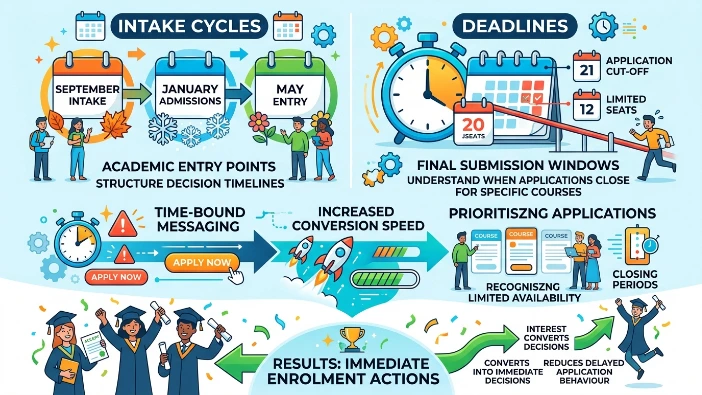
Deadlines and intake cycles influence enrolment decisions by creating time-bound urgency. Students respond to structured admission windows, application cut-off dates, and course start schedules, which guide immediate decision making and reduce delayed application behaviour in education funnels.
Intake cycles define academic entry points such as September, January, and May admissions. These cycles structure student decision timelines.
Deadlines communicate final submission windows. Students understand when applications close for specific courses or programmes.
Time-bound messaging increases conversion speed. Students prioritise applications when they recognise limited availability or closing periods.
This structured urgency ensures that interest converts into immediate enrolment actions rather than postponed decisions.
How is user experience structured in BOFU banner ad pathways?
User experience in BOFU banner ad pathways is structured around direct application access, simplified navigation, and minimal information steps. Students transition from banner ad to application form or enrolment page with reduced friction and clear procedural guidance for completion.
User experience prioritises speed and clarity. BOFU ads remove unnecessary academic explanations and focus on direct action pathways.
Click-through pathways lead directly to application forms. Students bypass multiple informational layers and reach enrolment systems quickly.
Navigation is simplified into structured steps. Students follow defined application processes without additional research requirements.
This design reduces abandonment rates during final decision stages and improves completion of enrolment actions.
What metrics measure BOFU banner ad conversion success?
BOFU banner ad conversion success is measured through application submission rate, enrolment completion rate, cost per acquisition, click-to-application ratio, and payment confirmation tracking. These metrics evaluate effectiveness of decision-stage advertising in student recruitment funnels.
Application submission rate tracks how many students complete initial enrolment steps after clicking ads.
Enrolment completion rate measures final confirmed admissions after application approval.
Cost per acquisition evaluates financial efficiency of converting students through paid advertising channels.
Click-to-application ratio measures transition from ad engagement to application initiation.
Payment confirmation tracking verifies successful financial completion of enrolment processes.
Explore More Expert Insights:
How SaaS Platforms Turn Sales-Ready Leads Into Customers Using Final Stage Display Ads
How Tech Companies Maximize Trial Conversions Using High-Performance Remarketing Ads
How do BOFU banner ads integrate with full education marketing funnels?
BOFU banner ads integrate with education funnels by completing the final conversion stage after awareness and consideration phases. They receive pre-qualified students from earlier stages and convert them into enrolled applicants through structured decision-focused messaging and application pathways.
Integration begins after students pass awareness and consideration stages. Earlier funnel ads introduce and explain academic options.
BOFU ads complete the funnel cycle. They convert students who already understand course structure and institutional value.
This stage ensures continuity across marketing systems. Each funnel stage connects logically from awareness to enrolment.
The final integration point is application submission. This completes the student acquisition process within structured education marketing systems.
What outcomes do educational institutes achieve using BOFU banner ads?
Educational institutes achieve higher enrolment rates, improved application completion, reduced drop-off rates, and increased return on advertising spend using BOFU banner ads. These outcomes result from structured conversion messaging and direct application pathways in decision-stage marketing systems.
Higher enrolment rates result from targeted conversion messaging aligned with student intent.
Application completion improves due to simplified enrolment pathways and structured instructions.
Drop-off rates decrease because students receive clear final-stage guidance.
Return on advertising spend improves due to efficient conversion of already interested student audiences into confirmed enrolments.
Explore:
How Educational Institutes Nurture Students Using Informational Banner Ads