

Online stores maximise checkout completion using conversion-focused banner retargeting ads by re-engaging users who abandon carts, revisit product pages, or show high purchase intent. These ads deliver personalized product reminders, urgency messaging, and checkout-focused prompts across digital platforms to complete unfinished transactions.
Read how awareness and consideration stages connect before conversion here: [Insert Link to TOFU Article] and [Insert Link to MOFU Article]
What are conversion-focused banner retargeting ads in e-commerce?
Conversion-focused banner retargeting ads are display advertisements shown to users who previously interacted with an online store but did not complete a purchase. These ads display previously viewed products, cart items, or related offers to drive users back to checkout pages and increase completed transactions.
Retargeting advertising tracks user behaviour across websites and apps. When a user visits an online store and leaves without purchasing, tracking signals store this interaction. Banner ads then appear on other platforms to remind the user about the product.

Conversion-focused campaigns operate at the final stage of the e-commerce funnel. The objective focuses on completing transactions rather than generating awareness or consideration.
A retargeting banner typically includes product images, price details, discount offers, and direct checkout links. The content is structured to reduce decision delay and support immediate purchase completion.
In the United Kingdom e-commerce environment, conversion-focused banner retargeting is widely used across fashion retail, electronics, travel bookings, and home goods sectors where cart abandonment rates remain high.
How do retargeting banner ads increase checkout completion rates?
Retargeting banner ads increase checkout completion rates by re-engaging abandoned users, reinforcing product interest, reducing purchase hesitation, and guiding customers directly back to checkout pages with previously viewed or cart-added products displayed consistently across digital channels.
Cart abandonment occurs when users add products to a shopping cart but do not complete payment. Industry data shows abandonment rates often exceed 60% in online retail environments.
Retargeting banners reconnect users with products already selected. This reduces the time required for product re-evaluation.
A user viewing running shoes without purchasing later sees banners featuring the same product during browsing sessions on news websites or mobile applications.
How does product reminder messaging influence checkout decisions?
Product reminders reinforce memory and reduce decision delays. Users often abandon carts due to distraction or comparison shopping. Retargeting banners bring the product back into focus.
A shopper leaving a smartphone in the cart receives repeated exposure to the same model across different websites. This repeated exposure increases likelihood of return visits.
Reminder frequency is controlled through campaign settings. Common exposure ranges from 3 to 10 impressions per user within a 7-day period.
How does urgency messaging improve conversions?
Urgency messaging increases time-sensitive decision-making. Banner ads include limited stock indicators, delivery deadlines, or discount expiration notices.
Examples include:
Limited stock remaining for selected size
Delivery guaranteed before a specific date
Price discount valid for 24 hours
These messages reduce delayed purchase behaviour and increase immediate checkout activity.
What triggers conversion-focused retargeting campaigns?
Conversion-focused retargeting campaigns activate when users perform high-intent actions such as product page visits, cart additions, checkout initiation, or repeated browsing of specific product categories, signaling purchase readiness across e-commerce platforms and digital tracking systems.
Trigger events determine when a user enters a retargeting segment. These triggers ensure ads reach users with strong purchase intent.
Product page visits indicate initial interest. Cart additions indicate stronger intent. Checkout page visits represent near-complete purchase behaviour.
Repeated visits across multiple sessions strengthen targeting signals.
A user visiting a laptop product page three times within a week enters a high-priority retargeting group.
How does cart abandonment tracking work?
Cart abandonment tracking records when items are added to a cart but no transaction occurs within a defined time period.
Common tracking windows include 30 minutes, 24 hours, and 7 days. Each window triggers different retargeting intensity.
Short-term abandonment triggers immediate reminder ads. Long-term abandonment triggers discount or incentive-based banners.
How does checkout abandonment differ from cart abandonment?
Checkout abandonment occurs when users begin payment but do not complete transaction confirmation. This represents stronger purchase intent than cart abandonment.
Users in checkout abandonment segments receive more direct conversion messaging, including return-to-checkout banners and payment reminder prompts.
These campaigns focus on completion rather than exploration.
What types of conversion-focused banner retargeting ads exist?
Conversion-focused banner retargeting ads include cart reminder banners, dynamic product ads, price drop alerts, checkout recovery banners, and limited-time offer retargeting formats designed to recover abandoned transactions and guide users back to purchase completion stages.
Cart reminder banners display previously selected items with product images and pricing.
Dynamic product ads automatically update content based on user browsing behaviour. These ads show exact products viewed by the customer.
Price drop alerts notify users when previously viewed products decrease in price.
Checkout recovery banners focus on users who reached payment pages but did not complete transactions.
Limited-time offer banners emphasize urgency using time-based promotions.
How do dynamic retargeting ads function?
Dynamic retargeting uses product feed data to automatically display relevant items. Each user sees personalized banners based on browsing history.
A user viewing multiple laptop models receives banners showing those specific devices instead of unrelated products.
This improves relevance and reduces unnecessary impressions.
How do price-based triggers influence conversion?
Price-based triggers activate when product prices change after user interaction. A reduction in price triggers re-engagement campaigns.
Users who previously viewed an item at full price receive updated banners highlighting discounted pricing.
This reduces hesitation and increases return visits to checkout pages.
What design elements improve checkout-focused banner performance?
Checkout-focused banner performance improves through clear product visuals, price visibility, urgency indicators, simplified messaging, mobile responsiveness, and direct return-to-cart pathways that reduce friction and support immediate purchase completion across digital advertising platforms.
Product clarity remains essential. Banners display high-resolution product images with minimal distraction.
Price visibility is prominently placed. Users compare costs quickly during decision-making stages.
Urgency indicators include time limits, stock status, and delivery deadlines.
Mobile optimisation ensures usability across smartphones, where a large portion of UK e-commerce traffic occurs.
Why does simplicity improve conversion rates?
Simple design reduces cognitive load. Users at checkout stage require fast decision clarity.
Excessive text or multiple product variations reduce focus. Conversion-focused banners highlight one product per advertisement.
Clear structure improves recognition speed.
How does consistency between banner and checkout page affect results?
Consistency ensures users see the same product details after clicking the banner.
If a banner shows a specific shoe model, the checkout page displays identical product information.
Mismatch between banner and landing page increases abandonment rates.
How do conversion-focused banners reduce cart abandonment?
Conversion-focused banners reduce cart abandonment by re-engaging users with reminders, reinforcing purchase intent, providing urgency-based messaging, and simplifying the path back to checkout pages, ensuring abandoned carts receive repeated visibility across multiple digital touchpoints.
Cart abandonment often results from distraction, comparison shopping, or delayed decision-making.
Retargeting banners address these factors by reintroducing the product during subsequent browsing sessions.
A user leaving a clothing item in the cart later sees the same product while reading unrelated content online.
How does repeated exposure improve recovery rates?
Repeated exposure increases familiarity and trust. Users are more likely to complete purchases after multiple reminders.
A consistent display of the same product reduces hesitation.
Frequency control ensures exposure remains balanced across campaign periods.
How do incentives support checkout completion?
Incentives include discounts, free delivery messages, and limited-time promotions.
These incentives are presented through banner ads to encourage immediate return to checkout.
A user who abandoned a cart receives a banner showing a time-limited discount on the same product.
What industries benefit most from conversion-focused retargeting?
Fashion, electronics, travel, beauty, furniture, and subscription-based e-commerce industries benefit most from conversion-focused retargeting due to high browsing activity, product comparison behaviour, and frequent cart abandonment patterns across digital shopping environments.
Fashion retail experiences high abandonment due to size and style comparison behaviour.
Electronics users often compare specifications across multiple devices before purchase.
Travel booking platforms use retargeting due to high browsing but delayed booking behaviour.
Furniture and home goods sectors benefit from longer decision cycles supported by repeated product exposure.
Beauty and personal care categories rely on repeat exposure for brand and product familiarity.
Explore More Expert Insights:
How E-commerce Platforms Turn Returning Visitors Into Paying Customers Using Remarketing Campaigns
How Retailers Convert Cart Abandoners Into Completed Sales Using Urgency-Based Banner Ads
Why is conversion-focused retargeting essential for e-commerce growth?
Conversion-focused retargeting is essential for e-commerce growth because it recovers lost sales, increases return visits, reduces abandonment impact, and improves return on advertising spend by targeting users with confirmed purchase intent across multiple digital platforms.
Retargeting ensures that existing traffic generates maximum value. Users who already interacted with products represent high-conversion potential.
Recovering abandoned carts directly increases revenue without additional acquisition costs.
Repeated engagement shortens decision cycles and improves purchase completion rates.
Campaign performance data also improves optimisation. Stores adjust messaging, frequency, and targeting based on conversion results.
How does conversion-focused retargeting connect to the full e-commerce funnel?
Conversion-focused retargeting connects to the full e-commerce funnel by acting as the final stage that transforms product awareness and consideration into completed purchases through direct reminders, urgency signals, and checkout reinforcement across digital advertising environments.
The funnel includes awareness, consideration, and conversion stages.
Awareness introduces products. Consideration supports evaluation. Conversion finalises purchase completion.
Retargeting sits at the final stage and ensures users who already engaged complete the transaction process.
Users move from initial product exposure to checkout completion through repeated interaction.
Explore awareness-stage strategies in:
How E-commerce Companies Increase Seasonal Sales Using Banner Ads
Explore consideration-stage targeting in:
How Online Stores Improve Product Awareness Using Targeted Banner Campaigns
Why do online stores prioritise checkout completion strategies?
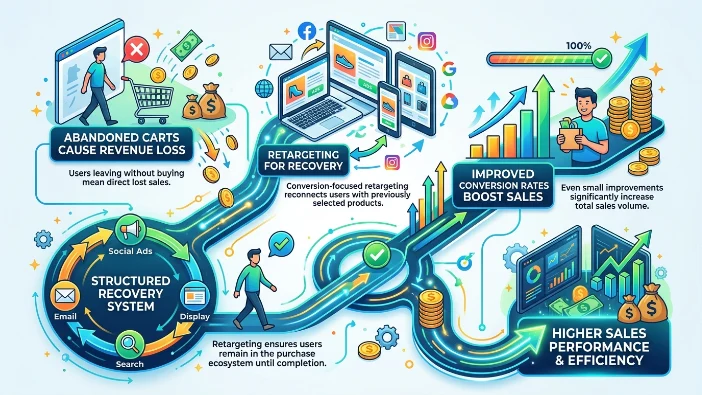
Online stores prioritise checkout completion strategies because abandoned carts represent direct revenue loss, and conversion-focused retargeting recovers these lost transactions by reconnecting users with previously selected products across multiple advertising platforms, ensuring higher efficiency in digital sales performance.
Checkout completion directly impacts revenue performance. Even small improvements in conversion rates significantly increase total sales volume.
Retargeting ensures abandoned users remain within the purchase ecosystem until transaction completion.
This creates a structured recovery system across digital marketing channels.



