

High-intent display retargeting is a performance marketing method that targets users who show strong purchase signals, such as cart additions or repeated product views. It delivers personalised ads designed to trigger immediate checkout decisions within a short conversion window.
High-intent display retargeting focuses only on users with measurable buying signals. These signals include adding items to cart, initiating checkout, or revisiting product pages multiple times within a defined timeframe.
Unlike general display advertising, this method excludes low-intent traffic. It prioritises users closest to transaction completion.
For example, a user who views the same product three times and adds it to cart enters a high-intent segment. Retargeting systems then serve ads showing that exact product with updated pricing or availability.
This approach reduces funnel leakage and accelerates purchase completion by targeting only decision-ready users.
How E-commerce Businesses Warm Up Leads Through Dynamic Display Ads
How does high-intent retargeting trigger instant purchase decisions?

High-intent retargeting triggers instant purchase decisions by reinforcing urgency, removing friction, and presenting precise product reminders. It aligns ad timing with peak intent signals, ensuring users receive conversion-focused messaging at the exact moment they are ready to act.
High-intent retargeting uses time-sensitive delivery. Ads are shown within minutes or hours after user exit. This timing captures peak intent before interest declines.
Urgency signals are embedded in ad creatives. These include limited stock indicators, price stability, or session-based reminders.
Friction reduction is achieved by directing users back to the exact checkout stage they left. This removes the need to restart the purchase process.
For example, a user abandoning a checkout page receives a banner showing the same product with a direct link to resume checkout. This shortens the decision cycle.
The combination of timing, relevance, and ease of action drives immediate conversions.
What data defines a high-intent user segment?
A high-intent user segment is defined using behavioural data such as cart additions, checkout initiation, repeat product views, session duration above defined thresholds, and recent interaction timestamps. These indicators confirm strong purchase likelihood within a limited time frame.
High-intent classification relies on measurable actions. Cart additions signal direct purchase consideration. Checkout initiation indicates advanced funnel progression.
Repeat product views show evaluation behavior. For example, viewing the same item three or more times within 24 hours indicates strong intent.
Session duration above 120 seconds on product pages reflects deeper engagement. Short sessions indicate browsing rather than buying.
Recency is critical. Users who interacted within the last 6 to 24 hours show higher conversion probability than older sessions.
These data points combine to form precise targeting segments used in retargeting campaigns.
How are retargeting ads structured for maximum conversion impact?
Retargeting ads are structured using personalised product visuals, concise messaging, urgency indicators, and direct navigation links. Each element is designed to minimise distraction and guide users back to checkout with minimal steps, ensuring fast decision-making and transaction completion.
Ad creatives follow a strict structure. Product images match the exact items viewed by the user. This ensures immediate recognition.
Messaging is short and direct. It focuses on product name, price, and availability without additional information overload.
Urgency elements include low stock indicators or time-sensitive reminders. These signals push users toward immediate action.
Navigation links are deep-linked. They direct users to cart or checkout pages instead of homepage entry points.
For example, a retargeting ad showing a specific jacket includes its image, price, and a direct “return to checkout” link.
This structured format reduces friction and accelerates conversions.
What role does timing play in high-intent display retargeting?
Timing determines when retargeting ads are delivered after user interaction. Immediate delivery within the first 24 hours captures peak intent, while delayed delivery reduces conversion probability. Time-based sequencing ensures ads align with user readiness for instant purchase decisions.
Timing is controlled using retargeting windows. The first 6 hours after abandonment show the highest conversion rates. Ads delivered in this period achieve stronger engagement.
Between 6 and 24 hours, intent remains high but gradually declines. Ads during this phase reinforce urgency.
After 48 hours, conversion probability drops significantly. Retargeting intensity is reduced to avoid wasted impressions.
Time sequencing also adjusts messaging. Early ads focus on product reminders. Later ads include urgency or scarcity signals.
For example, a user receives an ad within 2 hours showing the same product. After 12 hours, the ad includes stock availability messaging.
Precise timing ensures ads reach users at decision-critical moments.
How does frequency control impact purchase decision speed?
Frequency control regulates how often retargeting ads are shown to a user. Controlled repetition reinforces product recall and urgency, while excessive frequency causes ad fatigue, reducing engagement and delaying purchase decisions within high-intent retargeting systems.
Frequency is measured as impressions per user per day. High-intent campaigns typically operate within 3 to 6 impressions daily.
Low frequency reduces visibility and weakens recall. High frequency creates repetition fatigue and lowers click-through rates.
Balanced exposure ensures users see ads across multiple browsing sessions without negative perception.
Frequency caps prevent overspending on the same user. They also maintain efficiency by distributing impressions across the audience.
For example, showing an ad four times within 24 hours maintains visibility without overwhelming the user.
Effective frequency control accelerates decision-making by maintaining consistent but controlled exposure.
What technologies enable high-intent display retargeting?
High-intent display retargeting is enabled by tracking pixels, programmatic advertising platforms, real-time bidding systems, and dynamic creative optimisation engines. These technologies process behavioural data and deliver personalised ads instantly across multiple digital environments.
Tracking pixels capture user actions on websites. They record product views, cart additions, and checkout events.
Programmatic platforms manage ad buying and audience targeting. They automate ad placement across multiple websites.
Real-time bidding systems determine which ads appear in milliseconds based on user data.
Dynamic creative optimisation engines generate personalised ads using product feeds and user behavior.
For example, when a user leaves a product page, the system records this action and immediately prepares a personalised banner for delivery on external sites.
These technologies operate together to ensure accurate and fast retargeting execution.
What measurable benefits does high-intent retargeting deliver?
High-intent retargeting delivers measurable benefits including increased conversion rates, reduced cart abandonment, lower cost per acquisition, higher return on ad spend, and faster purchase cycles. These outcomes result from targeting users with verified intent signals.
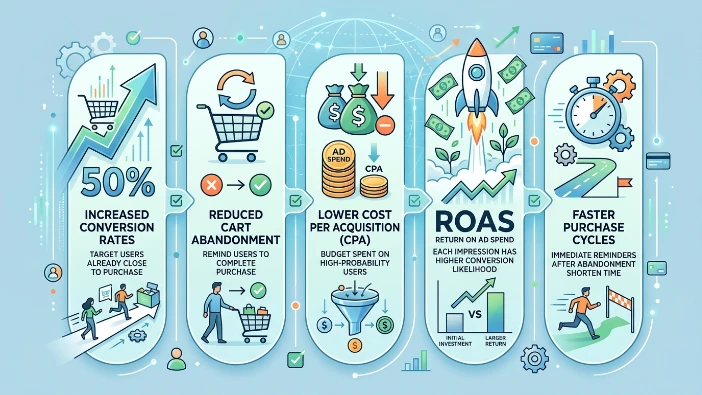
Conversion rates increase because ads target users already close to purchase. This reduces the effort required to complete transactions.
Cart abandonment decreases as users are reminded to complete purchases. Retargeting re-engages users who left mid-process.
Cost per acquisition decreases due to efficient targeting. Budget is spent on high-probability users instead of broad audiences.
Return on ad spend improves because each impression has higher conversion likelihood.
Purchase cycles shorten as users receive immediate reminders after abandonment.
For example, campaigns targeting cart abandoners often achieve significantly higher conversion rates compared to general display campaigns.
Explore More Expert Insights:
How Online Stores Turn Product Viewers Into Checkout Customers Using Dynamic Banner Ads
How E-commerce Brands Convert High-Intent Shoppers Into Immediate Buyers Using Retargeting Ads
How is high-intent retargeting applied across e-commerce use cases?
High-intent retargeting is applied in scenarios such as cart abandonment recovery, checkout completion prompts, price consistency reinforcement, and limited stock alerts. Each use case focuses on users with strong intent signals and aims to convert them instantly.
Cart abandonment recovery targets users who leave items in their cart. Ads remind them to complete the purchase.
Checkout completion prompts focus on users who begin checkout but do not finish. Ads guide them back to the final step.
Price consistency reinforcement reassures users that pricing remains unchanged. This removes hesitation caused by perceived price fluctuations.
Limited stock alerts create urgency by indicating low availability.
For example, a user leaving during checkout sees an ad showing the same product with a “complete your purchase” message and direct checkout link.
These use cases directly target high-intent behavior and drive immediate action.
How does high-intent retargeting complete the e-commerce funnel?
High-intent retargeting completes the e-commerce funnel by converting warmed leads into paying customers. It uses precise targeting, urgency-driven messaging, and frictionless navigation to transform strong intent signals into final transactions efficiently and consistently.
At the top of the funnel, users discover products. At the middle stage, they evaluate options through repeated exposure.
High-intent retargeting operates at the final stage. It converts prepared users into buyers.
This stage relies on data built during earlier interactions. Without prior engagement, high-intent targeting does not function effectively.
Retargeting ensures that no high-value user exits the funnel without re-engagement attempts.
For example, users who interacted multiple times with a product are guided back with targeted ads until purchase completion occurs.
Read & Explore:
How Online Retailers Recover Abandoned Carts Using Banner Advertising



