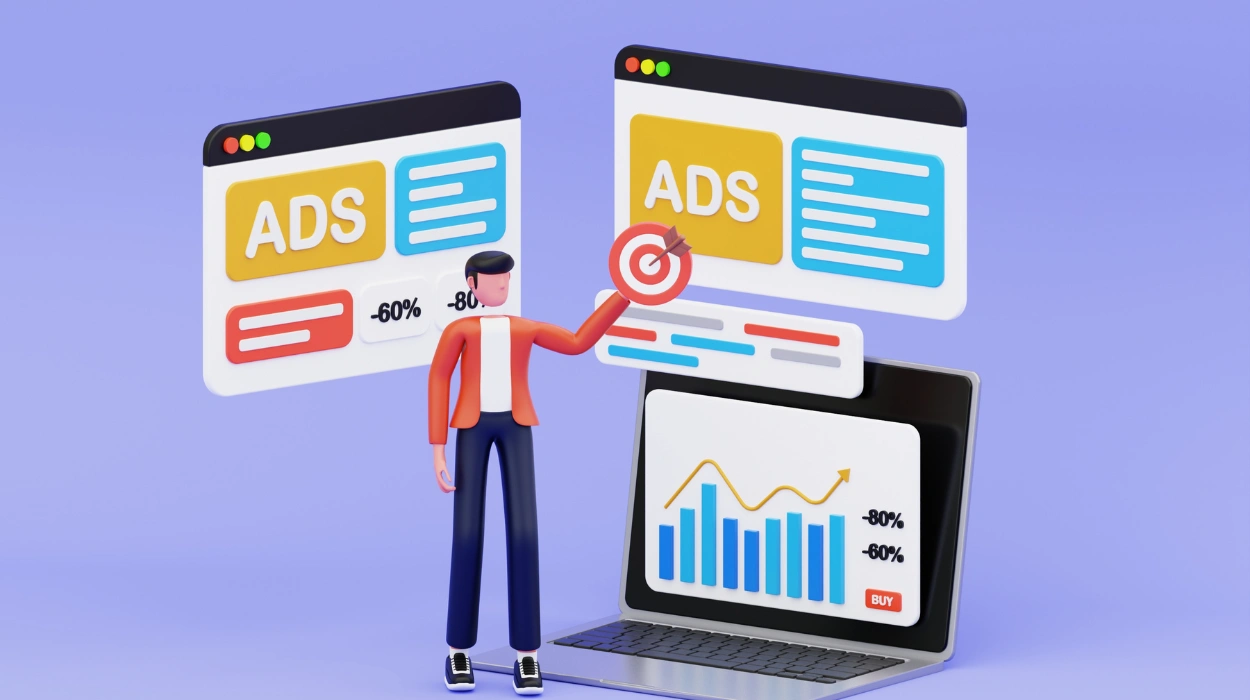
Banner ad campaigns help SaaS platforms attract potential buyers by displaying visual advertisements across websites, applications, and digital platforms. These campaigns increase product awareness, educate business users, and guide visitors toward demo request pages through targeted messaging, audience segmentation, and repeated visibility.
Banner ad campaigns are digital advertising strategies that use visual placements to promote software products. SaaS platforms use banners to present product functions, operational benefits, workflow improvements, and industry-specific solutions to business audiences.
A SaaS platform is a cloud-based software system delivered through internet access. Banner advertising supports SaaS customer acquisition by placing software messages in front of users already researching digital tools, automation systems, analytics platforms, or business management solutions.
Banner ads appear in multiple formats, including leaderboard banners, sidebar banners, responsive display ads, and mobile placements. Common campaign objectives include traffic generation, product visibility, and demo request growth.
In SaaS marketing, banner campaigns focus on audience intent. For example, a finance automation platform targets accounting professionals reading tax compliance content. A project management platform targets operations managers reviewing workflow optimization articles.
Readers who want broader educational context can also read:
How Software Companies Increase Demo Engagement Using Banner Campaigns
How do SaaS platforms use banner ads to increase demo requests?
SaaS platforms increase demo requests by connecting banner campaigns to targeted landing pages, industry-specific messaging, and audience behavior signals. The process focuses on attracting qualified users who already search for operational software, cloud tools, or business automation solutions online.
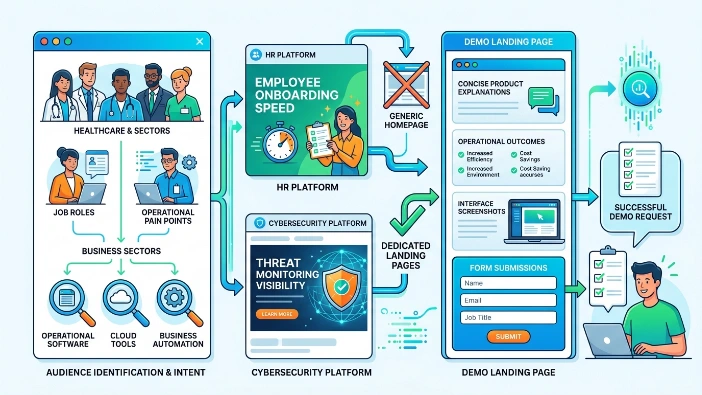
The process starts with audience identification. SaaS marketers define business sectors, job roles, operational pain points, and software adoption intent. Campaigns then deliver banner advertisements to users matching those characteristics.
Banner ads direct traffic toward dedicated demo pages instead of generic homepages. Demo-focused landing pages contain concise product explanations, operational outcomes, interface screenshots, and form submissions.
The messaging remains direct and contextual. A human resources software platform targets hiring managers with banners focused on employee onboarding speed. A cybersecurity platform targets IT teams with banners focused on threat monitoring visibility.
Retargeting also increases demo requests. SaaS platforms display repeated banner ads to users who previously visited pricing pages, feature pages, or case-study sections. Repeated exposure improves brand familiarity and increases return visits.
Campaign optimization relies on measurable performance indicators. Common metrics include click-through rate, landing-page engagement time, form submissions, and demo completion rates.
Why do banner ads work for SaaS customer acquisition?
Banner ads work for SaaS customer acquisition because they provide repeated exposure, audience precision, and scalable visibility across digital environments. These campaigns help software companies educate users before direct sales interaction while maintaining measurable performance tracking across marketing channels.
SaaS buying cycles often involve multiple decision-makers. Banner campaigns support awareness during the early research phase. Decision-makers repeatedly encounter software messaging while consuming industry content.
The visibility structure improves brand recall. A procurement manager researching workflow automation sees repeated software-related banners across news sites, business publications, and professional communities. This repetition increases familiarity before direct engagement.
Banner ads also support intent-based targeting. Platforms use behavioral signals, search activity, and content consumption patterns to identify relevant audiences. This targeting reduces exposure to irrelevant users.
Another advantage involves scalability. SaaS platforms distribute campaigns across thousands of websites and applications without changing the core infrastructure. Campaigns remain active across desktop, mobile, and tablet environments.
Measurement accuracy also supports SaaS acquisition strategies. Marketing teams monitor impressions, engagement, conversions, and assisted demo requests using analytics systems.
Readers exploring deeper engagement strategies can continue with:
How Software Companies Convert Demo Visitors Into Active Sales Calls Using Banner Campaigns
What types of banner ads are used in SaaS campaigns?
SaaS platforms use multiple banner ad formats to support awareness, education, and conversion goals. Common formats include static banners, animated banners, responsive display ads, retargeting ads, and account-based advertising placements targeting business decision-makers across industries.
Static banners use fixed visual layouts with concise messaging. These ads focus on clarity and speed. SaaS companies use static banners for feature visibility, software launches, and operational benefits.
Animated banners include motion-based transitions. These advertisements explain workflows, dashboards, or automation sequences in short visual cycles. Animated creatives often increase interaction rates because movement attracts user attention.
Responsive display ads automatically adapt to different screen sizes and placements. This format supports mobile compatibility and broader distribution across advertising networks.
Retargeting banners focus on returning visitors. These campaigns reconnect with users who already interacted with software-related pages. A visitor who explored reporting features later sees banners highlighting analytics dashboards or reporting efficiency.
Account-based advertising targets specific organizations instead of broad audiences. SaaS platforms use these campaigns when selling enterprise software to defined industries or company categories.
Each banner format serves a distinct operational role within the SaaS marketing funnel.
What elements make SaaS banner campaigns effective?
Effective SaaS banner campaigns combine clear messaging, audience alignment, landing-page relevance, and measurable performance structures. Campaign effectiveness depends on communication precision, contextual targeting, fast-loading visuals, and consistent alignment between advertisement content and demo request objectives.
Message clarity remains essential. Banner ads use concise statements explaining one operational outcome at a time. Overloaded messaging reduces user understanding and lowers interaction rates.
Visual hierarchy improves readability. Important elements such as product functions, efficiency improvements, or workflow outcomes appear first. Supporting information remains secondary.
Audience relevance directly affects performance. A manufacturing operations platform uses different messaging than a customer support platform because the operational needs differ significantly.
Landing-page consistency also matters. Users expect the landing page to match the banner message. A banner promoting reporting automation must direct users toward reporting-related content rather than unrelated product sections.
Page loading speed influences engagement. Slow-loading pages reduce conversions because business users abandon delays quickly during research sessions.
Performance testing improves campaign efficiency. SaaS marketers test multiple headlines, visuals, and targeting combinations to identify stronger engagement patterns.
How do SaaS companies target the right audience with banner ads?
SaaS companies target the right audience by using demographic filters, behavioral data, professional interests, industry categories, and retargeting systems. These targeting methods help software platforms display banner ads to users already connected to relevant operational or technical challenges.
Audience targeting begins with role identification. SaaS marketers define which professionals influence software purchasing decisions. Common roles include operations managers, IT directors, finance teams, procurement officers, and business owners.
Industry segmentation creates additional precision. Software platforms serving healthcare organizations use different targeting structures than platforms serving retail businesses or logistics companies.
Behavioral targeting tracks user activity patterns. Users researching workflow automation, cloud storage, compliance systems, or reporting tools become eligible for related software campaigns.
Contextual targeting places banners beside related content. A cybersecurity platform displays ads on technology security publications. A marketing analytics platform displays ads near performance reporting articles.
Geographic targeting also affects campaign delivery. SaaS platforms operating in the United Kingdom align campaigns with regional business hours, local compliance standards, and UK-specific operational terminology.
Retargeting strengthens audience qualification further. Users who interacted with feature pages or pricing sections receive follow-up advertisements designed to increase demo request completion.
How do landing pages support SaaS banner campaigns?
Landing pages support SaaS banner campaigns by converting advertisement traffic into demo requests through focused messaging, structured layouts, and simplified form submissions. Effective landing pages maintain consistency between advertisement claims and product explanations while reducing user confusion during evaluation.
A landing page is a standalone webpage connected directly to an advertisement. SaaS companies use landing pages instead of general website navigation because focused pages increase conversion rates.
Effective landing pages contain one clear objective. In demo-focused campaigns, the page centers on software explanation and demo scheduling rather than broad product exploration.
Headline consistency improves trust. If a banner promotes workflow automation, the landing page immediately explains workflow automation functions and operational outcomes.
Visual explanations improve understanding. SaaS platforms often include dashboard previews, reporting screens, process diagrams, or system workflows to demonstrate usability.
Form design also affects performance. Short forms reduce friction and increase submission rates. Common fields include business email, company size, and operational role.
Mobile optimization remains necessary because business users frequently research software using smartphones and tablets during meetings, travel, or remote work environments.
Explore More Expert Insights:
How Tech Companies Promote Product Launches Using Banner Advertising
How SaaS Companies Increase Free Trial Signups Using Banner Ads
What industries use SaaS banner campaigns most frequently?
Industries with high software adoption rates use SaaS banner campaigns most frequently. These industries include finance, healthcare, logistics, education, retail, cybersecurity, human resources, and project management because they rely heavily on cloud-based operational systems and digital workflows.
Finance software platforms use banner campaigns to promote accounting automation, invoicing systems, reporting dashboards, and compliance tools.
Healthcare software providers advertise patient management systems, scheduling platforms, and operational workflow solutions to clinics and healthcare administrators.
Retail technology companies promote inventory systems, customer analytics tools, and e-commerce integrations through display advertising campaigns.
Human resources software companies use banners to attract recruiters, onboarding specialists, and workforce management teams.
Cybersecurity SaaS platforms frequently rely on banner campaigns because security buyers conduct extensive online research before software evaluations.
Education technology platforms also use banner campaigns to promote learning management systems, virtual classroom tools, and student analytics solutions.
These industries depend heavily on continuous digital transformation, making banner visibility important during software research and vendor evaluation stages.
How do SaaS platforms measure banner campaign success?
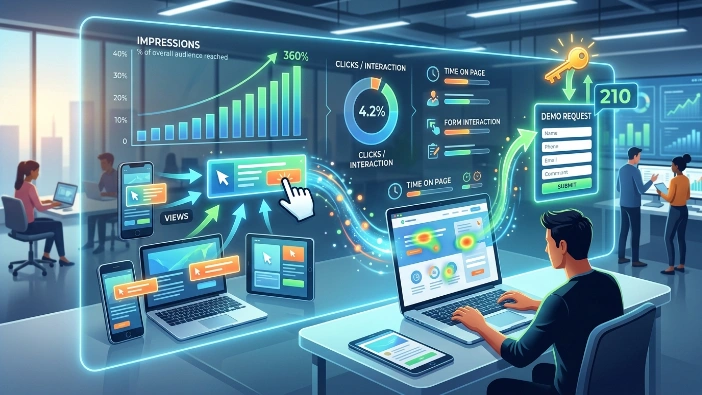
SaaS platforms measure banner campaign success using conversion metrics, engagement indicators, and audience quality data. Measurement systems track how users interact with advertisements, landing pages, and demo forms to determine campaign efficiency and lead-generation performance accurately.
Impressions measure advertisement visibility. This metric tracks how often banners appear across websites and applications.
Click-through rate measures interaction frequency. Higher click-through rates indicate stronger alignment between advertisement messaging and audience interest.
Landing-page engagement measures how users behave after clicking advertisements. Metrics include page duration, form interaction, and navigation activity.
Demo request completion remains the primary performance metric for many SaaS campaigns. This measurement directly connects advertising activity with sales pipeline generation.
Cost-per-demo analysis evaluates campaign efficiency. SaaS marketers compare advertising spend against total demo requests generated during a campaign period.
Audience quality metrics also matter. Marketing teams analyze company size, industry alignment, and decision-making authority to determine whether campaign traffic matches ideal customer profiles.
Continuous optimization improves long-term performance. Teams adjust targeting, visuals, messaging, and placements based on measured results across active campaigns.