

High-intent shopper conversion in retargeting advertising refers to the process of turning users who have already shown strong purchase signals, such as repeated product views or cart additions, into immediate buyers through targeted, personalised ads that reinforce product relevance, urgency, and completion of purchase actions across digital platforms.
High-intent shoppers represent users closest to purchase. These users already interacted with products or demonstrated strong behavioural signals. Retargeting ads focus on closing the gap between interest and transaction.
In e-commerce systems, conversion happens when behavioural signals align with final purchase action. Retargeting ensures that users who showed intent receive continuous exposure until purchase completion.
High-intent conversion differs from awareness-stage marketing. It focuses only on users already inside the decision phase.
What defines high-intent behaviour
High-intent behaviour includes repeated product page visits, cart additions, wishlist saves, and checkout initiation. Each action signals increasing purchase probability.
For example, a user viewing the same running shoes three times within 48 hours demonstrates strong buying intent.
How retargeting fits into conversion systems
Retargeting uses tracking technologies such as cookies and pixels. These systems record user activity and trigger ads across websites. This ensures that high-intent users remain engaged until purchase completion.
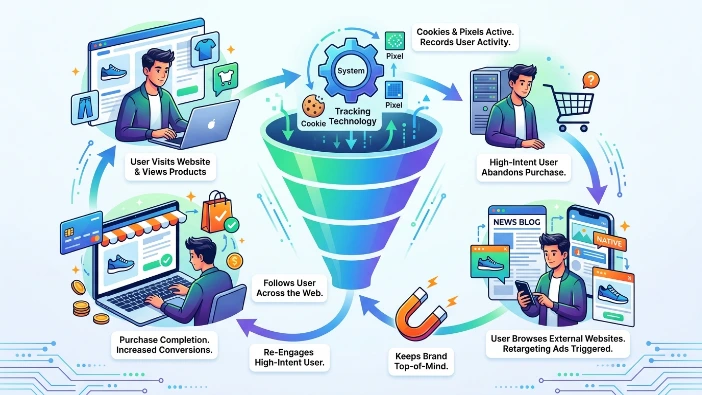
How do retargeting ads convert high-intent shoppers into immediate buyers?
Retargeting ads convert high-intent shoppers into immediate buyers by delivering personalised product reminders, reinforcing decision urgency, reducing friction in the buying process, and maintaining continuous visibility across multiple platforms until the user completes checkout actions without additional discovery steps required.
Conversion occurs through repeated exposure to the same product or category. Retargeting ensures users do not forget items already under consideration. This system removes the need for users to restart their product search.
Role of personalised reminders
Personalised reminders display exact products previously viewed. This reduces decision time because users already evaluated the item. For example, a user who viewed a laptop sees the same model in multiple banner placements later.
How reduced friction increases conversion speed
Friction refers to barriers in the buying process. Retargeting reduces friction by eliminating search repetition.
Users land directly on product pages instead of browsing multiple categories again.
Continuous exposure across platforms
Retargeting ads appear on multiple websites and apps. This ensures constant product visibility. Repeated exposure increases likelihood of immediate return and purchase completion.
What signals identify high-intent shoppers ready to buy?
High-intent shoppers are identified through behavioural signals such as repeated product page visits, cart additions, checkout initiation, price comparison activity, and extended engagement duration, all of which indicate strong purchase readiness within structured e-commerce tracking systems.
These signals are collected using tracking pixels and session monitoring tools. Each signal contributes to intent scoring models.
Higher scores indicate stronger readiness for conversion-focused retargeting.
Product interaction signals
Product interaction signals include multiple page views, zoom actions, and product image engagement.
For example, a user revisiting a product page five times within 24 hours shows strong intent.
Cart and checkout signals
Cart additions and checkout initiation are high-value signals. These actions indicate near-completion behaviour.
Users who abandon checkout represent the highest retargeting priority segment.
Comparative browsing behaviour
High-intent users compare similar products across multiple pages. This behaviour shows active decision-making. For example, comparing two smartphones across specifications indicates purchase evaluation stage.
How does dynamic product retargeting reduce purchase time?
Dynamic product retargeting reduces purchase time by automatically displaying personalised ads featuring previously viewed or related products, updated pricing information, and availability data, allowing users to complete transactions faster without re-searching or re-evaluating product options across digital environments.
Dynamic retargeting uses real-time data feeds. These feeds update ads based on user interactions.
This ensures each ad reflects the most relevant product information.
How dynamic ads display personalised content
Dynamic ads pull product data directly from catalog systems. Each user sees customised banners.
For example, a user viewing trainers sees the exact model in later ads.
Role of real-time product updates
Real-time updates include price changes, stock availability, and discounts. These updates create urgency and clarity.
Users are more likely to act when product availability is confirmed.
Reduction of decision cycles
Decision cycles shorten when users repeatedly see the same product. Familiarity reduces hesitation.
This leads to faster checkout completion without additional research.
What role does urgency messaging and inventory data play in conversions?
Urgency messaging and inventory data increase conversion rates by creating time-sensitive conditions such as limited stock, price changes, and countdown-based offers, which encourage high-intent shoppers to complete purchases immediately instead of delaying decision-making processes across e-commerce platforms.
Urgency messaging works by reducing hesitation. It introduces time constraints or scarcity indicators.
Inventory data provides factual product availability information.
Limited stock indicators
Limited stock messages inform users about product scarcity. This increases perceived urgency. For example, “Only 3 items left” signals immediate action requirement.
Time-based pricing updates
Time-based pricing includes limited-time discounts. These updates are reflected in banner ads. Users respond faster when price advantages are temporary.
Behavioural urgency triggers
Behavioural triggers include reminders of abandoned carts and previous visits. These reminders reinforce unfinished purchase actions.
How does funnel segmentation increase immediate conversions?
Funnel segmentation increases immediate conversions by dividing users into structured intent levels, allowing retargeting ads to deliver precise messaging based on behavioural readiness, ensuring high-intent shoppers receive direct purchase-focused ads while lower-intent users receive informational reinforcement.
Segmentation organizes users based on engagement depth. This improves ad accuracy and conversion efficiency.
High-intent segments receive direct product reinforcement.
Read:
How E-commerce Brands Build Purchase Intent Using Banner Retargeting Ads
High-intent segment targeting
High-intent users receive product-specific ads. These ads include exact items viewed or added to cart.
This reduces decision time and increases immediate purchase likelihood.
Mid-intent and low-intent filtering
Mid-intent users receive category-based ads. Low-intent users receive awareness-level messaging.
This ensures resources focus on conversion-ready users.
Conversion acceleration through segmentation
Segmentation removes irrelevant ad exposure. Users only see relevant content aligned with intent level. This increases conversion efficiency significantly.
What metrics measure success of retargeting campaigns?
BOFU retargeting campaign success is measured through conversion rate, return on ad spend, cart recovery rate, click-through rate, and checkout completion rate, all of which indicate how effectively high-intent shoppers transition into completed purchases within structured e-commerce tracking systems.
Metrics provide measurable insights into campaign effectiveness. Each metric reflects a different stage of conversion performance.
Conversion rate and checkout completion
Conversion rate measures completed purchases after ad interaction. Checkout completion tracks users finishing payment processes.
High rates indicate successful retargeting alignment.
Return on ad spend (ROAS)
ROAS measures revenue generated per advertising cost. A higher ROAS indicates efficient targeting of high-intent users.
Cart recovery rate
Cart recovery rate measures how many abandoned carts convert after retargeting exposure. For example, users returning to complete checkout after seeing ads increase recovery performance.
Explore:
How Banner Ads Increase E-commerce Sales and Conversions Fast
How do e-commerce brands optimise checkout completion using retargeting ads?
E-commerce brands optimize checkout completion using retargeting ads by reducing abandonment friction, reinforcing product relevance, re-engaging users with dynamic reminders, and maintaining continuous visibility until final purchase actions are completed within structured conversion pathways across digital shopping environments.
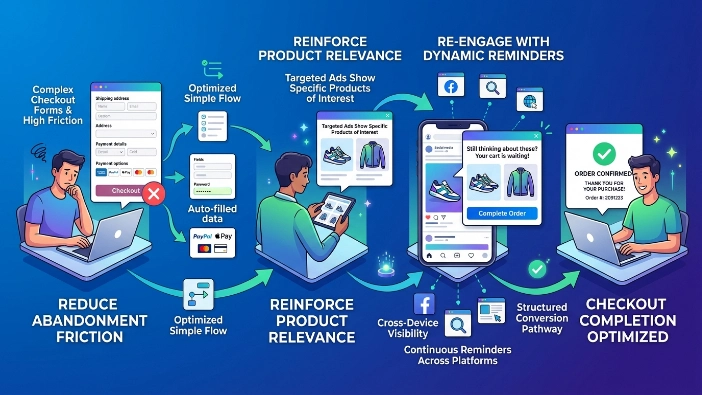
Checkout completion is the final step in conversion. Retargeting ensures users do not abandon this stage. Ads remind users of unfinished transactions and guide them back to checkout pages.
Abandonment recovery strategies
Abandonment recovery targets users who leave during checkout. Retargeting ads display exact products left in carts. This increases return probability significantly.
Explore More Expert Insights:
Get High-Converting Animated Banner Ads on UK News Sites
Run High-Impact Banner Ads on Local UK News Sites
Payment stage reinforcement
Retargeting reinforces trust and product relevance during payment stages. Users receive consistent product reminders.
This reduces hesitation during final purchase steps.
Multi-device continuity
Users often switch devices before completing purchases. Retargeting maintains continuity across devices. This ensures consistent exposure regardless of device changes.



