Banner advertising for dental clinics represents a structured digital communication method used across websites, mobile apps, and online platforms. It focuses on delivering visual promotional messages to audiences who are already active online. In the United Kingdom, healthcare-related digital visibility has increased as users rely on search engines and content platforms to find service information before making appointment decisions.
Banner advertising operates through audience targeting systems that segment users based on browsing behaviour, location signals, and content relevance. Dental clinics use this format to maintain continuous visibility across multiple digital touchpoints. The objective is not only exposure but also repeated recognition of dental services within a competitive healthcare environment.
This approach aligns with structured patient behaviour patterns, where individuals first become aware of oral health topics, then compare options, and finally move toward appointment booking decisions. Banner advertising sits at the earliest stage of this process, shaping awareness before direct intent is formed.
How Dental Clinics Nurture Leads Using Treatment Awareness Ads guides deeper evaluation of service understanding.
How Dental Clinics Turn Treatment Interest Into Paid Procedures Using Retargeting Ads explains final decision-stage conversion behaviour.
What is banner advertising for dental clinics and how does it work?
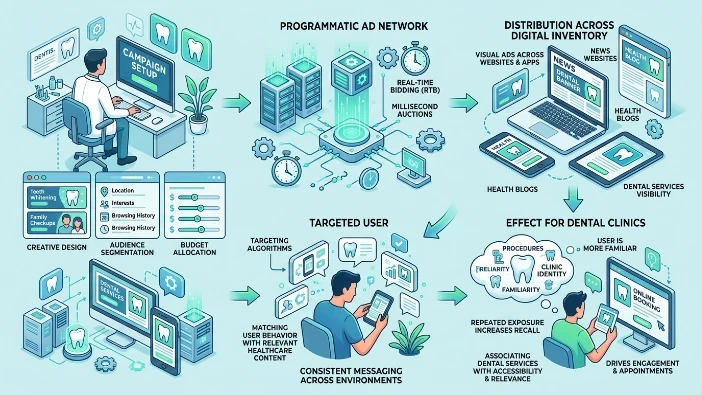
Banner advertising for dental clinics is a digital awareness system that displays visual ads across websites and apps to introduce dental services to online audiences. It operates through targeting algorithms that match user behaviour with relevant healthcare content across multiple digital environments consistently.
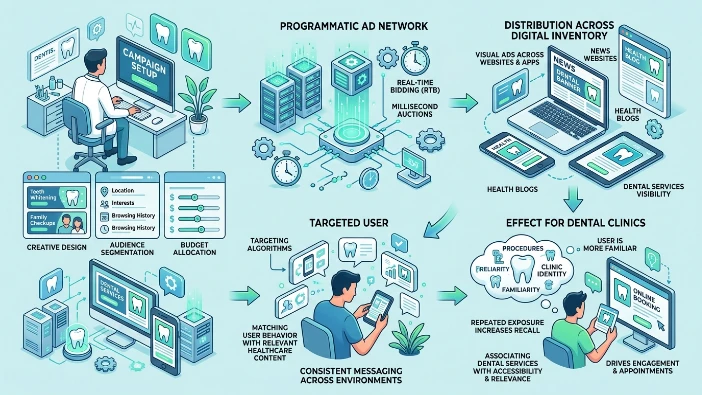
Banner advertising functions through programmatic ad networks that distribute visual creatives across digital inventory. These networks place ads on news websites, blogs, and health-related platforms. The system relies on real-time bidding, where ad placements are purchased within milliseconds based on audience relevance and budget allocation.
Dental clinics use banner advertising to create repeated exposure. Repetition increases familiarity with dental terminology, procedures, and clinic identity markers. Users encountering consistent messaging across platforms begin to associate dental services with accessibility and relevance.
The structure of banner advertising includes creative design, audience segmentation, and placement strategy. Each component contributes to visibility in different stages of online browsing behaviour. The system is designed to operate continuously without manual intervention once configured.
Why do dental clinics use banner advertising to increase bookings?
Dental clinics use banner advertising to increase bookings by improving visibility among online users, reinforcing brand recognition, and ensuring repeated exposure to dental-related content. This process strengthens awareness and increases the likelihood of users moving toward appointment-related decisions.
Banner advertising increases reach beyond search-based discovery. Users who are not actively searching for dental services still encounter relevant visual messages during everyday browsing. This expands the potential audience significantly across digital environments.
Repeated exposure plays a central role in behavioural influence. When users see consistent dental messaging across different platforms, recognition increases. Recognition reduces hesitation when users later consider booking appointments.
Banner systems also support segmentation. Audiences can be grouped based on location, age brackets, and online behaviour patterns. This ensures that dental-related messaging appears to users with higher relevance, improving informational alignment.
Over time, this structured visibility creates a continuous awareness loop that supports booking generation without requiring direct engagement at the initial stage.
How banner ads attract potential dental patients online?
Banner ads attract potential dental patients by using targeted visuals, behavioural data, and location-based segmentation to display relevant dental messages across websites, social platforms, and mobile applications where users spend significant browsing time daily.
Banner advertising uses data-driven targeting to identify users interested in health-related content. These users are then shown dental visuals that align with their browsing context. This creates relevance without requiring active search input.
Visual elements such as images, text overlays, and structured layouts help communicate dental concepts quickly. Since online users process information rapidly, banner ads focus on clarity and immediate recognition rather than detailed explanations.
Geographic targeting ensures that dental messages are displayed to users within specific regions such as cities or districts. In the United Kingdom, this allows localized awareness distribution across diverse populations.
The combination of behavioural targeting and visual repetition ensures that dental services remain visible during everyday digital activity, increasing the probability of future engagement.
What makes banner advertising effective in healthcare marketing?
Banner advertising effectiveness in healthcare marketing depends on audience precision, platform placement, frequency control, visual clarity, and compliance standards that ensure healthcare messaging remains accurate, relevant, and consistently delivered across multiple digital environments over time.
Targeting accuracy ensures that dental advertisements are shown to users with relevant interests or behavioural signals. This reduces irrelevant impressions and improves informational alignment.
Placement strategy determines where ads appear. High-traffic websites and contextually relevant pages increase visibility. Consistent placement across multiple platforms builds recognition over time.
Frequency management controls how often users see dental ads. Controlled repetition prevents overload while maintaining awareness. This balance is important in healthcare communication environments where clarity and trust are required.
Visual clarity ensures that dental messages are understood quickly. Simple layouts, readable text, and structured visual hierarchy improve comprehension during short browsing interactions.
Compliance standards ensure that healthcare-related advertising maintains informational accuracy and avoids misleading communication structures.
Explore More Expert Insights:
How Healthcare Providers Promote Services Using Banner Campaigns
How Clinics Boost Patient Visits Using Geo-Targeted Banner Ads
How does banner advertising fit into the patient journey funnel?
Banner advertising fits into the patient journey funnel by operating at the awareness stage, introducing dental concepts early, supporting consideration through repeated exposure, and maintaining visibility as users move gradually toward informational research and eventual booking decisions.
At the awareness stage, users encounter dental-related visuals without actively searching for services. This introduces general understanding of oral health topics and available treatments.
During the consideration stage, repeated exposure reinforces familiarity. Users begin to recognise patterns in messaging and associate them with dental care relevance. This encourages deeper information exploration across digital platforms.
Banner advertising also supports the transition between awareness and intent by maintaining consistent visibility. Even when users shift between websites or apps, dental messaging remains present across their browsing environment.
This structured positioning ensures that dental information remains part of the user’s decision-making environment before direct booking intent is formed.
What metrics measure success of dental banner advertising campaigns?
Metrics include impressions, click-through rate, conversion rate, cost per acquisition, and engagement time. These indicators measure how often ads are seen, how users interact with them, and how effectively they generate appointment-related actions in digital healthcare marketing environments measurably.
Impressions measure how frequently banner ads are displayed across platforms. High impression volume indicates broad visibility within targeted audiences.
Click-through rate measures the proportion of users who interact with ads after viewing them. This reflects message relevance and visual effectiveness.
Conversion rate tracks how many users complete a desired action after engagement. In healthcare contexts, this includes appointment-related interactions.
Cost per acquisition evaluates the financial efficiency of generating a single user action. Lower values indicate more efficient campaign performance.
Engagement time measures how long users interact with landing pages after clicking ads. Longer engagement suggests stronger informational relevance.
Banner advertising in dental contexts functions as an early-stage awareness mechanism that introduces services into everyday digital environments. It relies on structured targeting, visual communication, and repeated exposure to establish recognition before direct engagement occurs.
Across the patient journey, banner advertising supports gradual progression from awareness to consideration by maintaining consistent presence across platforms. This ensures that dental-related information becomes part of the user’s ongoing digital experience.
In structured healthcare communication systems, banner advertising remains a foundational tool for establishing visibility and supporting informed user progression toward appointment decisions.