
Retargeting advertising in dental marketing is a digital strategy that shows structured visual or display ads to users who previously interacted with dental content, with the purpose of converting existing treatment interest into confirmed paid procedures through repeated exposure and decision reinforcement.
Retargeting works through tracking technologies that record user interaction across websites and digital platforms. When a user visits a dental information page or engages with treatment-related content, a digital signal is stored.
This signal activates advertising systems that display relevant dental messages across other websites and apps. The system ensures that users who already showed interest continue receiving structured reminders.
In dental marketing, retargeting is positioned at the bottom stage of the patient journey. This stage is defined by high intent and near-decision behaviour. Users already understand treatments and require final clarity before committing.
Retargeting ads maintain visibility during this critical decision window, ensuring that treatment consideration remains active in the user’s digital environment.
How Dental Clinics Increase Bookings Using Banner Advertising Understand foundational dental awareness systems that introduce oral health topics before treatment evaluation begins.
How do retargeting ads convert treatment interest into paid dental procedures?
Retargeting ads convert treatment interest into paid dental procedures by repeatedly exposing users to structured treatment messages, reinforcing decision clarity, and reducing uncertainty through consistent visibility across multiple digital platforms during the final stage of the dental decision journey.
Conversion in dental retargeting depends on timing and repetition. Users who already researched treatments such as implants, orthodontics, or restorative care are categorized as high-intent audiences.
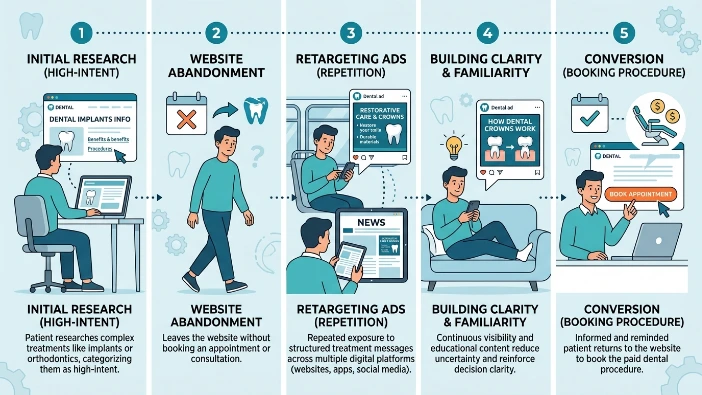
Retargeting systems display structured reminders based on previous engagement. These reminders maintain treatment awareness across websites, mobile apps, and content platforms.
Each exposure reinforces familiarity with treatment options. Familiarity reduces hesitation during booking decisions because users already understand procedural details.
An example includes a user who researched dental crowns being shown repeated structured explanations of crown procedures across multiple digital environments. This repeated exposure strengthens decision readiness.
Retargeting ads also reduce abandonment behaviour. Users who exit without booking are re-engaged through continuous visibility of relevant treatment information.
This structured reinforcement ensures that treatment interest remains active until conversion occurs.
What role does retargeting play in the dental decision funnel?
Retargeting plays a final-stage role in the dental decision funnel by targeting users who have already demonstrated treatment interest, maintaining structured exposure to dental procedures, and guiding them toward final appointment decisions through repeated informational reinforcement.
The dental decision funnel consists of three stages: awareness, consideration, and conversion. Retargeting operates exclusively in the conversion stage.
At this stage, users already understand their dental condition and available treatment options. The remaining barrier is decision finalisation.
Retargeting maintains structured visibility during this stage. Users encounter repeated treatment messages across digital platforms, ensuring continuous engagement with relevant information.
This prevents decision drop-off. Without retargeting, users may lose focus or shift attention to unrelated content.
An example includes users who explored orthodontic treatment receiving repeated structured content about alignment procedures and treatment timelines until decision readiness increases.
Retargeting ensures that dental treatment interest remains active within the user’s digital environment until booking occurs.
Why do dental clinics use retargeting instead of general advertising at the conversion stage?
Dental clinics use retargeting instead of general advertising at the conversion stage because retargeting focuses exclusively on users who already demonstrated treatment interest, making communication more precise, efficient, and aligned with final-stage decision-making behaviour.
General advertising targets broad audiences. These audiences include users with no prior exposure to dental treatment information. This reduces conversion precision at the final stage.
Retargeting focuses only on warm audiences. These users already interacted with dental content such as implant information, gum treatment explanations, or orthodontic procedures.
This focus improves message relevance. Users receive content that directly matches their prior engagement history.
For example, a user who viewed dental whitening content receives repeated exposure to whitening procedure explanations instead of unrelated dental topics.
This structured alignment reduces informational gaps. Users already familiar with treatment details require reinforcement rather than introduction.
Retargeting ensures that communication intensity matches decision readiness, supporting efficient progression toward paid procedures.
How does retargeting improve treatment booking completion rates?
Retargeting improves treatment booking completion rates by maintaining continuous exposure to dental treatment information, reducing decision hesitation, and reinforcing procedural understanding among users who have already demonstrated interest in specific dental care options.
Booking completion depends on decision stability. Users often exit before final confirmation due to uncertainty or distraction.
Retargeting addresses this by maintaining structured visibility. Users repeatedly see treatment-related content across different digital environments.
This repetition strengthens decision clarity. When users encounter consistent information, confidence in treatment understanding increases.
An example includes users researching dental implants being shown structured implant procedure explanations multiple times before returning to complete a booking action.
Retargeting also reduces abandonment cycles. Users who leave booking pages are re-engaged with treatment information rather than general advertisements.
This structured reinforcement ensures that decision momentum continues until conversion is completed.
Higher exposure frequency correlates with improved booking completion because users remain continuously engaged with relevant treatment information.
What types of retargeting ads are used in dental marketing?
Retargeting ads in dental marketing include display ads, search retargeting ads, dynamic treatment ads, and sequential messaging ads that present structured dental procedure information to users based on their previous interaction history and treatment-related engagement patterns.
Display retargeting ads appear across websites and mobile apps. These ads show visual treatment reminders such as dental procedure explanations or oral health conditions previously viewed by users.
Search retargeting ads target users who searched for dental-related terms. These users receive structured reminders based on their search behaviour.
Dynamic retargeting ads adjust content automatically based on user interaction history. If a user viewed orthodontic content, the ad displays orthodontic treatment information.
Sequential messaging ads present information in structured stages. Users first see general treatment reinforcement and later receive detailed procedural explanations.
An example includes a user who researched gum disease being shown progressive ads explaining periodontal treatments in structured stages across multiple platforms.
Each ad type ensures continuous exposure to relevant treatment content during the decision phase.
Explore More Expert Insights:
How Healthcare Providers Increase Consultation Bookings Using Final Stage Banner Campaigns
How Clinics Convert Educated Patients Into Scheduled Appointments Using Conversion Ads
How is user behaviour tracked for dental retargeting campaigns?
User behaviour tracking in dental retargeting campaigns uses cookies, pixel tracking systems, and behavioural analytics tools that record website visits, content interactions, and treatment page engagement to build structured audience segments for targeted dental advertising delivery.
Cookies store user interaction data when individuals visit dental-related content pages. These cookies enable identification of returning users across digital platforms.
Tracking pixels are embedded in web pages. These pixels record user actions such as page views, time spent on treatment information, and navigation paths.
Behavioural analytics systems aggregate this data into structured audience profiles. These profiles categorize users based on treatment interest level and engagement depth.
For example, users who spend time on implant procedure pages are grouped into high-intent dental segments. These segments receive targeted retargeting ads.
This tracking structure ensures that only relevant users are included in conversion-focused advertising campaigns.
Data collected through tracking systems supports precise audience segmentation and improves message alignment during the final decision stage.
How does retargeting connect to the full dental marketing funnel?
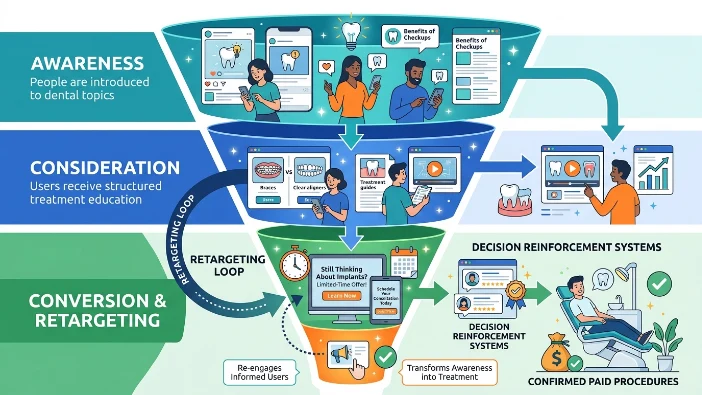
Retargeting connects to the full dental marketing funnel by operating at the final conversion stage, where it transforms previously generated treatment awareness and consideration into confirmed paid dental procedures through structured re-engagement and decision reinforcement systems.
The dental marketing funnel consists of awareness, consideration, and conversion stages. Retargeting operates exclusively at the conversion stage.
At the awareness stage, users are introduced to dental topics. At the consideration stage, users receive structured treatment education. At the conversion stage, retargeting re-engages users who are already informed.
This creates a complete funnel structure. Each stage builds upon the previous one, ensuring continuous informational progression.
Retargeting ensures that earlier engagement is not lost. Users who explored treatment awareness content remain within the communication system until they make a final decision.
Internal funnel continuity is supported through structured linking systems.
How Dental Clinics Nurture Leads Using Treatment Awareness Ads explains treatment awareness development.