
Banner campaigns in healthcare promotion are structured digital display advertisements shown across websites and apps to deliver healthcare-related awareness messages. These campaigns use visual formats, defined placements, and targeted distribution systems to communicate medical information to large online audiences.
Banner campaigns operate as part of digital advertising systems that prioritise visibility and structured message delivery. They appear in fixed spaces such as website headers, sidebars, or in-content sections. In healthcare promotion, these banners focus on educational messaging about health conditions, services, or general medical awareness.
These campaigns rely on visual hierarchy, where text, images, and layout guide attention in a controlled sequence. The content is designed to introduce healthcare topics in a simple and direct format. This makes banner campaigns suitable for initial awareness building in digital environments.
How do banner campaigns work in digital healthcare communication?
Banner campaigns in digital healthcare communication work by placing structured visual content on selected digital platforms where audiences already consume health-related or general information, using targeting systems, placement rules, and impression-based delivery methods.
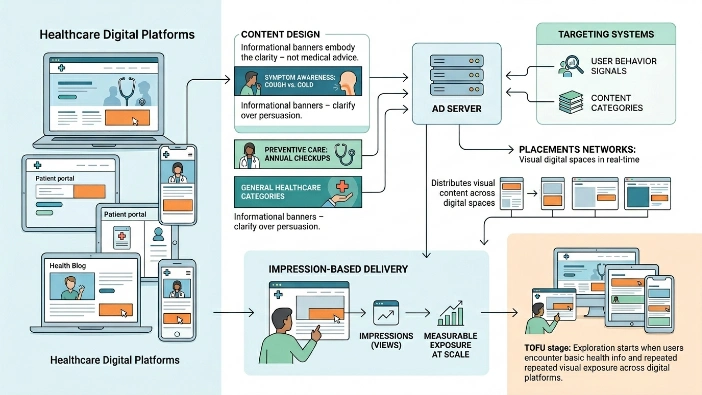
The system behind banner campaigns uses ad servers that distribute visuals based on predefined criteria such as user behavior signals, content categories, and browsing environments. When a user visits a webpage, the system selects and displays a relevant banner in real time.
Healthcare communication through banners follows a structured flow. First, content is designed with a specific informational message. Then placement networks distribute it across digital spaces. Finally, impressions are recorded when users view the banner. This creates measurable exposure at scale.
In healthcare contexts, banner communication focuses on clarity of medical themes rather than persuasion. The aim is to introduce topics such as preventive care, symptom awareness, or general healthcare categories.
What elements make healthcare banner campaigns effective?
Healthcare banner campaigns become effective through structured visual hierarchy, clear informational text, precise audience targeting, and consistent message repetition across multiple digital placements, ensuring users process healthcare information quickly and accurately without cognitive overload.
Visual hierarchy determines how users process information inside the banner. Headlines carry the main message, while supporting text provides minimal clarification. Layout structure ensures that attention flows in a predictable direction.
Targeting systems enhance effectiveness by matching banner content with relevant user contexts such as health-related browsing behavior or content categories. This ensures that impressions occur within relevant informational environments.
Repetition also plays a role. Users who see similar messages multiple times develop familiarity with the healthcare topic being introduced. This strengthens awareness without requiring direct interaction.
Why do healthcare providers use banner campaigns for awareness?
Healthcare providers use banner campaigns for awareness because they allow large-scale distribution of standardized health information across multiple digital environments, ensuring consistent exposure to medical topics among diverse online populations.
Banner campaigns support awareness by reaching users across different websites and platforms simultaneously. This wide distribution ensures that healthcare information is not limited to a single source or environment.
The format also supports consistency. Every user sees a controlled version of the message, reducing variation in how healthcare topics are presented. This improves clarity in public understanding of health-related information.
Healthcare awareness depends on repeated exposure rather than single interactions. Banner campaigns provide structured repetition across browsing sessions, which helps users become familiar with basic medical concepts over time.
How do users interact with healthcare banner campaigns online?
Users interact with healthcare banner campaigns online primarily through visual exposure, passive recognition, and occasional engagement actions such as clicks, though most interactions occur at the awareness level rather than direct participation or conversion activity.
The majority of interaction begins with impression-based viewing. Users see banners while browsing unrelated content, which creates passive awareness of healthcare topics. This exposure builds familiarity over time.
Some users engage by clicking banners to access additional informational content. This interaction typically leads to structured pages containing expanded explanations of the healthcare topic introduced in the banner.
Even without clicks, repeated exposure influences recognition. Users begin to associate certain visual patterns with healthcare information, which strengthens informational recall.
What types of banner formats are used in healthcare promotion?
Healthcare promotion uses multiple banner formats including static image banners, animated banners, responsive banners, and contextual in-content banners, each designed to deliver structured healthcare information across different digital environments and device types.
Static banners contain fixed visuals and text that remain unchanged during display. These are widely used for simple healthcare awareness messages.
Animated banners introduce motion elements such as transitions or sequential text presentation. This helps structure more detailed healthcare information in a limited space.
Responsive banners adjust automatically to screen sizes and device types. This ensures that healthcare messages remain readable across mobile, tablet, and desktop environments.
In-content banners appear within articles or informational pages. These formats integrate healthcare messaging into relevant reading contexts, improving exposure during information consumption.
Explore More Expert Insights:
How Clinics Boost Patient Visits Using Geo-Targeted Banner Ads
How Medical Centers Generate Leads Using Banner Ads
How is performance measured in banner campaigns?
Performance in banner campaigns is measured using impression count, click-through rate, viewability percentage, and engagement duration, all of which provide structured data on how users visually and behaviorally respond to healthcare messages.
Impression count measures how many times a banner is displayed to users. This indicates the scale of exposure achieved by the campaign.
Click-through rate measures how often users click on a banner after viewing it. This reflects the level of active interest generated by the message.
Viewability percentage tracks whether banners appear within visible screen areas for a minimum time threshold. This ensures that impressions represent actual visibility rather than background loading.
Engagement duration measures how long users stay on linked content after interacting with a banner. This helps evaluate the depth of informational interest.
Read:
How Healthcare Providers Increase Consultation Interest Using Banner Campaigns
What role do banner campaigns play in patient awareness stages?
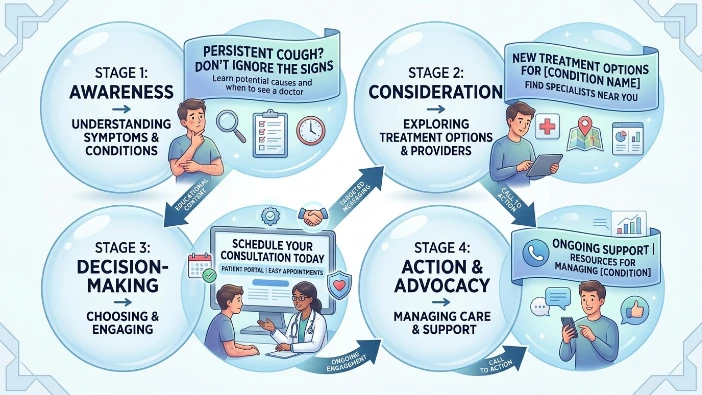
Banner campaigns play a foundational role in patient awareness stages by introducing healthcare topics at the earliest point of information discovery, where users first become aware of conditions, services, or general medical concepts through structured visual communication.
At the awareness stage, users typically have no prior engagement with specific healthcare topics. Banner campaigns provide the first structured introduction to these topics through repeated visual exposure.
This stage focuses on recognition rather than action. Users begin to identify healthcare-related information and categorise it within their understanding of general health knowledge.
Explore:
How Healthcare Providers Increase Consultation Bookings Using Final Stage Banner Campaigns
Banner campaigns support progression by establishing baseline awareness that can later develop into deeper informational exploration. They act as the entry point in a broader healthcare communication system.