Event news coverage is media content that reports on a business event, conference, launch, exhibition, awards ceremony, networking event, or industry gathering. It converts into leads when relevant audiences discover the coverage, understand the event’s value, and have clear reasons to engage with the organisation behind it.
For businesses, event coverage connects public visibility with measurable audience interest. The conversion process starts with news discovery and continues through relevance, credibility, information quality, and audience action.
What is UK event news coverage?
UK event news coverage is editorial reporting about an event published through relevant British news, business, regional, trade, or industry media. It gives an event public visibility while communicating its purpose, participants, developments, and wider relevance.
Event news coverage differs from an event listing or promotional advertisement. Editorial coverage presents an event as a newsworthy subject. The content can include factual information about the organiser, speakers, attendees, announcements, partnerships, awards, product launches, or industry discussions.
Examples include coverage of a London technology conference, a Manchester business summit, a Birmingham trade exhibition, or an Edinburgh professional networking event.
The geographic focus also affects audience relevance. UK national publications reach broad audiences, while regional publications connect an event with specific locations such as London, Manchester, Birmingham, Leeds, Cardiff, Glasgow, or Edinburgh.
Trade publications provide another layer of relevance. A healthcare conference belongs in a different media environment from a property exhibition or fintech summit.
How does event news coverage generate leads?
Event news coverage generates leads by placing relevant information in front of potential customers, establishing context around the organisation, and creating opportunities for readers to investigate, visit, contact, register, or engage with the business.
The conversion process contains several stages.
1. Audience discovery
A potential customer encounters the event through a news article, search result, social sharing, industry publication, or referral.
2. Relevance recognition
The reader identifies a connection between the event and a business need. A technology buyer reading about a cybersecurity conference has a different commercial intent from a general reader.
3. Credibility assessment
The reader evaluates the information presented in the article. Clear event details, named speakers, verified facts, organisational information, and industry context improve understanding.
4. Further investigation
Interested readers search for the organiser, event, speakers, products, services, or related announcements.
5. Lead action
The reader takes an identifiable action. Examples include completing a registration form, requesting information, subscribing to updates, contacting a sales team, or visiting a commercial website.
This sequence explains why media exposure alone does not equal lead generation. Conversion requires relevance and a clear path between editorial discovery and audience action.
Which elements make event coverage more likely to convert?
Event coverage converts more effectively when it contains a clear news angle, relevant audience information, specific facts, credible sources, strong topical relevance, and enough context for readers to understand why the event matters to them.
A clear news angle
A news angle gives readers a specific reason to read the article.
Examples include:
- A company launching a new product at an event
- A major industry conference addressing a current business issue
- A recognised expert joining an event programme
- A new partnership announced during a conference
- An awards event recognising companies or professionals
- A regional event supporting a local business sector
The angle determines how the event enters the news environment.
Specific event information
Useful coverage identifies the event, location, date, organiser, purpose, audience, and key participants.
Specific information reduces uncertainty. It also gives search engines and readers identifiable entities and relationships.
Relevant industry context
Industry context explains why an event matters beyond its schedule.
A fintech conference can discuss payments, financial regulation, open banking, digital banking, or cybersecurity. A property event can focus on development, investment, construction, planning, or commercial real estate.
This contextual information connects event coverage with specific professional interests.
Why does audience relevance affect lead conversion?
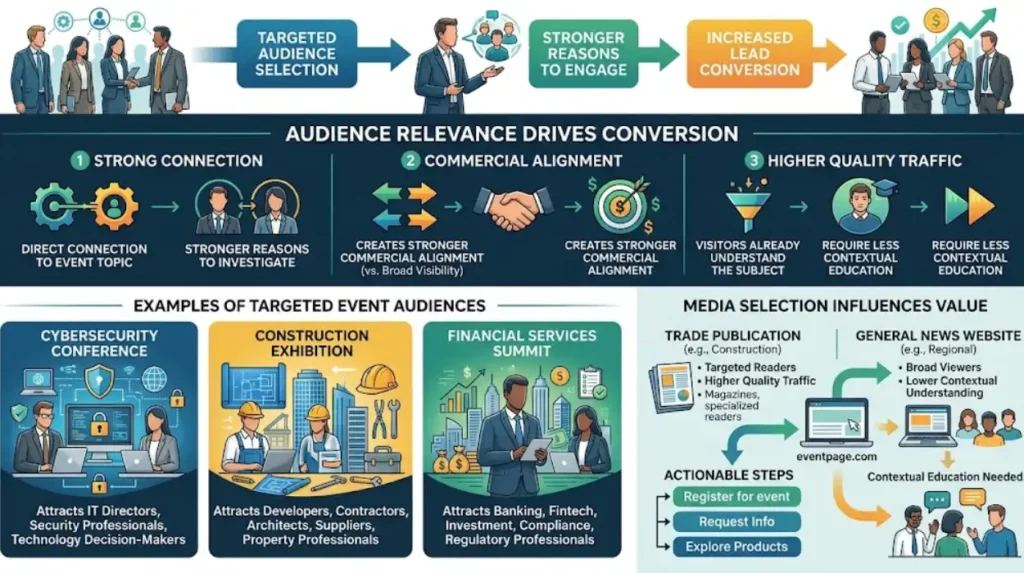
Audience relevance affects lead conversion because readers with a direct connection to the event topic have stronger reasons to investigate the organiser, participate in the event, request information, or explore related products and services.
A broad audience can generate visibility, but a relevant audience creates stronger commercial alignment.
Consider three event examples:
- A cybersecurity conference attracts IT directors, security professionals, and technology decision-makers.
- A construction exhibition attracts developers, contractors, architects, suppliers, and property professionals.
- A financial services summit attracts banking, fintech, investment, compliance, and regulatory professionals.
Each event has a different potential lead audience.
Media selection therefore influences the commercial value of coverage. A trade publication focused on construction provides a different audience from a general regional news website.
Audience relevance also affects the quality of website traffic generated after publication. Visitors who already understand the subject require less contextual education before taking an action.
How does search visibility support event lead generation?
Search visibility supports lead generation by allowing potential customers to discover event coverage when they search for the event, organisation, topic, speaker, location, or related industry subject through search engines.
Event coverage creates additional searchable content around an organisation and its activities.
Relevant search entities include:
- Event name
- Organisation name
- Event location
- Speaker names
- Industry topic
- Product or service discussed
- Conference theme
- Event date
- Partnership announcement
- Award category
For example, an article about a Manchester fintech event can contain relevant references to fintech, financial technology, Manchester business events, payments, banking innovation, and named participating organisations.
This creates a wider semantic relationship around the event.
Search visibility also extends the useful life of event coverage. A live event ends on a specific date, but published coverage remains available as an information asset for future searches, references, and discovery.
What role does credibility play in converting media readers into leads?
Credibility reduces uncertainty by giving potential customers independently published information about an event, its organisers, participants, announcements, and industry relevance before they decide whether to investigate the organisation further.
Readers evaluate information before taking commercial action.
Credibility comes from several factors:
Named people
Named speakers, executives, organisers, experts, and participating organisations provide identifiable entities.
Verifiable information
Dates, locations, event themes, announcements, and participation details give readers factual reference points.
Relevant publication context
A business event reported by an appropriate business or trade publication reaches an audience already interested in the subject.
Consistent information
Accurate information across event pages, media coverage, company pages, and other public sources reduces confusion.
Credibility does not replace a strong commercial offer. It supports the first stage of consideration by making the organisation easier to understand.
How do calls to action influence event coverage conversions?
Calls to action influence conversion by directing interested readers toward a specific next step after they understand the event, its relevance, and the organisation behind it.
A call to action creates a transition between information and engagement.
Common actions include:
- Register for an event
- Request event information
- Download an event programme
- Join a mailing list
- Contact the organiser
- Visit an event website
- Explore a product announcement
- Request a consultation
The action must match the reader’s level of intent.
An awareness-stage reader often needs additional information. A reader actively researching an event can respond to registration or contact options.
This distinction is important because event coverage sits within a wider customer journey. Not every media reader is ready to become a sales lead immediately.
For readers moving from awareness into evaluation,
Event news coverage provides a natural connection to more detailed information.
What types of events generate lead opportunities through news coverage?
Events generate lead opportunities when their subject, participants, announcements, location, or audience connects with identifiable customer needs and produces useful information for a defined professional or consumer audience.
Corporate events
Corporate conferences, business summits, leadership events, and networking sessions create opportunities to communicate organisational expertise and industry participation.
Product launches
Launch events provide news material around new products, features, technologies, partnerships, and market activity.
Industry conferences
Conferences attract professional audiences around defined subjects. Examples include fintech, healthcare, technology, property, construction, energy, and finance.
Exhibitions
Exhibitions create multiple news angles through exhibitors, product demonstrations, partnerships, industry announcements, and visitor activity.
Awards events
Awards generate coverage through winners, categories, achievements, judges, and industry recognition.
Regional events
Local events connect organisations with geographically defined audiences. A Cardiff business event, for example, has different geographic relevance from a London-based national conference.
How can businesses measure leads from event news coverage?
Businesses measure leads from event news coverage by connecting media exposure with identifiable actions such as website visits, referral traffic, registrations, enquiry forms, downloads, subscriptions, and qualified sales conversations.
Measurement begins with defined conversion events.
Useful metrics include:
- Referral visits from published coverage
- Event registration completions
- Contact form submissions
- Content downloads
- Email subscriptions
- Enquiry volume
- Qualified leads
- Sales opportunities
- Conversion rate
- Revenue attributed to media-generated leads
Tracking links provide a direct method for identifying traffic sources. Analytics platforms can then distinguish referral visitors from other acquisition channels.
Lead quality also requires measurement. Ten relevant enquiries have different commercial value from 100 visitors who take no further action.
A useful reporting structure separates visibility metrics from engagement metrics and conversion metrics.
Visibility includes article reach and search impressions.
Engagement includes clicks, visits, registrations, and content interactions.
Conversion includes qualified enquiries, sales opportunities, and revenue.
For organisations developing a more detailed measurement framework,
Qualified sales leads provides the next stage of understanding.
What is the relationship between event coverage and long-term lead generation?
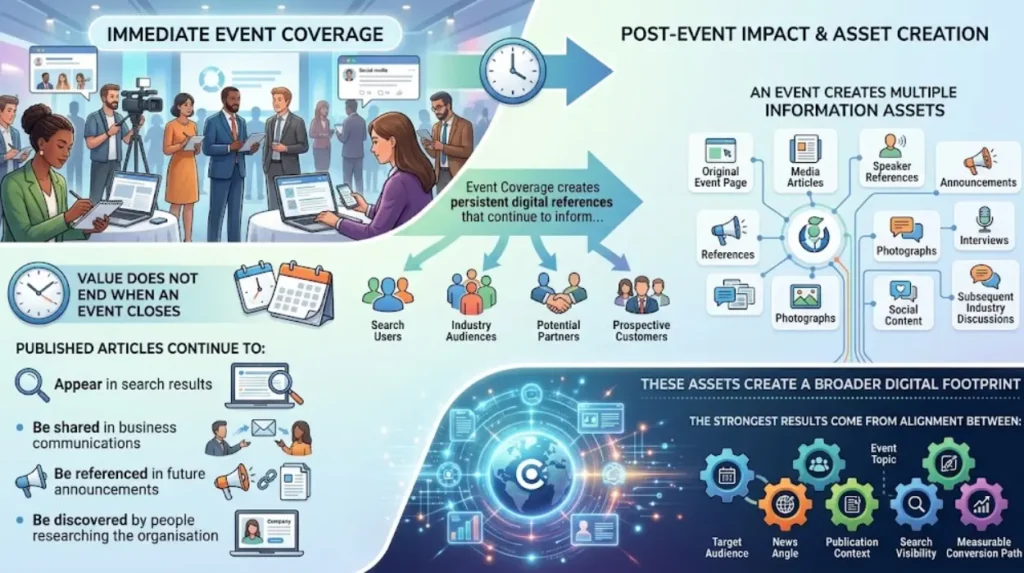
Event coverage supports long-term lead generation by creating persistent digital references that continue to inform search users, industry audiences, potential partners, and prospective customers after the physical event has finished.
The value of coverage does not end when an event closes.
Published articles can continue appearing in search results. They can also be shared in business communications, referenced in future announcements, and discovered by people researching the organisation.
An event therefore creates multiple information assets.
These include the original event page, media articles, speaker references, announcements, interviews, photographs, social content, and subsequent industry discussions.
Together, these assets create a broader digital footprint around the event and its organiser.
The strongest results come from alignment between the event topic, target audience, news angle, publication context, search visibility, and measurable conversion path.
What makes UK event news coverage convert into leads?
UK event news coverage converts into leads when it combines newsworthiness, audience relevance, credible information, search visibility, clear event context, and measurable next actions that move interested readers from media discovery toward meaningful business engagement.
Lead generation from event coverage is therefore a structured process rather than a single media metric.
The essential components are clear:
- News value gives audiences a reason to read.
- Audience relevance connects the story with potential customers.
- Credibility reduces uncertainty.
- Search visibility creates additional discovery opportunities.
- Useful information helps readers evaluate the event.
- Clear actions create measurable engagement.
- Tracking connects media activity with leads and commercial outcomes.
Explore More Expert Insights:
How Financial Events Earn Credible UK News Coverage
Why Retail Launches Need News Coverage in 2026
When these components work together, event news coverage becomes part of a measurable customer journey. The event provides the news subject. The media article provides discovery. Search provides continued visibility. Audience relevance creates interest. A defined conversion path turns that interest into measurable leads.