
B2B organisations allocate the second-largest share of their marketing budgets to events, spending roughly 23% of total marketing budgets on events in 2026. Event spending totals vary by company size: small firms spend £25,000–£120,000 annually; mid-market firms spend £200,000–£1.2m; large enterprises spend £1.5m–£15m.
Event spending includes venue hire, production, staffing, travel, promotion, and media relations. Industry surveys show increases from 2023 levels due to return-to-live activity and hybrid formats. In the UK, professional services, technology, and manufacturing allocate the largest event shares. Measuring this spend requires line-item tracking in marketing budgets and mapping event ROI metrics such as leads, opportunities, and media mentions.
How do organisations define “coverage” for events?
Coverage for events means measurable media output: press mentions, editorial features, social media amplification, broadcast segments, and trade outlet reporting. Coverage is both quantitative (number of mentions, reach, impressions) and qualitative (tone, placement, message accuracy). Define target outlets (national press, trade journals, trade associations, X accounts) and set numeric goals: for example, 10 trade articles, 2 national mentions, and 50 influencer posts. Coverage also includes owned channels such as blogs, newsletters, and recorded session views.
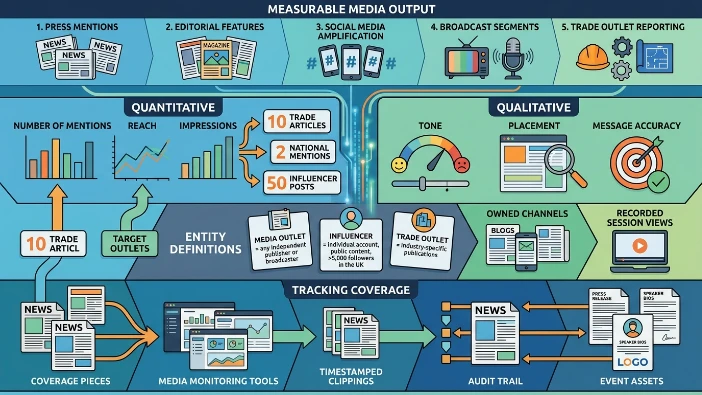
Define entities: “media outlet” = any independent publisher or broadcaster; “influencer” = an individual account with public content and >5,000 followers in the UK; “trade outlet” = industry-specific publications. Track coverage using media monitoring tools and timestamped clippings. Maintain an audit trail linking each piece of coverage to event assets.
Why does coverage lag behind event investment?
Coverage lags because PR resources, media access, and proactive outreach often fail to match rising event budgets and production scale. Organisations expand production values faster than they expand media strategy capacity. Events add stages, sessions, and talent but keep the same PR headcount or outsource last-minute. Media schedules run months in advance, so late outreach delivers fewer high-value placements. Journalists require clear news angles, embargoed materials, and logistical support to attend; without these, coverage reduces.
Other factors: saturation of event invitations, decline in specialist trade journalists, and editors’ preference for packaged, data-led stories. Coverage also falls when metrics focus only on attendance rather than editorial pickup. To measure this gap, compare event spend growth percentage with coverage growth percentage year over year.
What process delivers consistent event coverage?
A consistent coverage process includes early planning, a written media strategy, targeted outreach, embargoed content, and post-event follow-up. Start planning media strategy 10–12 weeks before the event. Produce a one-page media brief that lists news hooks, spokespeople, session highlights, and embargo dates. Create media kits containing speaker bios, high-resolution images, factsheets, and data points. Offer journalists pre-event interviews and tight logistical support (travel, interviews schedule, dedicated media desk).
Embed media steps into the event project plan with deadlines and owners. Use a CRM for media contacts and track outreach attempts and responses. After the event, distribute press releases, social assets, and edited highlights within 24–48 hours. Conduct a coverage audit 2–4 weeks post-event and store clippings with reach and sentiment metrics.
Which components should a pre-event media plan include?
A pre-event media plan includes objectives, target outlets list, key messages, spokespeople, embargo schedule, media kit, and outreach timeline. Objectives state measurable outcomes such as “secure five trade features and one national mention.” Target outlets identify 20–40 journalists and 8–12 trade outlets. Key messages are 3–4 concise facts to guide journalists. Spokespeople include lead executives and subject-matter experts with prepared quotes and availability windows.
The embargo schedule clarifies when and how news is released. The media kit contains bios, photos, statistics, agenda highlights, and contact details. The outreach timeline maps email pitches, follow-up calls, and exclusive offers (for example, an exclusive interview slot for one national outlet). Plan journalist hospitality and on-site logistics to remove attendance barriers.
How should organisers adapt outreach to UK media?
Adaptation requires UK-focused outlets, precise data, compliance with privacy and competition rules, and scheduling around national news cycles. Prioritise UK national newspapers, broadcast bureaus, and trade publications relevant to the event’s sector. Use UK time zones and avoid clashing with major national events (budget day, election coverage, major sports fixtures). Provide UK-specific data points and UK spokespeople when possible. Respect UK privacy rules by securing consent for personal data in media lists. Confirm embargo terms explicitly with UK journalists.
Use local press offices in major cities (London, Manchester, Birmingham) for regional coverage. Offer regional exclusives to increase pickup. For broadcast, prepare short video assets and B-roll to meet station formatting needs.
Which metrics define successful event coverage?
Success metrics include number of placements, reach (audience size), share of voice, message accuracy rate, and engagement (clicks, reads, social shares). Set numeric targets: for example, 15 placements, combined reach of 2 million, 80% message accuracy, and 5,000 combined social engagements. Measure share of voice by comparing event mentions against competitor events during the same period. Use media monitoring tools to capture impressions and sentiment. Verify message accuracy by sampling coverage and noting factual discrepancies for corrective outreach.
Track conversions attributable to coverage: referral traffic, sign-ups, and lead volume. Use UTM-coded links in press assets to map direct impact. Report results in a concise media coverage dashboard.
What are common mistakes that reduce coverage?
Common mistakes include late outreach, no clear news angle, lack of journalist access, and poor media assets. Late outreach makes journalist attendance impossible because editorial calendars fill early. Lack of a newsworthy hook reduces editorial interest. Restricting journalist access or failing to provide spokespeople deters coverage. Poor-quality photos or no press-ready assets force editors to decline or use low-quality substitutes.
Other mistakes: using generic email blasts rather than personalised pitches, not aligning spokespeople availability with media requests, and ignoring follow-up. Avoid these by following the pre-event media plan and assigning a single point of contact for media.
What benefits does strong media coverage deliver for events?
Strong coverage increases attendance, extends reach beyond attendees, strengthens thought leadership, and generates measurable leads. Editorial pick-up reaches audiences that cannot attend and builds credibility through independent reporting. Coverage amplifies event themes and reinforces sponsorship value for partners. Trade features position speakers as industry leaders and create post-event evergreen content for reuse. Measured leads from coverage show direct business impact when tracked with UTM parameters and landing pages.
Coverage also supports future event marketing by creating social proof and press clippings for sponsorship sales. Quantify benefits by comparing booked attendees and lead volume for events with high coverage versus events with low coverage.
Explore More Expert Insights:
Why 6 in 10 UK Corporate Events Generate Zero Earned Media Coverage
Events Are B2B’s Second-Highest Investment Priority in 2026: What’s Missing?
Which use cases demonstrate coverage impact?
Use cases include product launches, policy announcements, executive thought-leadership events, and trade shows where media pickup drives sales and regulatory engagement. Product launches require timed media release and product demos to secure editorial features. Policy announcements need accurate spokespeople and fact sheets to shape public debate. Executive thought-leadership events rely on op-eds and guest interviews to widen influence. Trade shows benefit from multiple on-site interviews and trade outlet summaries that attract buyers.
For each use case, define the target outcome (media mentions, stakeholder awareness, or direct leads) and map the media plan to that outcome. Track performance against those objectives.
Explore More Useful Information:
How to Build a Pre-Event Media Strategy That Fills Seats and Generates Coverage
How should organisers summarise coverage performance after an event?
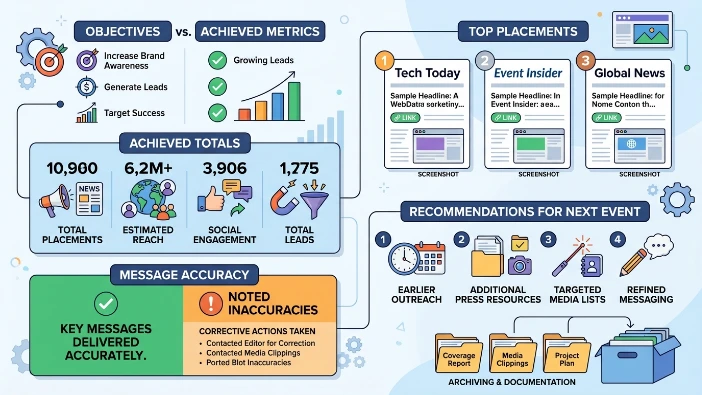
Summarise performance with a short report that lists objectives, achieved metrics, top placements, message accuracy, and lessons for the next event. Start with original objectives and state achieved totals for placements, reach, social engagement, and leads. Highlight three top placements with links and screenshots. Note any inaccuracies and corrective actions taken. Provide a short recommendations section with 3–5 concrete changes for the next cycle, such as earlier outreach or additional press resources. Archive the report alongside media clippings and the event project plan for future reference.
Click Here to Explore More:
Events Media Coverage Service: What a Full Package Includes From Setup to Publish



