Media fragmentation in 2026 means audiences are spread across many platforms, channels, and publishers rather than concentrated on one platform.
Media fragmentation describes the distribution of attention and consumption across multiple digital and traditional outlets. In the UK, fragmentation increased from 2016 to 2026 as new social platforms, specialist newsletters, regional digital publishers, audio podcasts, streaming services, and vertical news apps gained users. Audience shares fall across social X-style networks, short-video platforms, long-form publisher sites, aggregator apps, email newsletters, audio platforms, and local newsrooms. Measurement now requires combining publisher analytics, platform APIs, panel data, and server-side tracking to understand where users engage.
Why do single-platform strategies fail now?
Single-platform strategies fail because audience reach, engagement, and conversion are insufficient when users disperse across many channels.
Relying on one distribution channel limits reach to the subset of users that use that channel. Platform-specific algorithms prioritize different content types and change frequently, creating volatile visibility. Ad fatigue and rising ad-blocker rates reduce paid reach effectiveness on single platforms.
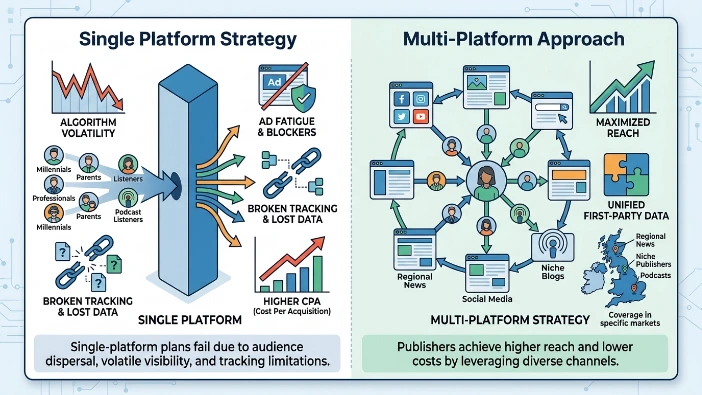
First-party data restrictions and evolving privacy rules reduce reliable cross-platform user identification, so conversion tracking breaks when activity moves elsewhere. In the UK market, where regional newsrooms, niche vertical publishers, and podcast networks capture dedicated segments, a single-platform plan cannot access all relevant audiences. Publishers and marketers record lower incremental reach and higher cost-per-acquisition when they limit themselves to one platform.
How does audience behavior cause fragmentation?
Audience behavior causes fragmentation because users select formats, contexts, and publishers by topic, time, and device, creating dispersed engagement patterns.
Consumers choose news by topic relevance, trust, convenience, and format. For example, commuters prefer short audio or short-form video; policy professionals read long-form analysis on niche publisher sites; local readers access regional digital outlets. Device choices influence session length: mobile sessions drive short interactions, desktop sessions support in-depth reading. Platform loyalty decreases; users follow specific journalists, newsletters, or podcast hosts rather than platforms. This behavior fragments attention into focused micro-audiences that require distinct editorial and distribution tactics.
What measurement gaps exist for single-platform approaches?
Measurement gaps appear because single-platform metrics do not capture cross-channel attribution, audience duplication, or off-platform engagement.
Platform metrics report impressions, clicks, and engagement inside that environment only. They do not show how a user then visits a publisher site, signs up for a newsletter, or listens to a related podcast. Cross-platform identity resolution suffers from privacy changes and cookie deprecation. Panel-based tracking provides estimates but lacks granularity for specific campaigns. Server-to-server measurement and clean-room analysis provide better attribution but require technical integration and data governance. Without these, teams misjudge reach, overvalue a platform channel, and underinvest in channels that produce downstream conversions.
Which structural factors in the UK media market increase fragmentation?
Structural factors include a diverse mix of national broadcasters, regional outlets, specialist digital publishers, and independent creators that split audience attention.
The UK has public-service broadcasters, national newspapers with digital editions, local news startups, specialized vertical publishers, and independent newsletter creators. Regulatory and licensing environments support public-service content that remains widely consumed. Investment in local digital journalism increased post-2020, creating new regional audiences. Podcast production and audio platforms grew rapidly, adding a non-text content layer. Aggregation apps and personalized feeds direct users to different sources based on algorithms. These structural elements create multiple stable audience pools that operate simultaneously, increasing fragmentation.
What content types perform best across fragmented audiences?
Different content types perform best by context: short-form video and audio for discovery, long-form analysis for retention, and newsletters for direct reach.
Discovery channels favor short, attention-grabbing formats on social platforms and short-video apps. Audio content retains commuting and multitasking audiences. Long-form analysis on publisher sites retains specialist and professional readers who consume detailed reporting. Newsletters provide a predictable, permissioned direct line to engaged readers and drive repeat visits. Real-time breaking coverage performs on social and live blogs. Content strategies that map content type to context reach more fragmented audiences than uniform content pushed to one platform.
How should measurement and analytics adapt to fragmentation?
Measurement must shift to multi-source attribution, server-side tracking, cohort analysis, and privacy-first identity solutions.
Combine platform analytics with server logs and consented first-party data. Use cohort-based performance metrics to track groups over time instead of relying solely on last-click attribution. Implement server-side event collection to reduce data loss from client-side restrictions. Adopt privacy-preserving identity resolution techniques, such as hashed identifiers in clean rooms, to measure cross-platform user journeys while complying with regulations. Regularly audit data pipelines to ensure consistent definitions across channels for impressions, engaged sessions, and conversion events.
What strategic components make a multi-channel approach effective?
An effective approach uses audience segmentation, content mapping by channel, cross-channel measurement, and governance for data and publishing.
Segment audiences by interest, intent, and consumption context. Map content types to channels: headlines and clips for social discovery, long reads for owned sites, audio episodes for commuting audiences, and newsletters for loyalty. Connect analytics systems to measure the same KPIs across channels. Build editorial workflows that allow content repackaging for each format while maintaining source accuracy. Create data governance for consent, retention, and sharing rules so identity resolution remains lawful. This component mix ensures coordinated reach and efficient resource allocation.
What are the cost and resource implications of multi-channel strategies?
Multi-channel strategies require investment in content repurposing, analytics integration, and cross-functional teams, raising upfront costs but reducing channel risk.
Teams need skills in audio production, video editing, SEO, newsletter creation, and analytics engineering. Technical investment includes server-side tracking, data clean-room access, and integration with platform APIs. Editorial time increases for producing and tailoring content for multiple formats. These costs add to budgets, but they reduce reliance on a single platform and lower long-term volatility. Resource allocation decisions should measure incremental reach and lifetime value per channel to justify ongoing spend.
What use cases show multi-channel success in the UK context?
Use cases include regional news distribution, specialist vertical outreach, and national campaign coverage that requires broad reach across formats.
Regional newsrooms extend reach by combining local sites, social clips, community newsletters, and podcast interviews to capture commuters and local readers. Specialist verticals such as health or education use long-form analysis on publisher sites, topical newsletters to professionals, and short video explainers for wider audiences. National campaigns covering elections or public-health announcements distribute breaking alerts across broadcaster streams, social platforms, and email to ensure timely, verified reach. These coordinated approaches access fragmented audiences effectively.
Explore More Expert Insights:
Why 75% of Enterprise B2B Firms Are Increasing Media Partnership Budgets This Year
What B2B Creator Partnerships Look Like in 2026 Versus 2023 in the UK
How should publishers decide channel priorities?
Publishers should prioritize channels based on audience overlap, cost per engaged user, and campaign objectives.
Measure audience overlap across channels to identify unique reach. Evaluate cost per engaged user by dividing channel spend by engaged sessions that meet quality thresholds. Align channels with objectives: awareness needs broad discovery formats; retention needs direct channels such as newsletters; conversion needs measurable paths and consented data. Reallocate investment toward channels that deliver incremental reach and measurable downstream value.
What governance and compliance steps are essential in fragmented media?
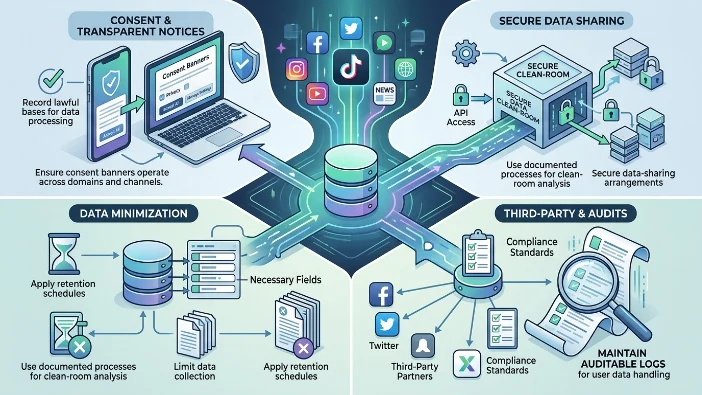
Governance must cover consent management, data minimization, transparent user notices, and secure data-sharing arrangements.
Record lawful bases for data processing and ensure consent banners operate across domains and channels. Limit data collection to necessary fields and apply retention schedules. Use documented processes for secure data clean-room analysis and API access. Ensure third-party partners meet compliance standards and maintain auditable logs for user data handling.
Read More to Understand Better:
Building a Multi-Publisher Partnership Strategy Across UK News Verticals
Media fragmentation in the UK in 2026 distributes audiences across many platforms and formats. Single-platform strategies fail because they miss large audience segments, lack cross-channel attribution, and depend on variable platform algorithms. Effective responses use audience segmentation, mapped content formats, privacy-first measurement, and cross-functional teams to coordinate reach. Publishers and marketers must invest in analytics, editorial repurposing, and governance to capture fragmented audiences efficiently while maintaining compliance.
Get the Full Insights Here:
How Times Intelligence Media Group Partners Deliver 4M+ Monthly Unique Readers