

A pre-event media strategy is a documented plan that aligns news angles, target outlets, spokespeople, and outreach timelines to secure media attendance and editorial coverage before an event. A pre-event media strategy defines measurable objectives and assigns owners. Objectives can include numeric targets such as number of placements, reach, and lead attributions.
The document lists target outlets (national press, trade journals, broadcast, and regional media), key messages, spokespeople with bios, embargo dates, and media assets. Use a single-sheet media brief for alignment and a CRM to manage outreach records.
Why build a pre-event media strategy for UK events?
A strategy increases journalist attendance, improves placement quality, and optimises editorial timing against UK news cycles and outlet priorities. UK outlets plan coverage weeks in advance. A structured approach ensures journalists receive clear news hooks and logistics.
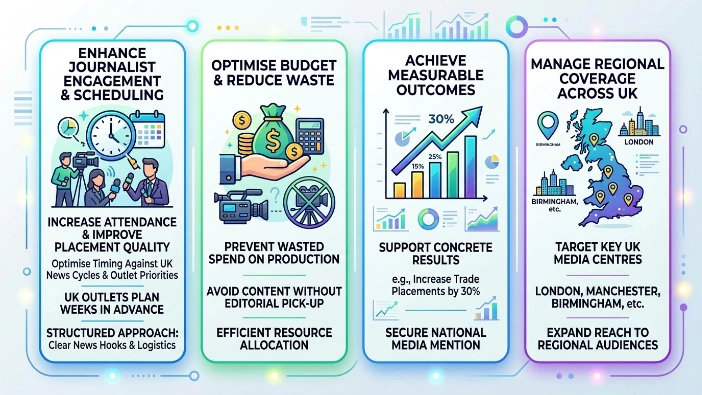
The strategy reduces wasted spend on production that lacks editorial pick-up. It supports measurable outcomes: for example, increasing trade placements by 30% or securing one national mention. The plan also manages regional coverage in London, Manchester, Birmingham, and other UK media centres.
When should organisers start planning media outreach?
Begin media planning 10–12 weeks before the event to secure high-value placements and schedule interviews with busy journalists. Early planning gives time to craft embargoed materials, offer exclusives, and align spokespeople availability. For product launches or policy announcements, start 12 weeks out. For recurring trade shows, embed the media timeline into the annual event calendar. Late outreach within four weeks reduces chances for national coverage and limits broadcast opportunities. Track milestones and approvals in the event project plan.
Who should own the media strategy and what roles are required?
Assign a single media lead who coordinates PR outreach, supported by a content author, a media relations executive, and an on-site media handler. The media lead signs off on objectives and outreach lists. The content author prepares press releases, factsheets, and Q&A documents. The media relations executive handles journalist pitching and follow-up. The on-site media handler manages journalist registration, interview schedules, and technical requests. For larger events, add a broadcast producer to prepare video assets and a monitoring analyst to track mentions.
Which components must the media plan contain?
The plan must include objectives, target outlet list, key messages, embargo schedule, media kit contents, outreach timeline, and on-site media logistics. Objectives state numeric targets such as ten trade articles and one national feature. The target outlet list names 20–40 journalists and 8–12 trade publications. Key messages contain three concise facts tied to data. The embargo schedule sets dates and times for pre-release. The media kit holds speaker bios, headshots, factsheets, and B-roll files. The outreach timeline details initial pitch, two follow-ups, and exclusive offers. On-site logistics assign a dedicated media desk, interview room, and press Wi‑Fi.
How should organisers craft news angles and key messages?
Develop three to four distinct news angles that relate directly to data, speaker announcements, or exclusive demonstrations and distil them into three concise key messages. News angles must be newsworthy and time-sensitive. Use quantitative evidence such as survey results, case study metrics, or launch dates. Assign one speaker per angle and prepare a 150-word summary for each. Key messages should be short factual statements that journalists can quote. Test messages with a small group of industry contacts before broad outreach.
How to build and use a media list effectively?
Compile a segmented media list with contact details, outlet beat, past coverage examples, and preferred contact times, then prioritise outreach by likely editorial fit. Segment lists by outlet type: national newspapers, trade journals, broadcast, regional press, and industry bloggers. Record past coverage examples for each contact to personalise pitches. Prioritise 10–15 high-value journalists for exclusives and 20–40 additional contacts for broader distribution. Maintain consent records and follow UK privacy requirements for contact use.
What outreach sequence generates the best response?
Use a three-step sequence: a personalised initial pitch, a follow-up call or message within five working days, and a final reminder one week before the embargo lift or event. Initial pitches present the top news angle and offer interview slots. Follow-up calls confirm receipt and offer exclusives to priority outlets. The final reminder includes logistical details and press registration link. For high-priority targets, offer pre-event briefings or one-on-one interviews. Log all interactions in the media CRM to avoid duplicate contact and to measure response rates.
Which assets accelerate journalist coverage?
Press releases, embargoed fact sheets, speaker bios, high-resolution images, video clips, and pre-packaged interview slots accelerate coverage and make editorial production simpler. Prepare press releases with headline, subhead, and three data points. Provide embargoed fact sheets summarising key facts and supporting data with sources. Include downloadable high-resolution images and ready-to-use quotes from spokespeople. Supply short B-roll clips for broadcast. Offer scheduled interview slots and a dedicated media desk on-site. Host assets on a press-only webpage with secure access.
How to handle embargoes and exclusives in the UK market?
Set clear embargo dates and times, state embargo terms in writing, and offer timed exclusives to specific outlets with documented agreements. Choose embargo times that align with editorial deadlines, for example 07:00 for print and 09:00 for online updates. Send embargoed materials to priority contacts 48–72 hours before the embargo. Document any exclusive arrangements in writing and limit exclusive windows to 24–48 hours. Respect embargo breaches by noting them in outreach records and recalibrating future outreach.
What logistical steps improve journalist attendance?
Provide clear travel and registration information, a dedicated media desk, interview rooms, Wi‑Fi credentials, and on-site contacts to speed journalist workflows. Offer press registration with badge priority and express entry. Provide a one-page logistics sheet with nearest transport links, parking, and arrival times. Reserve an interview room with a facilitator. Share Wi‑Fi network and upload instructions for large files. Assign an on-site media handler reachable by phone and email for last-minute needs.
Explore More Expert Insights:
Video, Written, Social: Which Event Coverage Format Gets Most UK Shares?
How to Pitch a UK Corporate Event to 10 News Sites Simultaneously
Which metrics track media outreach performance?
Track placement counts, aggregate audience reach, engagement metrics (clicks and social shares), message accuracy, and referral traffic with UTM tags. Set numeric targets before outreach. Use monitoring tools to capture placements and compute combined reach. Measure social engagement totals and number of corrected inaccuracies. Use UTM-tagged links in press assets to measure referral traffic and conversions. Produce a concise coverage dashboard for stakeholders showing objectives versus outcomes.
Learn Everything About It Here:
Events Are B2B’s Second-Highest Marketing Investment in 2026: Is Coverage Keeping Up?
What are practical next steps after the event?
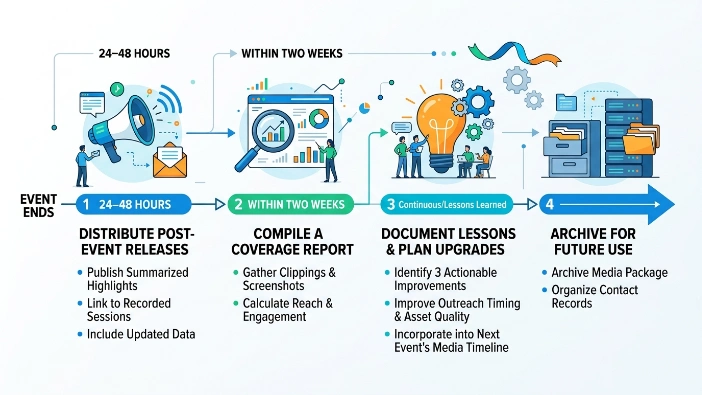
Distribute post-event releases within 24–48 hours, compile a coverage report within two weeks, and document lessons for the next cycle to improve outreach timing and asset quality. Post-event releases summarise highlights, link to recorded sessions, and include updated data. Assemble clippings and screenshots and calculate reach and engagement. Identify three actionable improvements and incorporate them into the next event’s media timeline. Archive the media package and contact records for future use.
Click Here to Explore More:
Events Media Coverage Service: What a Full Package Includes From Setup to Publish



